Let me start by saying, I hope you had a nice Father’s Day. If you’re a guy and have your own child(ren) or precious pets, I hope someone made you feel loved and appreciated. Even better, I hope you were able to celebrate your own dad/father figure too. Dads are important. I dislike how even now in popular culture they get stereotyped as bumbling, immature fools or as cruel, controlling patriarchs. Most dads are better than that, especially nowadays, and we need to continue recognizing and encouraging their contributions and participation in all aspects of their children’s lives.

On Saturday, Daphne and I enjoyed four hours in the cool weather on Crystal Lake with our favorite guy, and on Sunday morning we gave him his Father’s Day gift–a Battery Daddy– and triple chocolate cupcakes before heading out on a casual jaunt to our favorite suburb, Lebanon, NH (great place to visit but, being a suburb, we wouldn’t want to live there).
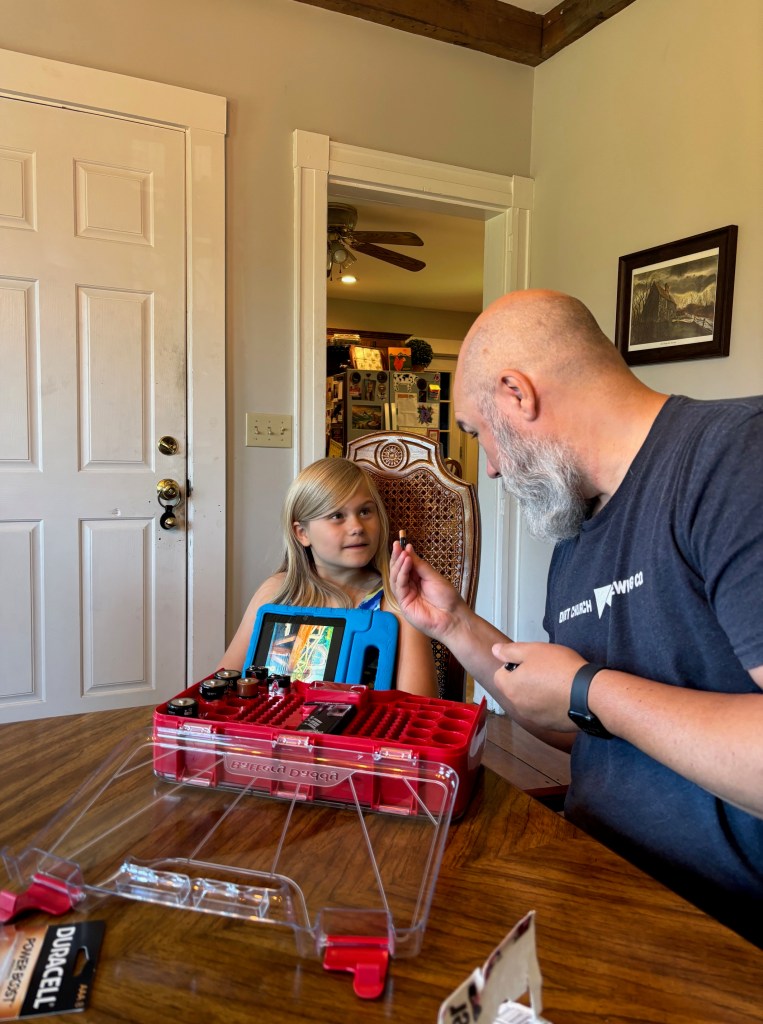
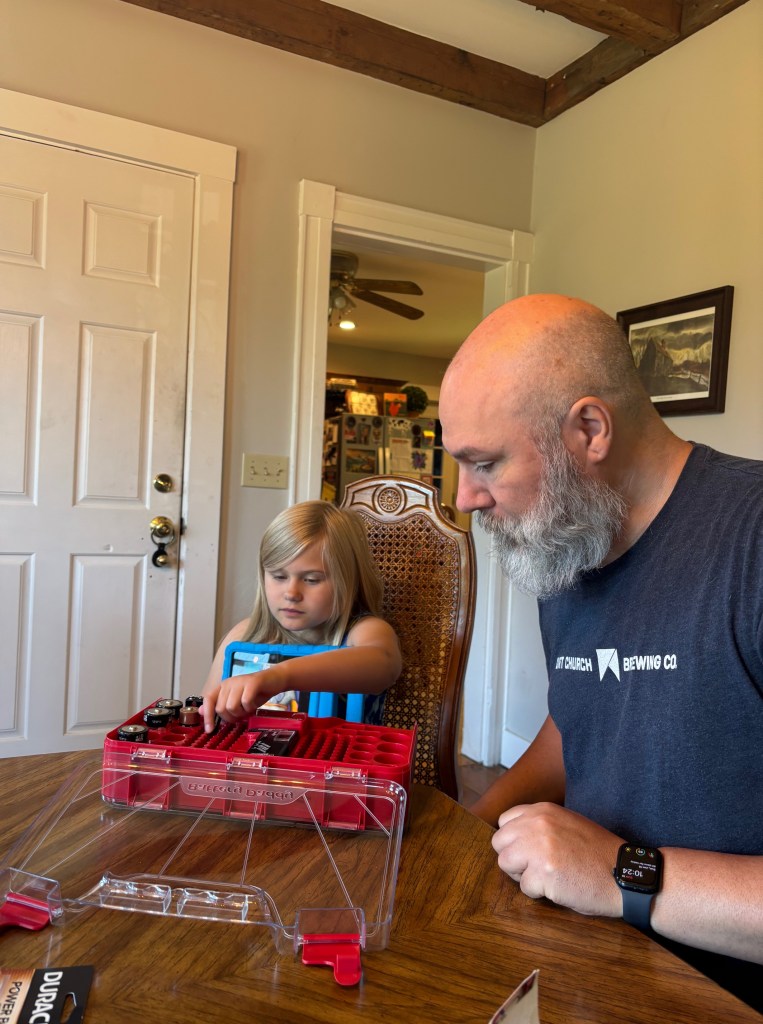
In Lebanon, we bought $50 of random stuff at Target, walked through JoAnn’s Fabrics looking for potpourri, and had lunch at Wendy’s because Daph had been telling us on her AAC device (her “talker”) that she wanted French fries and chicken nuggets. Then we headed home to give our own dads a call. Later, Jer admitted he didn’t feel like firing up the grill as we’d planned, and I gladly told him no, relax instead. All in all, not the most exciting or novel Father’s Day weekend, but it was cheerful time spent together, and I think Jer just enjoyed being with his girls.
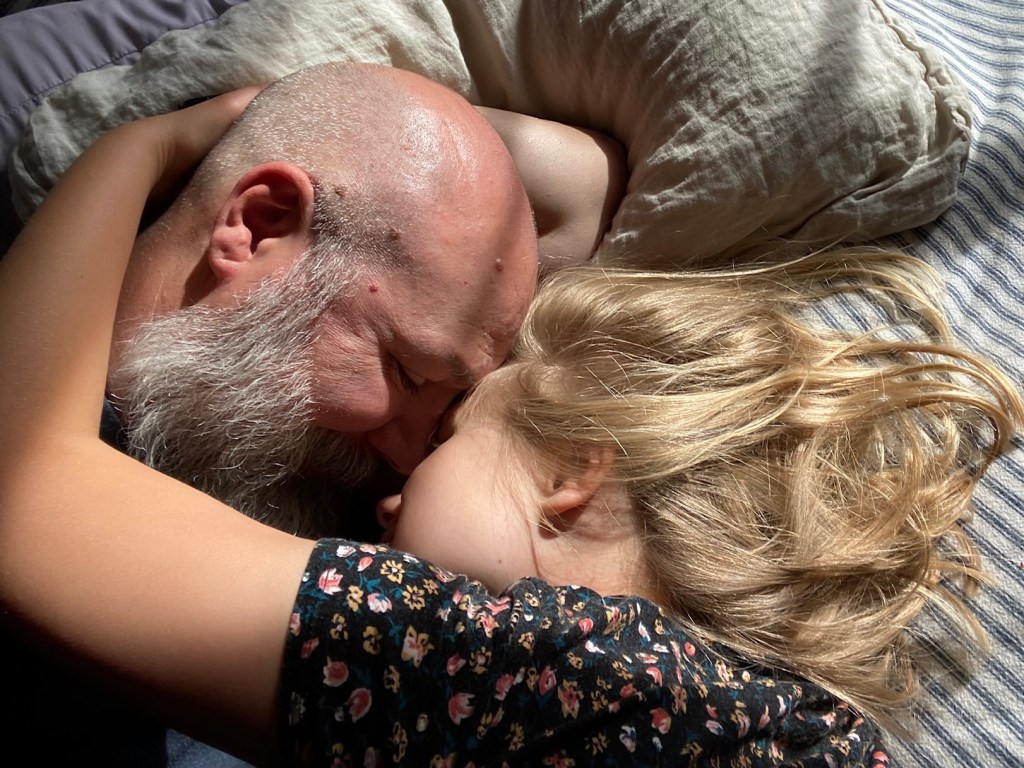
I will say it again–I am so lucky. He is an amazing daddy. He’s always been a true partner in every aspect of parenting, right down to the physical care of our child. When we’re struggling through a rough patch of behavior or need to advocate for something in our daughter’s education, he’s there beside me to listen, provide respite and advice, and help me carry the emotional and decision-making loads for things like trips to the ER and sensitive school meetings.
Thank you, babe. We love and adore you.
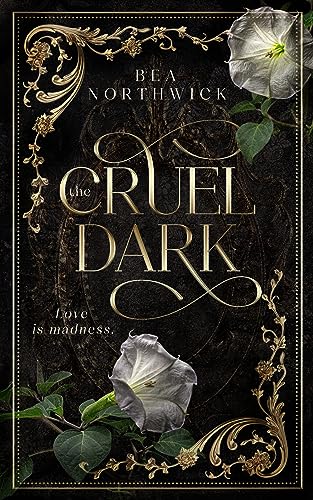
On a writerly note, I also finished reading The Cruel Dark by Bea Northwick on Saturday morning. It was a great book, and Northwick is my new author hero. After years in the query trenches trying to publish traditionally, she finally chose to self-publish this novel, her debut, and it deservedly won this year’s Writer’s Digest Best Self-Published E-Book award. It is a horror love story with gorgeous Gothic elements, lovely language, a satisfying ending, and some great spice (“spicy Bronte” it’s been called, though it reminds me more of Rebecca with some old-school VC Andrews vibes). Though titillating, the sex scenes do not come at the expense of the story. Not at all. Yes, they are developed and vivid, but they’re also tasteful and function not just as a source of reader excitement but also as a way for the main character, Millie Foxboro, to physically ground herself as she battles what feels like increasing mental illness. Thus, the descriptions felt relevant, not gratuitous at all.
Another reason I love this book is because it’s a successful example of a challenge I’ve become familiar with as a writer myself: that challenge, when composing a story, of keeping straight the character’s narration, the reader’s experience, and your own authorial intentions. This is a little abstract, so bear with me. Author-character-reader is the idea that there are three separate lines, or levels of consciousness, at work during the development of a story, and ultimately they connect to form the shape of a triangle (if you want to visualize it that way), with the author at the top followed by the narrator/main character on the bottom left and the reader on the bottom right (or so I see it).
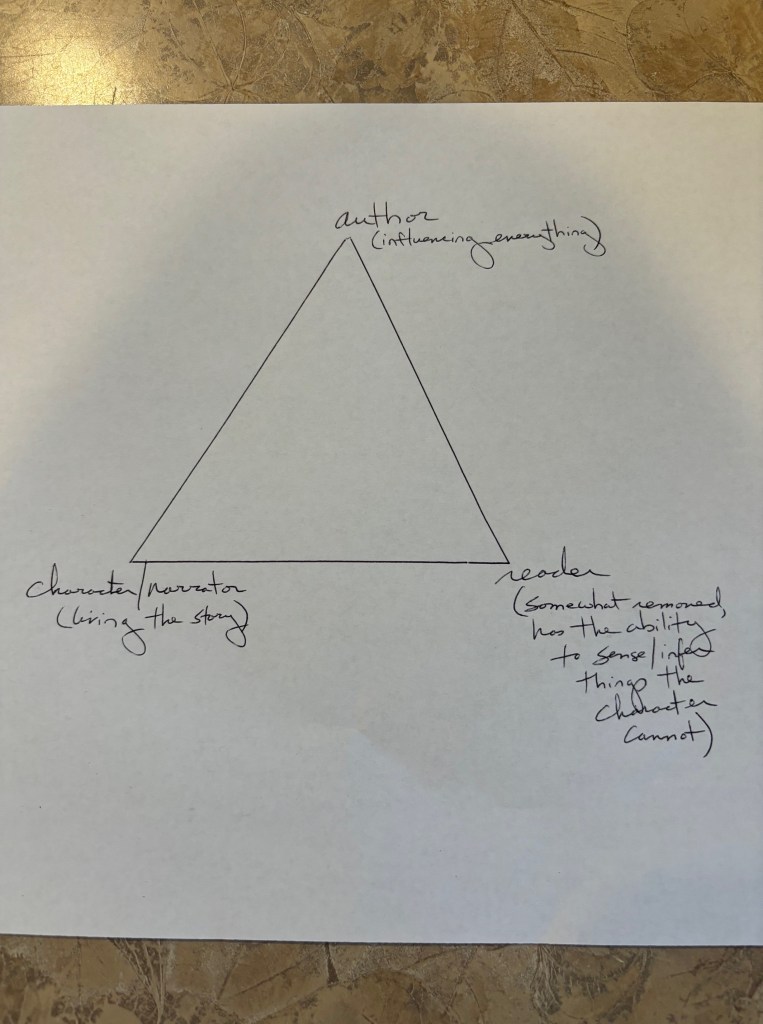
It is very easy, when you’re drafting, to confuse these lines, to tangle them or allow them to connect incorrectly, misshaping the story and confusing the reader in the process. Let me try to explain.
The author begins with characters and struggles, which develop into a plot framed by settings. Ultimately topics and theme(s) emerge. All of this swirls in the author’s mind–there’s a plan, an intent with a message.
Now, the author conveys the story via the main character, describing and narrating events and emotions as this character experiences them, and the reader’s experience is vicarious through the character’s eyes, especially if it’s a first person point of view. As this character becomes aware of certain facts at certain points in the plot, truth dawns on him/her and the story concludes. Perhaps before that, however, the author wants to foreshadow something, or maybe the author purposefully makes the narrator unreliable and wants the reader to sense there are other realities at work, which can heighten the mood, create interest or suspense, and add depth to the story. If this is the case, the author has to include (or perhaps omit) certain details and choose certain words to make a thoughtful reader pay attention, and when the character him/herself finally makes the discovery or realizes the truth, the reader experiences an exciting moment of satisfaction–the I Knew IT! moment. This takes skillful, conscious maneuvering on the part of the author, an ability to compose and revise effectively at those three different levels–the character’s, the reader’s, and finally, above it all, the author’s–without leaving something out or including something too early. No easy feat, especially in the hot mess of the early drafts when the elements are still rough and all kind of knotted up in the author’s imagination. Teasing it out effectively is more complex than a nonwriter might think. When it’s done well (after a lot of feedback and revision usually), it’s seamless and satisfying.
This is another way in which Northwick succeeds with The Cruel Dark.
WARNING: SPOILER AHEAD! STOP READING NOW IF YOU THINK YOU WANT TO READ THIS BOOK.

In Northwick’s novel the main character, Millie, takes a new job as an assistant to a reclusive professor working from his creepy, abandoned mansion in the New England countryside. Millie has a difficult past–her mother was abusive, her father neglectful, and she woke up two years ago in a psychiatric ward, unable to remember anything in recent memory. Now, her special knowledge of Celtic mythology, plus the lure of an exorbitant paycheck, has her taking this position despite her trepidations. She learns right away that the professor’s wife went mad and committed suicide by throwing herself from a cliff. Hearing this, Millie thinks about her own former nickname, “Mad Millie,” and once she gets to the mansion, a maid screams when she sees her face, the housekeeper is ill at ease, and her new boss (tall, handsome man, of course, slightly dangerous) keeps his back to her, unwilling to look her in the eye upon introduction. When Millie and Callum, the professor, do come face to face in a dark corridor at night (as Millie follows strange sounds and visions), the professor suggests he finds her irresistible and that she ought not to tempt him toward lewd desires. All dark and romantic, yes, but not random. Not necessarily there for the sake of just genre and sex appeal. What all of that suggested to me, the reader, was that the main character, Millie, was in fact the professor’s wife (not actually dead), and that this situation was all somehow a way for him to get her back, though of course she herself, the narrator, has ZERO suspicions of such a thing. I also suspected, despite all the suggestions that Callum was malicious (from other characters, the dead wife’s diaries, and the MC herself), that he was in fact a good man in love with Millie and desperate to have her, his beloved wife, back.
And, bingo.
When I finished the book on Saturday morning, I learned I was right.
I do believe Northwick wanted readers to make my same prediction. Therefore, she had to carefully craft details that could look logical one way to Millie the narrator but make perfect, ironic sense another way once they were reconsidered at the story’s end, all without Millie inadvertently thinking or saying anything she shouldn’t yet know. Again, no easy feat, and as a reader it worked for me. I was driven to solve the mystery of the details and confirm whether I’d been right, and I found it highly satisfying to see my prediction validated. I also loved the ironic characterization of the professor. It made for a tender, surprising love story, and one of redemption for Millie, who by the story’s end is a stronger person.
In contrast, maybe an author doesn’t want to do that. Maybe s/he wants the reader to be surprised or to realize something new right along with the main character, so s/he has to be careful not to reveal too much too early in a particular word choice or detail. This can be tricky when one is getting everything out in an early draft, during that time when something (big picture in mind) can accidentally slip in–when the narrator accidentally describes something from the author’s level (momentarily becoming the author) and not as the character him/herself. It’s an error, a confusing mistake.
It’s one I nearly made in an early draft of my own short story “We Were the House of Usher,” a retelling of Poe’s famous tale “The Fall of the House of Usher” from the doomed character Madeline’s perspective.

I won’t reveal too much, but I realized in an early passage that I described Madeline wanting to escape the “deathly influence” of the Ushers’ castle. “Influence” was the problem here; I realized I was perhaps suggesting too much too early. I wanted, instead, for readers to realize the nature of the story’s magic alongside Madeline herself, which must come later in the tale. I wanted that part to be something of a surprise, so I didn’t want to give close readers anything, in that respect, to go on. I also realized it would be illogical for Madeline to think that way so early about her house–she would have no reason at that point to suspect it was having any kind of direct effect on events. Consequently, I changed the phrase to “deathly atmosphere,” a word much likelier to come to Madeline’s mind at the story’s beginning. I’m now eagerly awaiting more suggestions from a developmental editor; I’m sure she’ll have other corrections like this one, for there are certainly multiple lines of consciousness at work in my piece, and I’m sure I’ve confused them in other places too.
I did, however, intend to suggest something early in my story about my Roderick Usher (much like Northwick does about Millie’s situation early in her book). I wanted to suggest an ambiguity in Roderick’s character, that perhaps he’s not exactly as his sister perceives him. Therefore, in the early dialogue, I intentionally have him respond to her angry fit in particular ways. I wanted to suggest that Madeline perhaps jumps to emotional conclusions about her “awful” brother. In so doing, I’m aiming to stir readers’ curiosity about what exactly happened the night of Madeline’s engagement supper, which, in turn, should make them want to keep reading. Hopefully, I succeeded.

We’ll see what my editor says.
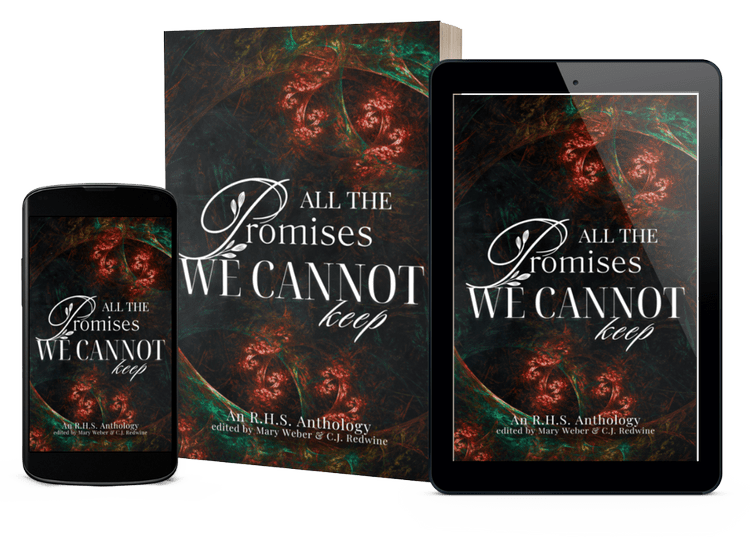
If you’re interested, my story “We Were the House of Usher” will be out in the Red Herrings Society’s anthology All the Promises We Cannot Keep on November 18th of this year.
Whew. This felt like a long one. Thanks for bearing with me; I hope it all makes sense. Again, I’d love to hear your thoughts on this author-character-reader concept, as a writer or a close reader yourself. What do you think? Any interesting endeavors or experiences you’d like to share? Any failures and takeaways from that?
Until next time, enjoy your friends and family, and happy reading! I hope it’s thrilling.
XOXO,
Jenn
 Jennifer Shaw