First, those thoughts:
In my more serious ballet years, I often heard from teachers and guest instructors at summer intensives how important it was to be versatile.
If you were a ballet dancer, for example, it was important to take classes in modern and character dancing. The modern dance, with its frequent focus on contraction/release and fall/recovery, would help you perform contemporary pieces more easily.

The character work would serve you well in the national folk dances so often included in the older repertory–think the Russian variation from The Nutcracker, for example, and the Hungarian dance in Swan Lake.
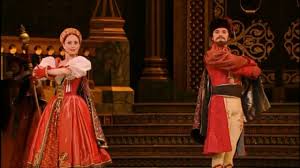
The same went for any other genre of dance–if you were a student of Martha Graham, you ought to take ballet technique. If you wanted to be a Rockette or go into musical theater to dance primarily in the Broadway styles–tap, kick, jazz, and cabaret–then modern dance and classical ballet could do you a world of good. You’d have a solid and “correct” foundation from which to move.
Ultimately, dancing proficiently across various styles deepened your artistry, improved your musicality, and even strengthened your overall technique as you were forced to approach movement differently, perhaps work different muscles, and become more fluent in those new movements. All of it would make you a choreographer’s dream, since it meant you could dance almost anything well.
This idea extends beyond types of dance into the broader world of fitness and cross-training, too–dancers of all kinds are encouraged to take Pilates, for example, which is part of the standard curriculum at the School of American Ballet. Professional dancers often make time for strength and HIIT training, particularly the men who have to partner the women.
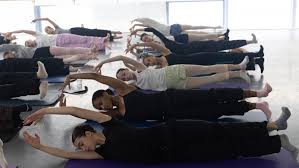
We see this in the world of sports as well. Football players are sometimes encouraged to take ballet, and baseball players to pursue in the off season any other sport that does not work their shoulders or throwing arm quite so hard. Holistically, they become better and even healthier athletes.

Could this also apply to writing?
I think it does. I think as writers, the more genres we practice and become proficient in, the better structuralists and word-smiths we’ll be.
(Notice I say proficient in, not masters in. I do think true mastery probably lies in spending most of our time, our deepest time, in one to two genres only, where we ultimately specialize.)
That is a major reason why I enjoy writing all kinds of things. I’m often drawn to genre fiction, especially the darker genres I can steep in history and compose in more elevated language, like gothic fiction. But, I also enjoy writing contemporary lit and historical fiction, informal essays, and even some poetry.
In literary fiction, I find myself considering fresh word choice and ambiguity.
In essays and other types of nonfiction, like book reviews, I tend to think more about clear structure and transitions.
With poetry–the toughest!–the challenge is pin-point precision and concision.
My hope is that all of it refines my execution in terms of rhetorical context–a particular piece’s topic, audience, purpose, and of course genre conventions, which I am still learning. Genre has been, for me, the most surprising struggle. It wasn’t until I took writing seriously that I realized how little I understood about it.
Hopefully, given the multiple genres I’m now reading and practicing, that understanding will continue to improve.
And, perhaps, a little extra sharpness, accuracy, or uniqueness that might not otherwise exist will find its way into each piece of work. I don’t think that would happen (or will happen, if it’s not already) if I didn’t choose to write broadly across styles.
Plus, it’s fun. You know the old cliche about variety. All those spices–the salt, pepper, basil, thyme, nutmeg, coriander, you name it–make the entire act more delicious.
Finally, the alchemy that might arise one day from all that practicing, from some mixing…
From the cross-pollination that might occur… the genre mashup that might, just might, grow into something that works, could be pure magic.
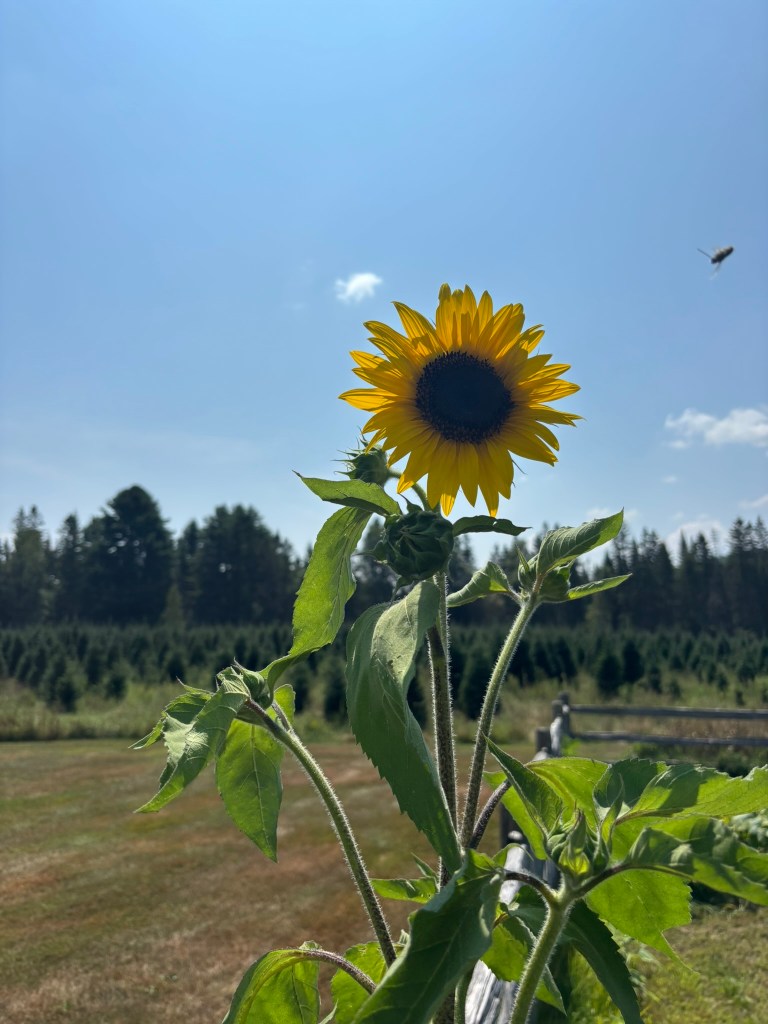
So, in this spirit of writing widely and joyfully, here are two summer haikus I recently penned, all inspired by things I’ve observed from my own Vermont yard.
Silent green hills nap
under shadows draped like shawls,
a languid appeal.

The first sunflower,
last of summer’s several blooms,
greets slow turning days.
If you’re not familiar with this form, a haiku is a simple poem of Japanese origin (I prefer the simple, fixed forms because they feel manageable). It consists of just three lines. The first line must contain five syllables, the second line seven syllables, and the third line five syllables, once more.
Traditionally, haikus capture some image or aspect of nature, but they can be about anything.
These little poems I’ve written as exercises in word choice and imagery and, ultimately, for fun. They’re easy to share because I am not an aspiring poet and do not have a ton of emotional investment in any of their receptions, though of course I hope you like them. I don’t love the ending of that first one, so we’ll definitely consider it a draft.
What are your thoughts on writing or even reading different genres? Do you think it makes the entire experience better?
See you again soon!
XOXO,
Jenn

 Jennifer Shaw