So, I decided to be brave and share the first scene of the first chapter of my latest work-in-progress (WIP), a novelette sequel to “Elspeth and the Fairy.”

CHAPTER ONE, Scene 1
When the second, and final, transformation occurred, Muir’s arms were smeared in blood past his elbows.
Toiling in Lord Aitken’s scullery, he gripped the buck’s hindquarter with his feeble left hand and sawed the flattened blade of the skinning knife down the inside of its leg toward the gutting incision with his equally afflicted right, careful to keep the blade between the skin and muscle. Releasing the animal, he began to pull its skin away with his free hand, using the knife to carefully separate the connective tissue where it clung. The tawny fur did not give way easily.
Muir’s stringy muscles strained at the effort. His breath grew ragged, and sweat slicked the fleshed parts of him, for he was still mostly a wretched man. Of this exertion, he was not conscious; his body labored in motor memory. He felt, however, the fullness of his throat—inside, still very human despite his goat’s brow—though he’d done such butchery a hundred times.
Already gutted, the deer’s fur remained even and unblemished; it bore on its head only four points. It had been a young animal, and the destruction made Muir ache, an internal throb that matched the rhythm of his efforts. The dressing and skinning always felt like a sin, so he had laid the deer out on a worktable rather than hang it from a hook, though that made the awful chore more difficult. He did not care.
As he skinned the creature, he grunted a quiet prayer in Latin.
“Gratias tibi ago, Domine, pro hac largitate. Non vastare.”
Thank you, Lord, for this bounty. It will not go to waste.
Though a priest would have condemned it as heresy, he added in Gaelic, “Tapadh leibh, Cernunnos; tapadh leat, Danu, airson an tiodhlac seo dhut fhèin. Bidh mi ag ath-aithris, cha tèid e gu sgudal.”
I repeat, it will not go to waste.
When the hide finally came free, he laid it aside; the fur would line some new garment to keep someone warm. Sill gripping the knife, he paused to stroke the animal’s cold head and plush ear, its glassy eye unresponsive. Meat now. Carnes. Only empty meat.
No, not empty. From it, other tangible things would come.
Indeed, nothing would go to waste. He thought it again for the thousandth time, and it was as precious and necessary as a prayer bead.
He’d said it first when, ten years ago, he’d suffered the initial curse, that great crucible of his life. That vow had kept him moving forward, enabling him to assist Elspeth.
Elspeth.
She was his redemption here on earth.
He must remain in her house. With her, near her.
He could not bear their parting. That would be the true damnation.
While Alistair had chosen another—blind fool that he still was—Muir was not so confident another man wouldn’t eventually recognize Elspeth’s beauty and great worth, beyond jewels indeed. She would likely marry this man and leave her father’s house.
Leave him.
Or, perhaps, she would take Muir with her. As a devoted servant. And he’d have to witness another man put his arms around her, watch her belly swell with children not his own…
He set the knife down and leaned his palms flat on the worktable. He tried to breathe through his nausea as he gazed at a hand. Muir’s hands, seared in boils and crimson as the deer’s blood, red as a blood moon. Though Elspeth never once shrank from them, they were hands that could not hold her.
He closed his eyes.
A sensation washed through him, like warm seawater. Soothing but ancient and rife with power…
***
This year, I’ve concentrated on developing effective scene structure, and the following photos show the self-edits/reflections and highlights for structure I’ve already completed on these two pages.
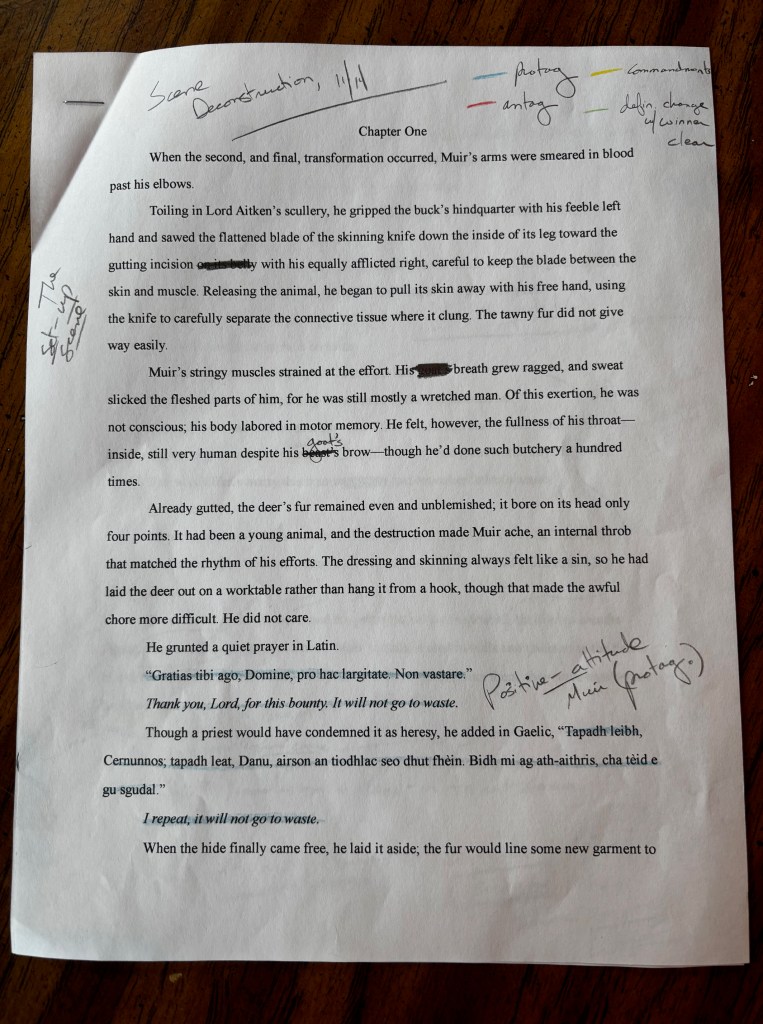

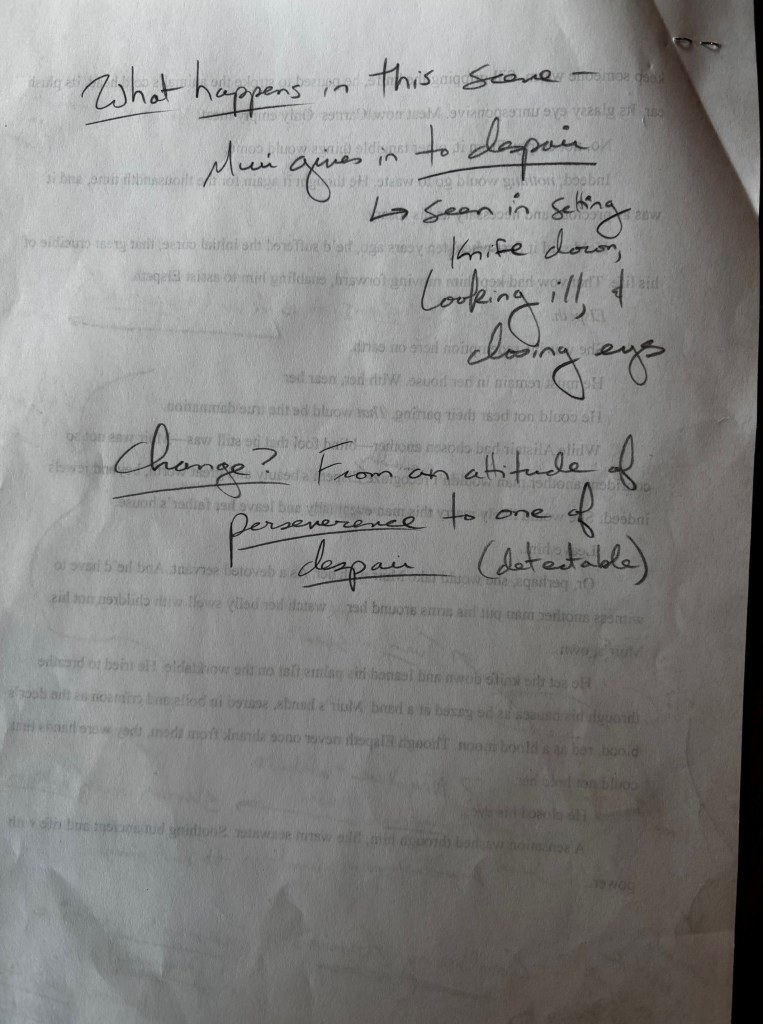
Basically, I analyzed what I had to ensure everything required for a complete scene was there:
- a clear protagonist & antagonist with conflicting desires (more subtle in this case because it is the persevering Muir vs. his despairing self)
- the five commandments of storytelling (inciting incident of scene, progressive complications, crisis, climax, & resolution)
- a definitive change where someone “wins” the scene (in this case, despairing Muir wins)
(The above criteria comes from Tim Grahl and is a condensed version of what Shawn Coyne teaches in his craft book The Story Grid).
This scene, which sets up the entire novelette, is very much a working draft. I find it interesting that a visual scan reveals over half of it is spent grounding readers in character, setting, and tone before the inciting incident occurs. This might suggest there’s too much grounding, given the proportions between that and the storytelling commandments.
I need to step away from the entire work, for now, and eventually have a reliable critique partner or editor look at all of it for me, especially if I want to do anything with it.
And, oh god, I’ll have to find people to edit the Latin and Gaelic. Why did I do that to myself?!
But, I hope the scene’s on its way to hooking, orienting, and intriguing you.
Thank you for letting me share it with you. Have a wonderful weekend!
XOXO,
Jenn

 Jennifer Shaw