Jennifer Shaw

A writer's musings in the mountains

  • A Musing Inspired by the Day of the Dead

    Hi! If you celebrate Spooky Season, I hope you had a good one.

    Cheers to you, Boo

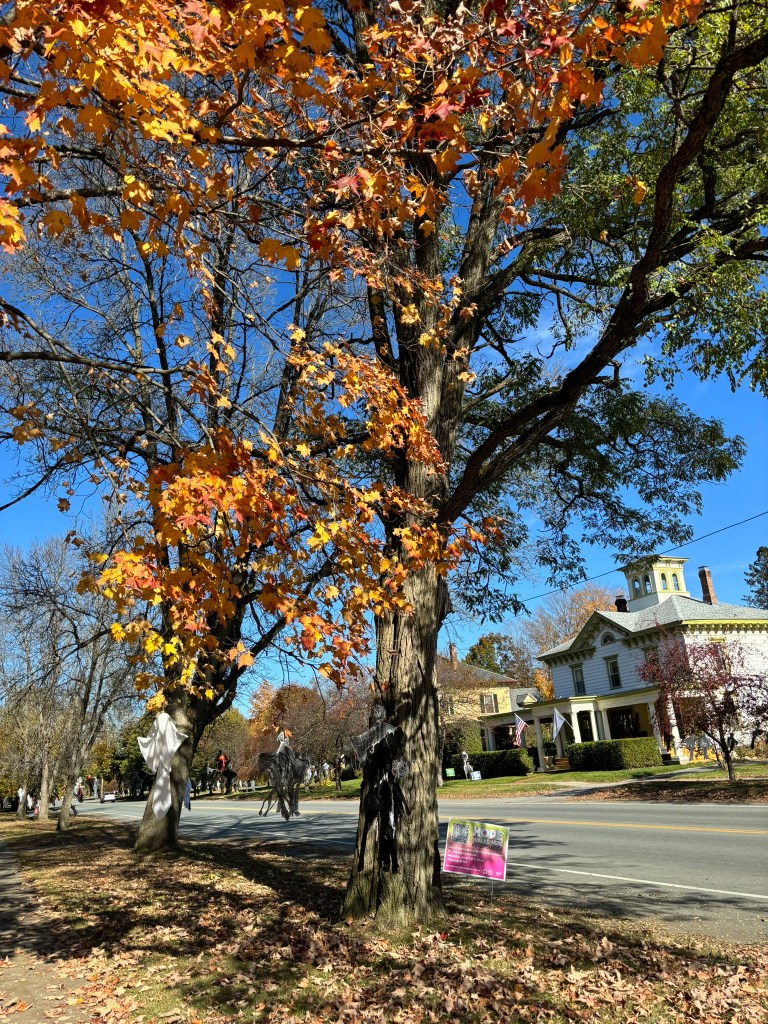
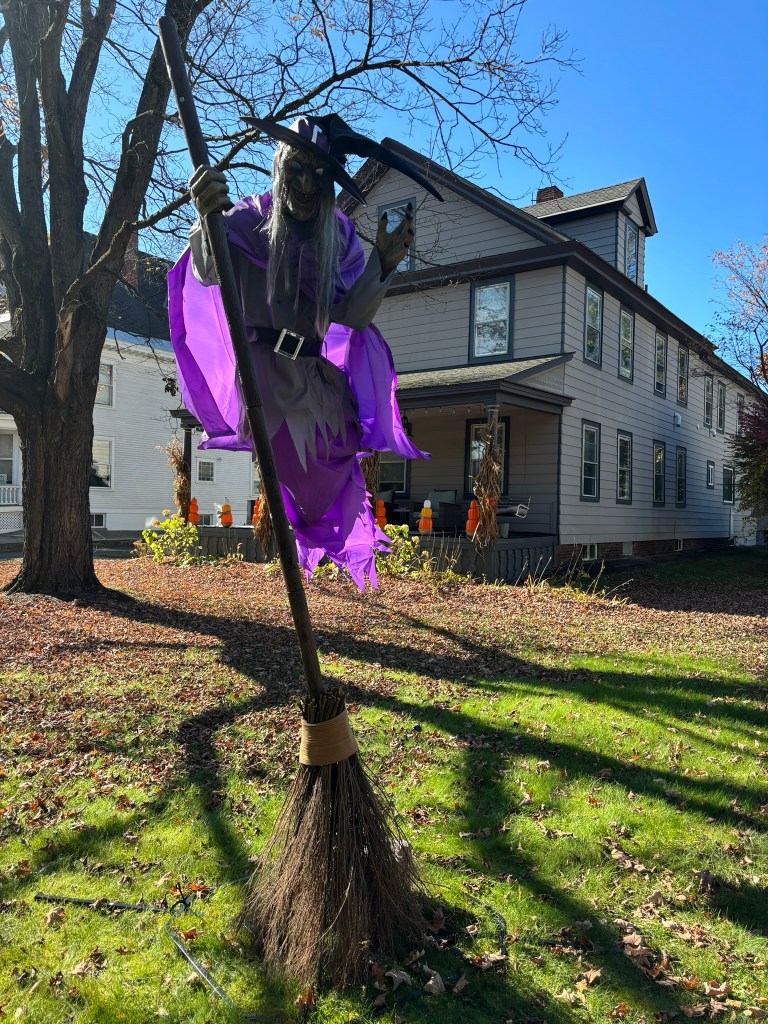
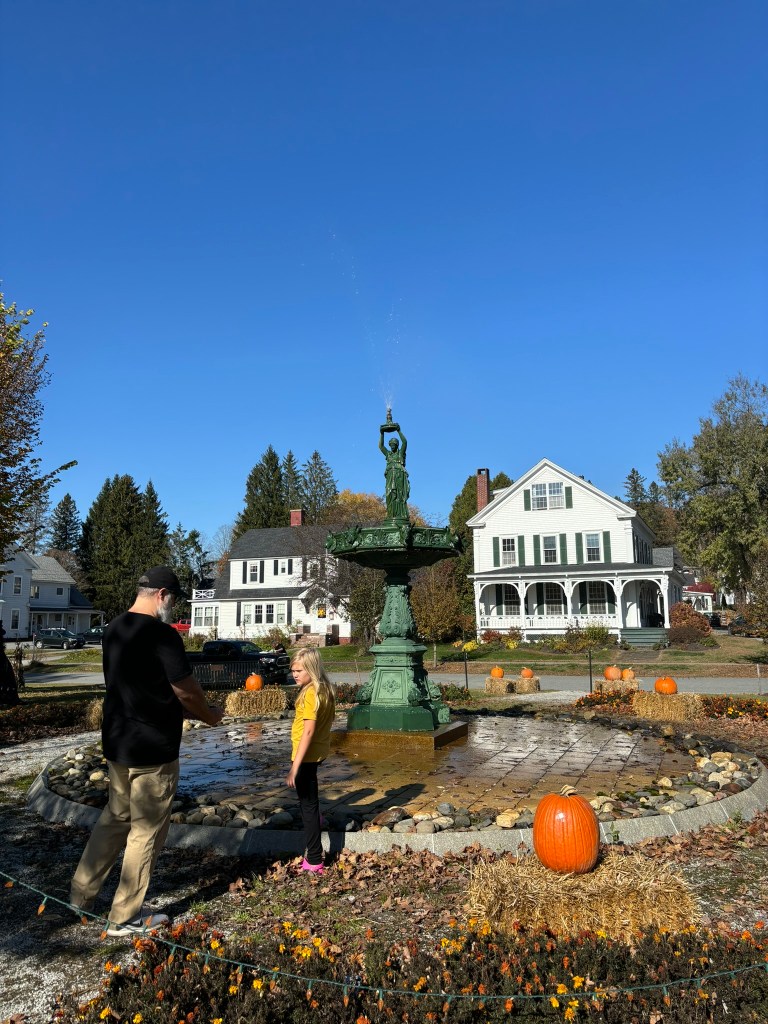
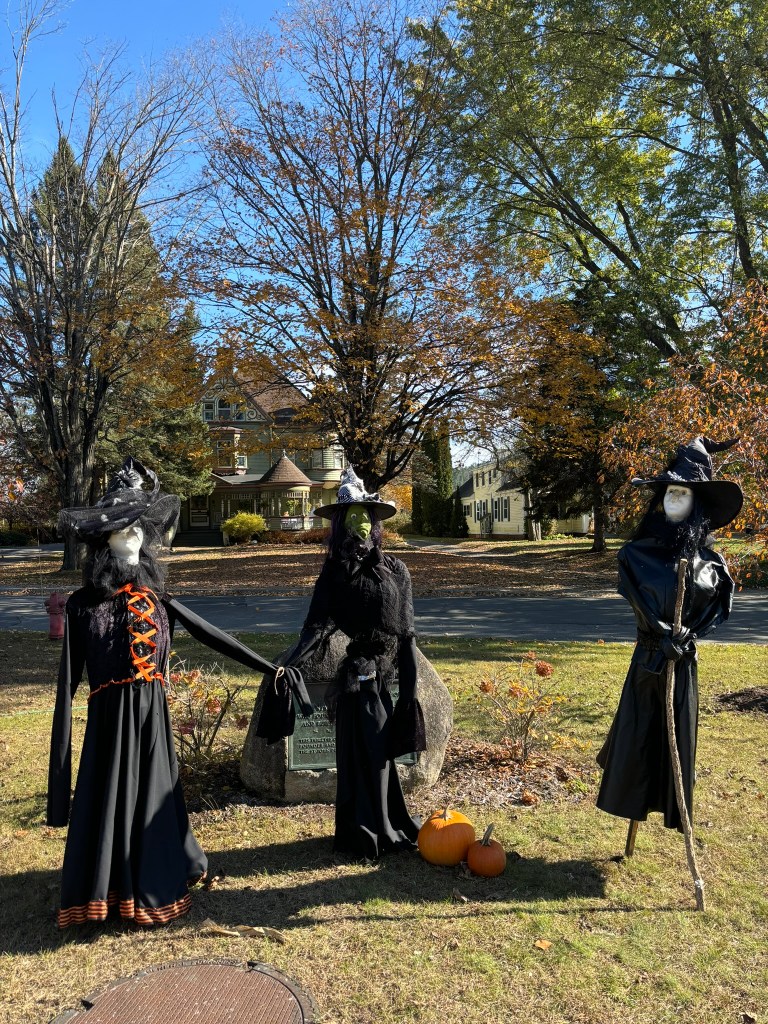
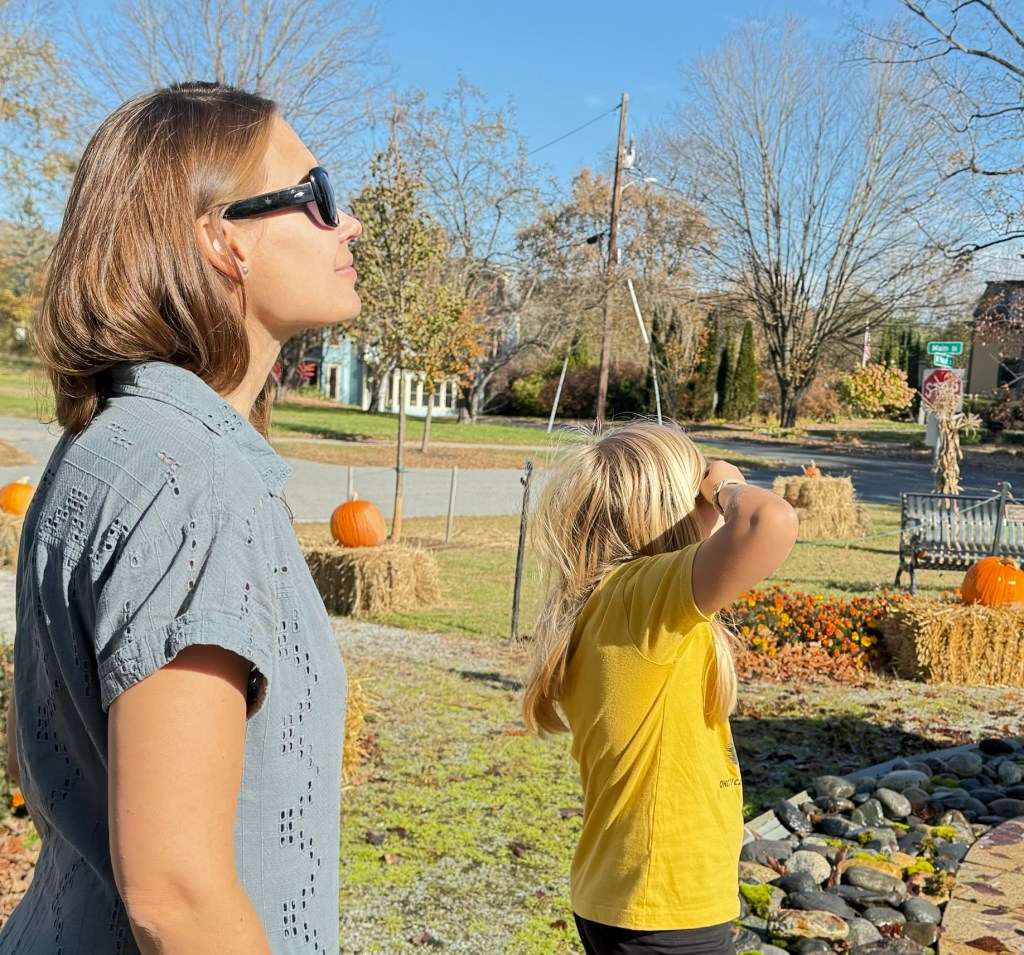
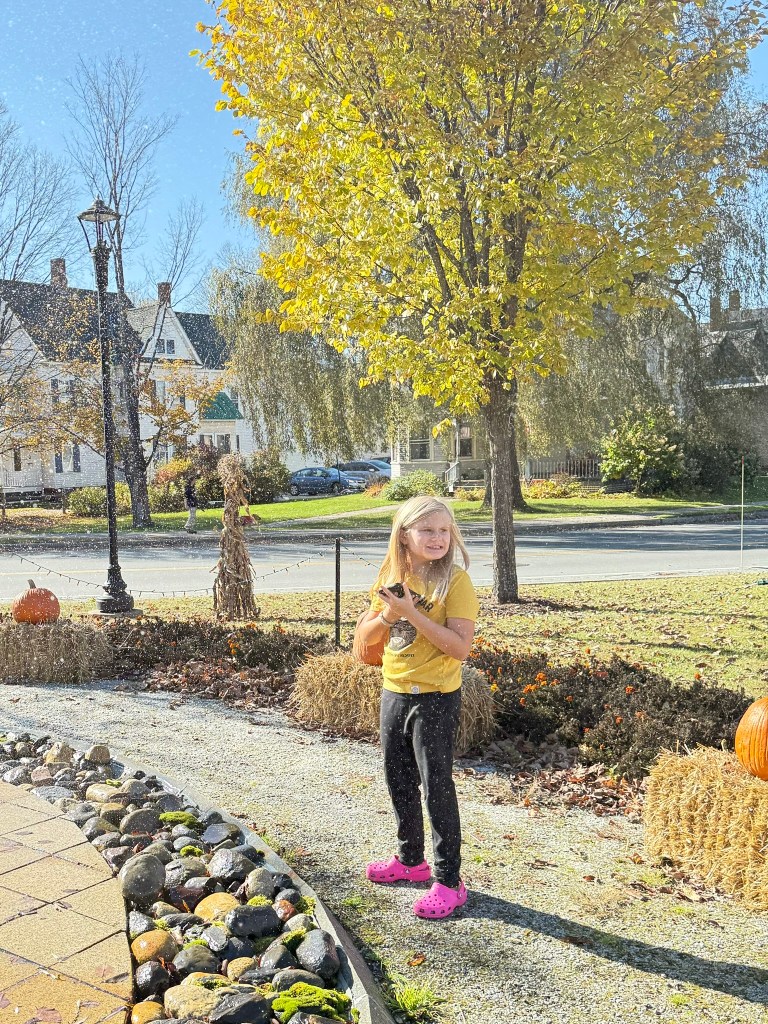
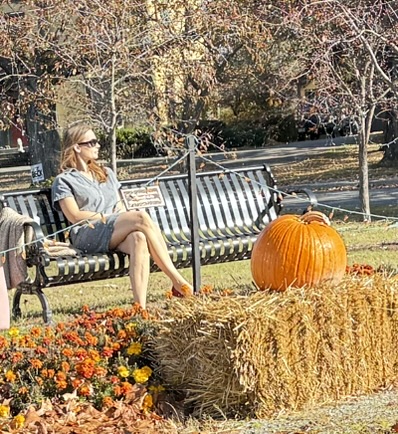
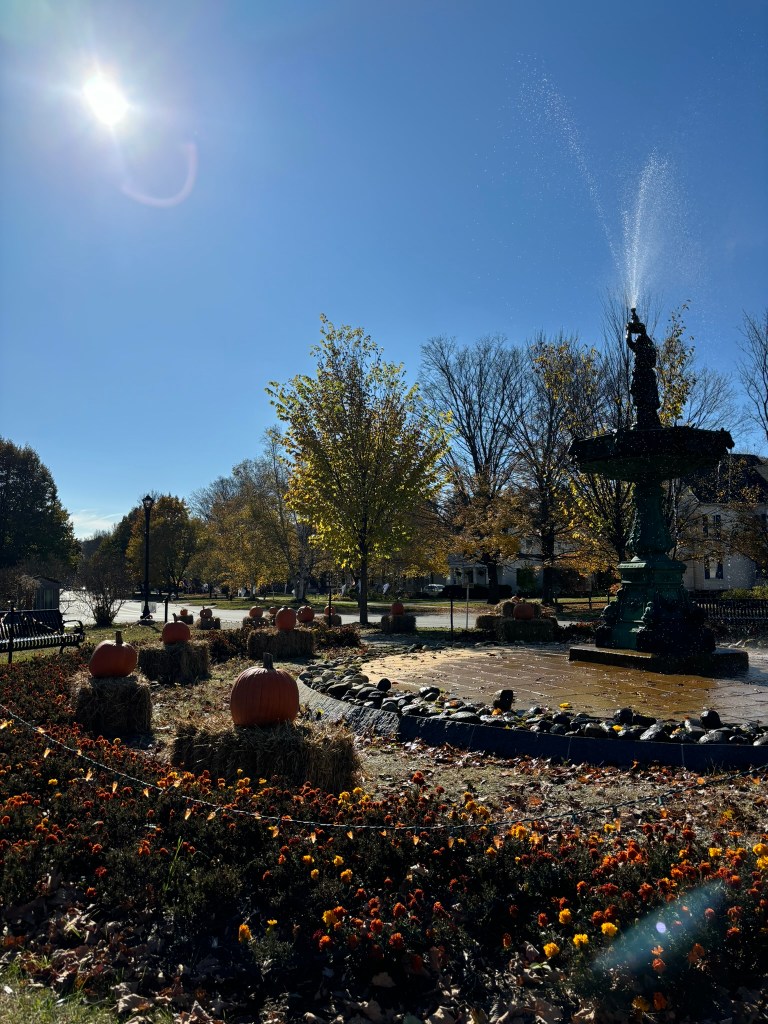
    One awesome, festive thing we did prior to Halloween Night was take Daphne to the nearby town of St. Johnsbury, our county seat, to Arnold Park located along one of their main streets, which was beautifully decorated for the holiday.

    St. Johnsbury

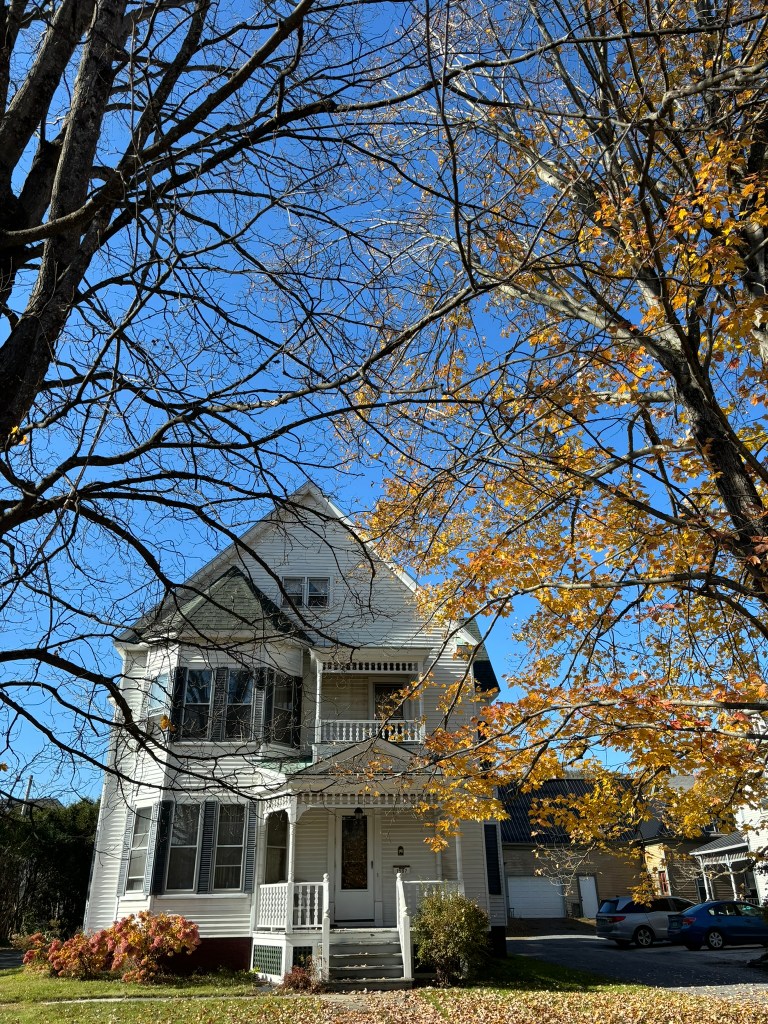
    St. Johnsbury was a prosperous 19th century railroad town also famous for its development of platform scales and maple sugar uses, and Arnold Park is still surrounded by the giant Victorian houses from centuries ago, in which resided the pillars of the local community. (One house still has the circular drive and covered entrance where you can tell carriages pulled up.)

    St. Johnsbury
    Spooky tree in St. J

    The gorgeous old houses, along with all the lovely, bucolic fall decor, was deliciously atmospheric. It felt like a setting in a Hallmark Halloween movie. All I was missing was a pumpkin-spiced latte or a cup of warm apple cider. Not sure why I didn’t insist we stop for one beforehand…

    More St. J
    More…
    Arnold Park in St. J
    Double, double, toil, and trouble
    Fire burn and…
    Fountain bubble

    Our family didn’t do a whole lot for the Big Spooky Day.

    Wicked sweet

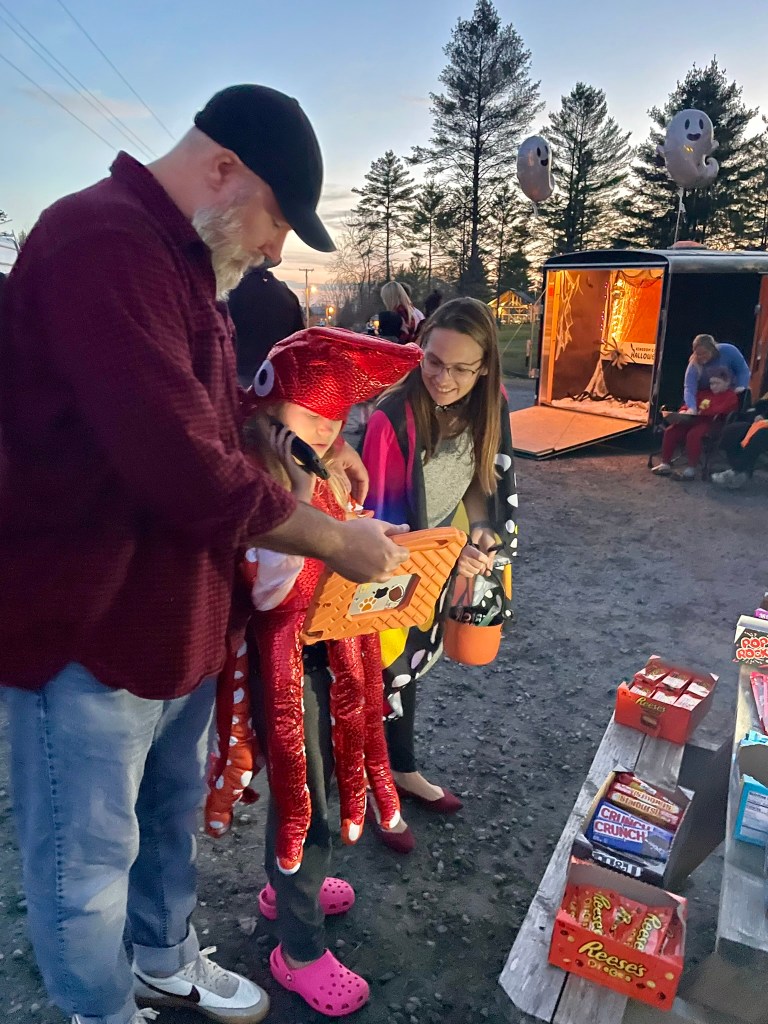
    My parents were in town from Houston, and at 5:30 we all took Daphne down the road to Kingdom Campground for the town’s unofficial Trunk-Or-Treat, and she did a great job walking from vehicle to vehicle, selecting one piece of candy per trunk and saying “Trick or treat” on her talker (her AAC device).

    Trick or treat!

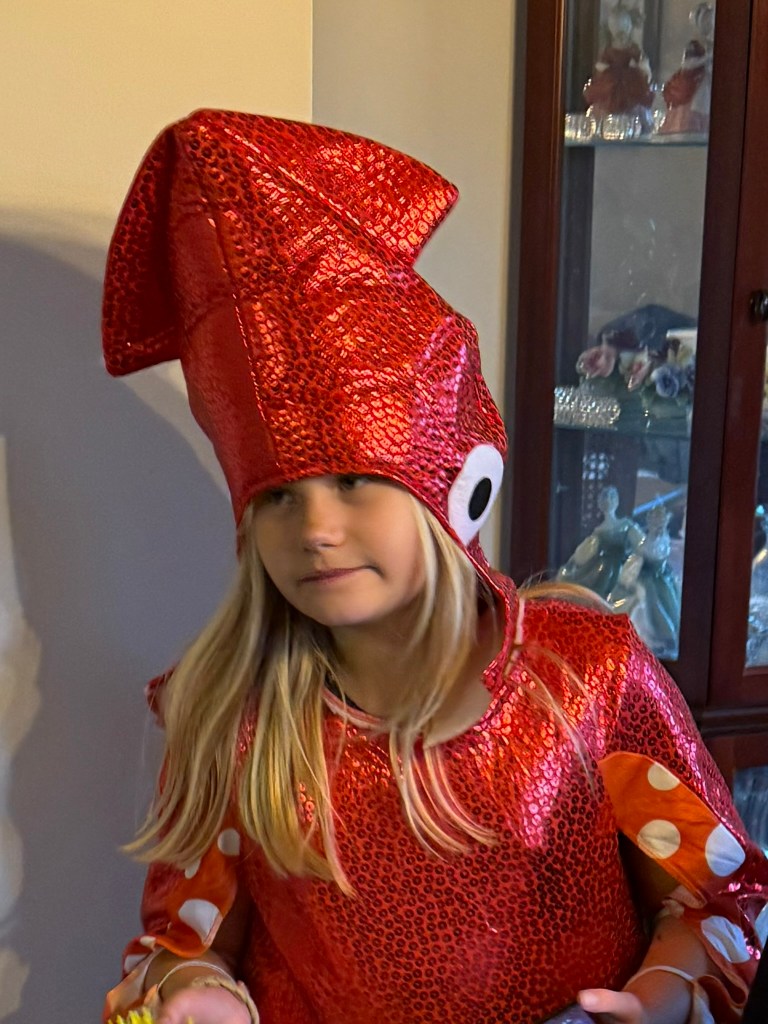
    She was adorable in her red sequined squid costume.

    Beautiful squid

    Just like last year, she was able to tell us this year via her communication device what she wanted to be, and this year it was indeed this very specific water animal (last year she told us “elephant”). I think her inspiration came from Mrs. Squid in the Pout-Pout Fish books, her favorite series.

    Crafting with AAC

    God bless augmentative and alternative communication (AAC). Without it, Daphne would be so much more limited in her expression, but TouchChat (just one of many AAC programs available to non or limited-speaking individuals) allows her to more fully participate in fun things like Halloween right alongside her speaking peers.

    She loves this word

    And speaking of these peers, several kiddos and adults stopped to say hello to Daphne throughout the evening. She is popular in town, so warmly embraced by this close-knit community, which was our hope when we relocated from a ginormous suburb in the fourth largest city to this vastly smaller, rural village.

    It was great having my parents with us, too.

    Out to lunch with Mom and Dad in Littleton, NH

    They love spending time with Daph, and she adores them. They had a blast watching her collect candy.

    Now, I’m going to wax philosophical for a moment. Bear with me, please.

    My father is 70 and my mother is 69; my husband is 49 and I’m 42. As we all get older, we find ourselves talking more and more about the past whenever we get together, growing nostalgic for days that were, empirically-speaking, a long time ago though they don’t always feel that way. Or, sometimes they do, and it’s shocking to think how much time has passed, and how quickly.

    In the catalogue of past things we chatted about on this visit, one I brought up was my high school acquaintance, Kristina.

    In the spring of 1999, just after the time change, when we were juniors in high school, Kristina pulled out in front of an eighteen-wheeler on her way home from an extracurricular activity on campus. I think the sun, suddenly in a different position, must have blinded her.

    She was life-flighted down to the Medical Center in Houston, and though she survived the collision, she was profoundly injured and on life support. Her family, ultimately, chose to take her off that life support, and our entire high school class, along with several staff members, was shocked and utterly devastated.

    I knew her well. We’d taken a lot of the same classes over the years, beginning in our 8th grade Newspaper elective, and we were pretty good friends at one point, though our interests eventually took us in different directions (I was on the dance team, she was in theater).

    We liked a lot of the same things, particularly reading, English class, and creative writing. I believe Kristina wanted to be a writer, among other things. She was a sweet, incredibly intelligent, driven young woman, and she was taken from this life so violently and unexpectedly.

    It was probably my first lesson in the tenuousness of things.

    She’s been gone now twenty-five years. A quarter of a century. How is that possible?

    But it is.

    I think about her regularly. This year, on November 1st, after I’d brought her up again to my parents, I tried to explain why she’s always somewhere in my mind, haunting my thoughts in the quietest, most profound, and ultimately positive way.

    Basically, I’ve thought about her at every major milestone in my life. When I graduated from high school, then college. When I started teaching and I began having students who reminded me of her in their sweetness, intelligence, and drive. When I fell in love, got engaged, and then got married. When I had a baby. Now, when I get my little pieces published. I think she would have liked to have had a story or poem of hers in print.

    Musings

    I think about all the things I’ve had a chance to do, or try, or even fail at, that she didn’t get to do. How she was prevented from having these similar experiences, for some reason or another (or perhaps for no reason at all; I don’t know how the universe works, ultimately).

    And it reminds me, better than anything else, to be grateful for all of my experiences. The good and the easy and the hard and even the bad, in their richness and depth and in the wisdom they cultivate (though, trauma aside, is anything really ever bad, if we learn and grow from it?)

    Reflecting on the prematurity of Kristina’s death enables me to appreciate what I’ve been given, even on the mundane or difficult days, and I’m thankful for it all.

    These sentiments seem appropriate, given the new season we’re heading into, and given this time to reflect on both the living and the dead.

    A reminder

    I understand that in Mexican tradition, Dia de los Muertos is a day, basically, to welcome back the dead and recognize that death is an essential part of life, of being fully human.

    Photo from Day of the Dead Resources web page, National Museum of the American Latino, the Smithsonian

    Without the knowledge that we will die, perhaps tomorrow, can we fully live? Is that the ultimate factor that allows us not to take our lives for granted…? As long as we can pause long enough to really think about that, to be truly present in that uncomfortable fact. Away from our screens, our phones, our social media, our petty grievances, away from our everyday but very limited, curated, and ultimately artificial perceptions of reality?

    I consider my thoughts about Kristina a special sort of visitation. If she is somewhere higher and infinitely better than here on our plane of existence, I hope (among many other things) she knows she inspires my gratitude for all the experiences life has allowed me.

    Alright, enough of that.

    Back to the holidays.

    On Thanksgiving, we will see more family–my husband’s mother and step-father down in Newport, RI. And on Christmas, we plan to host Uncle JT and his dog, Toby, who Daphne loves.

    It’s awesome we still get to be with loved ones on the holidays, despite living so far away from everyone.

    What are your holiday plans? What do you celebrate, and what do you have on your festive agenda? I’d love to hear it.

    Thanks for reading this kinda heavy post, and see you next week!

    XOXO,

    Jenn
  • Hardest Phase of the Writing Process?

    Remember my Christmas horror project? That was the story I originally wrote in August to submit to West Avenue Publishing for their Secrets of the Snow Globe anthology. It had to be a fantasy or horror 4-10k story set at Christmas and featuring a snow globe.

    Spooky Christmas

    My rough draft, if you recall, exceeded the word count by about 5k, and I didn’t have enough time to trim it down effectively before the 8/31 deadline. So, I shelved the project, hoping another publishing opportunity might come along for it eventually.

    Well, it looks like there are two opportunities for it now, so I’ve spent the last three weeks revisiting and revising that piece (despite my assertion a while ago that I wouldn’t submit anything else this year and would, instead, focus on finishing my novel).

    Not a totally precise rendition of a scene, but close enough in essence

    I enlisted the amazingly-generous help of a talented author friend who knows the horror genre well, and she gave me excellent, thorough feedback, kindly tempering her constructive criticism with praise for what was working. After processing all of her feedback, I had a super-clear idea of what I needed to do, and yesterday morning I finished my revisions. I’m proud of my latest version, though I recognize how imperfect it still is. Soon, I’ll be ready to take the plunge and submit the piece… I think.

    My poor FMC

    This work did prompt me, however, to reflect on a question I’ve often seen posed online and in authors’ groups.

    What is the toughest part of the writing process?

    When I began writing in earnest two years ago, the toughest part for me was the initial drafting. Getting words down was rigorous mental labor, sometimes an ordeal, in the same way a distasteful academic assignment felt when I was in school. Racking my brain for the right words to choose, typing them into a document, getting tired after about thirty minutes, my fingers aching, then rereading the passage only to discover it didn’t communicate the ideas in my brain or the feelings/scenes in my imagination, and getting frustrated. I did a lot of stopping and starting, and I suffered a lot of doubt about whether this was a worthwhile use of my time.

    Looking back, I realize I just didn’t have the stamina, fluency, or confidence that comes with writing regularly–when you do it long and often enough to develop a solid, effective habit, enabling you to finish a couple of projects and get your writer’s feet beneath you.

    This is actually hard

    But, writing was a stimulating and comforting escape, so I kept at it. I’m glad I did.

    Now that a few years have passed, I’ve finished everything from flash pieces to novellas. I’ll have five publications by the end of this year, four out and one forthcoming, and I have a novel underway.

    I have the stamina and fluency now for relatively-easy drafting. That has become the fun part, and I’ve settled into my method as a plantser. I’ll sketch out a big idea, usually using the Pixar story formula (so I have the essence and end in mind), along with brief character and setting descriptions and maybe an idea for a motif or extended metaphor (which is the seed for a theme). Then I’ll start writing. About midway through, I often pause to outline the remainder of my story so I can successfully navigate from a murky midpoint to the conclusion (or maybe to the new ending inspiration has just sprung on me). Then I’ll be done.

    I try to let a story sit for a few weeks, at least, before I revisit it. And now, if I consider submitting the piece anywhere, I always ask for others to provide feedback on it first. My mom is a fantastic alpha reader, and I have wonderful author acquaintances in my writing group who make insightful, precise, and empathetic comments and suggestions.

    Adding to these experiences and habits, I’ve also read dozens of writing-related articles and taken several online webinars in craft and mindset, from various sources. As my knowledge has increased, so, too, has my awareness of the strengths and weaknesses in my own work, and I have a much more sophisticated understanding of what makes certain kinds of writing effective or ineffective.

    In contrast, when I was a raw beginner, I thought it was enough to have a protagonist with a couple realistic traits struggle with a related internal and external conflict over a series of events. If those events built to a turning point and the conflicts were resolved, and if the story read smoothly and clearly to me, I thought that meant it was probably good.

    Ha!

    You know that phrase, the more you know, the more you realize you DON’T know?

    This paradox is true. Only the clueless believe they’re masters at something.

    For me, this wisdom now means that deep structure revision (not drafting) is the hardest part of my writing process. It requires the most careful, considered, and objective reflections about the nuances, unity, and impacts of my work, especially in terms of how others receive it. It also requires the most honesty with myself.

    Ugh

    When I sit down to complete a developmental edit, I often face the hard truth that I tried to do too much in my first draft, or I didn’t meet genre expectations fully. Or, the piece didn’t know what it wanted to be–too many POV shifts (including head-hopping), a dabbling in multiple genres rather than a solid, clear commitment to one. Or, I wasn’t clear enough in a character’s backstory or motivation. Or, the thematic threads or perspectives (author’s, character’s, & reader’s) are tangled… etc.

    Or, toughest of all, that all the story elements aren’t quite coalescing. Those big picture, synthesis issues are what often get me. I’m good with language on the sentence and paragraph level. I’m pretty good with narrative even on the elemental/scene level–composing a character, a conflict, or an immersive setting where a brief goal, struggle, choice, and consequence occur. But it’s easy for me to get caught up in finetuning the individual pieces (or, you if will, the individual links), and I fail to zoom out to consider how they all fit (or link) together and how the picture looks (or the chain connects) overall.

    I lose the forest for the trees, as that old cliche goes.

    And sometimes, even when I’m really trying to get the proper big-picture perspective, I just can’t see this global vision/impression at all, and that’s where I definitely need my alpha readers, critique partners, and editors.

    Just can’t see it

    But facing these deep-structure, fundamental revisions, which often don’t have simple, quick fixes–where you often make high-stakes changes or total overhauls–is daunting.

    There’s often the feeling of, oh God, I’ve spent so much time on this already. Do I have the bandwidth, the energy, for another long, deep bout?

    Or

    What if I just don’t have the skill to redo it this way?

    Or

    What if I lose all objectivity completely? What if I find myself revising in metaphorical darkness and… I make my story worse?!

    Or, when a submission deadline looms:

    Can I do this well enough in the time I have left?

    Or, ultimately,

    Is this good enough NOW? Am I rushing it, being too eager? Or, am I making the mistake of lingering over it too long? Are these ruminations becoming counterproductive?

    I think I’ve struck the balance with this latest piece. I employed most all of my friend’s suggestions. The only one I couldn’t achieve was cutting the story down to just being, essentially, Part II, with effective flashbacks interwoven. That would have taken the piece from being a novelette/novella (depending on how you define those terms) to a true horror short.

    I just didn’t have the skill for that, I think.

    Or the will.

    Maybe, I was just being lazy.

    Oh well… it is what it is

    Luckily, one of the opportunities for this piece is a call for fantasy/horror novellas (from an Australian press!). The other press seeking holiday horror has a strange definition of short story–being up to 20K words. (It’s odd, but I’ve triple-checked their guidelines, I promise, just to make sure I’m not imagining it).

    I’ll keep you posted on the fate of this 16K Christmas horror story, which now has an official title–So Many Fragile Things.

    I’d love to hear from you. If you’re a writer, what’s the hardest part of the writing process for you? Why that part?

    See you next week!

    XOXO,

    Jenn

  • My Glamorous Life as a Hobby Farmer

    Hey there!

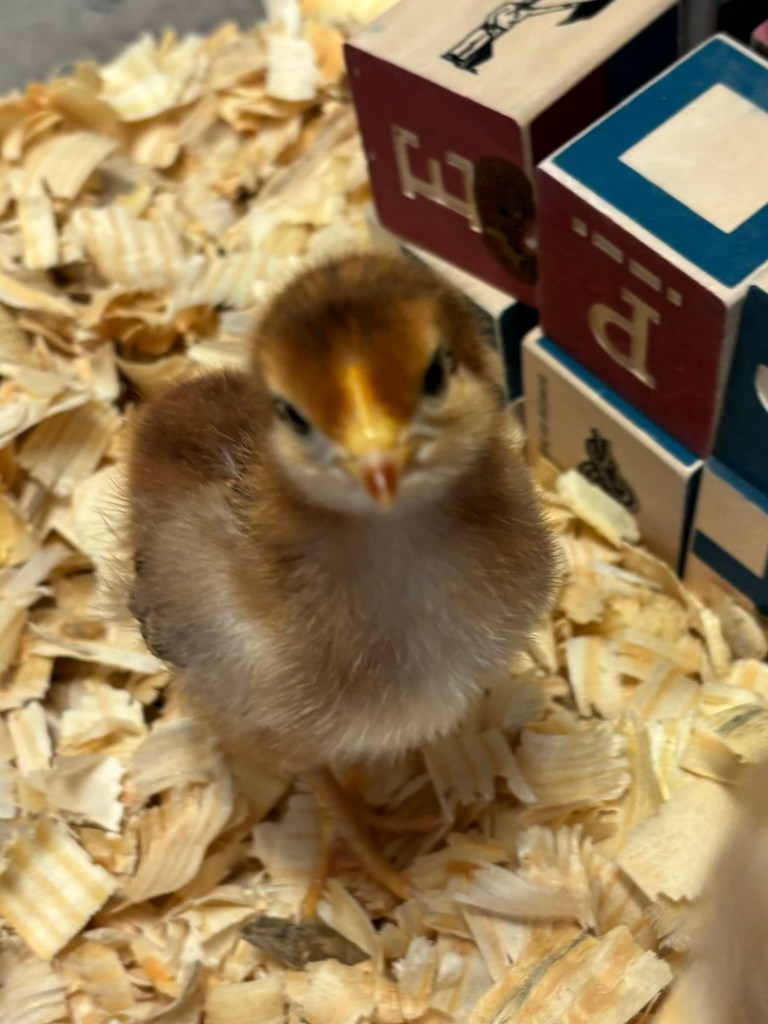
    It’s hard to believe it, but our chicks are already six weeks old. They’ve grown rapidly from tiny, peeping little fuzzlings…

    Just a baby

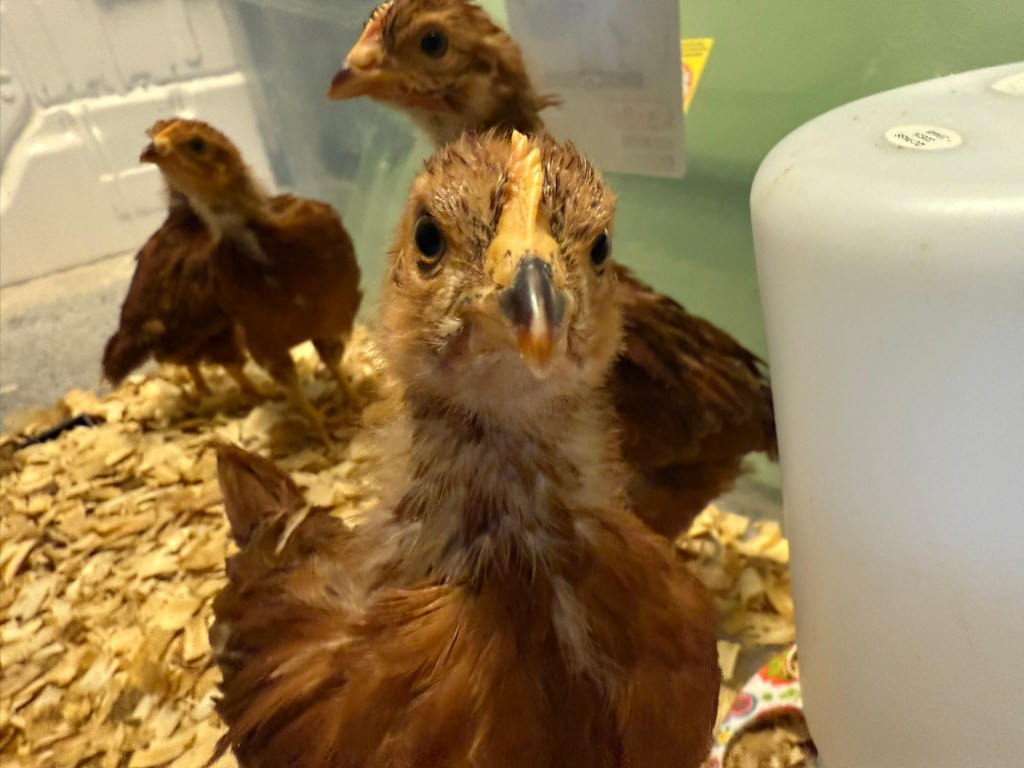
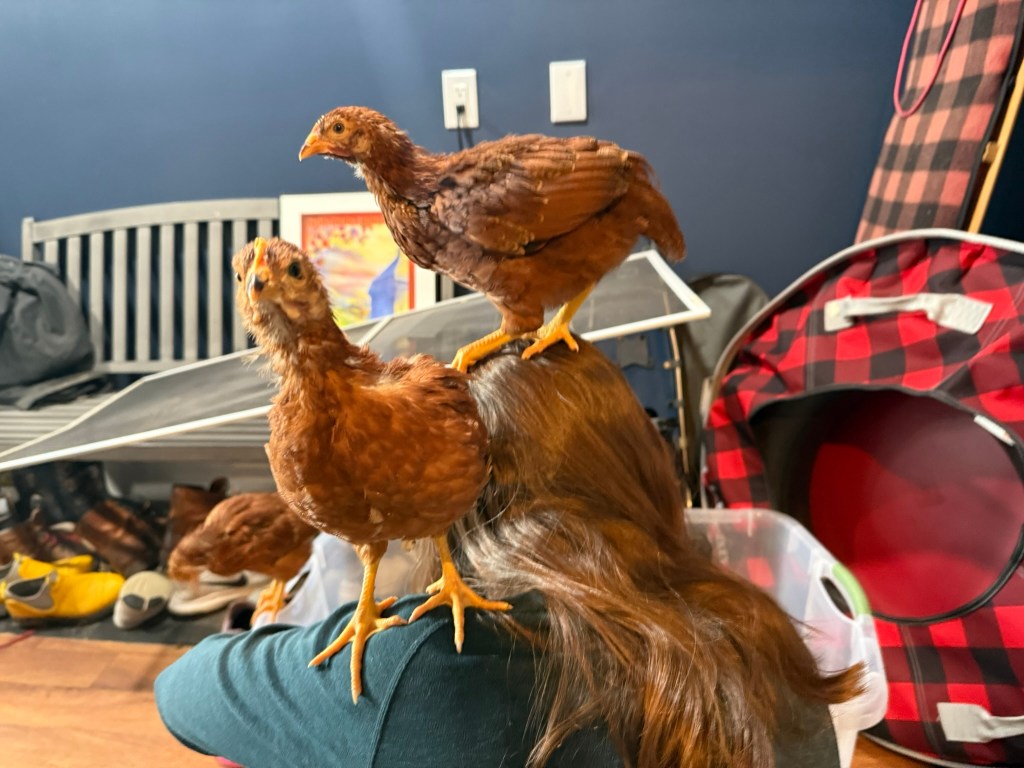
    …into surly, restless pullets–that’s poultry-speak for chicken teenagers.

    What are you looking at, butt-head?
    Human perch

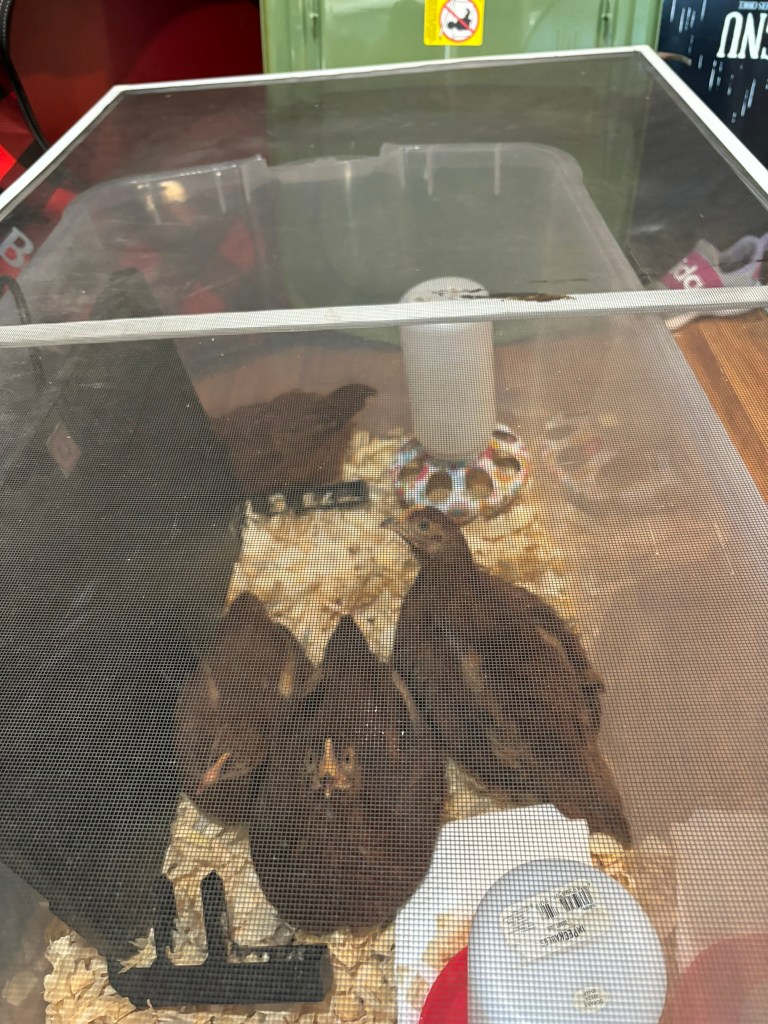
    And they’re way too big for their brooder.

    Get us out of here!

    Our plan is to move them into the official, outdoor grown hen coop–a.k.a, the Granny Coop–in a few days. They’re old enough and they have all their mature feathers, so their little bodies should be able to acclimate to the chillier weather.

    Jer and I are a little nervous, though. We’ve never integrated a younger group into an older flock before, and though we’ve read about it and plan to follow the recommendations to the best of our ability, we’re afraid there might be some “chicken-on-chicken violence,” as Hubby likes to say.

    What are the recommendations for successful flock assimilation? Basically, put the new chickens in the main coop at night with the older ones, and when they all come out in the morning, they will recognize one another as a new, larger flock. Then, they’ll naturally go about adjusting their flock dynamic.

    Hmm…ok, internet. If you say so.

    Coop catastrophe?!

    I’m a bit worried about the younger girls because they’re, well, comparatively little. Especially Daisy, our meek little runt of a pullet, although she’s good about staying out of the way, poor baby.

    Jer’s more worried about the older hens because he says the younger ones are “b%*#@&s,” which isn’t entirely inaccurate; they can be little spitfires and nasty with each other. And, they outnumber the big girls.

    Back off, B!

    We’ll see.

    Prep for this move also meant I had to get on with the autumn coop deep cleaning ASAP, which I would need to do anyway, but now it felt especially urgent given that the older hens appeared to have a moderate case of mites, and I still hadn’t treated them or the coop itself.

    I do not want the little ones beginning their outdoor lives by contracting mites.

    So, that meant I had to hop to it this week, when really all I wanted to do was curl up with a book or leisurely revise my latest work-in-progress (more about that in a later post).

    The weather had been cold and rainy, with temps dipping below freezing at night, frosting the ground in the morning. But the weather cleared yesterday, so I put on my chicken-chore Carhartt and got to it, starting with older girls’ booty baths and mite treatments. Hubby was kind enough to help me with that part.

    This entailed washing the girls’ vent areas (their single external openings, from which they both lay eggs and excrete bodily waste) with water and Dawn to clean off old poop and mite eggs, then spraying their vent areas and skin with a solution made from 9 ounces of Elector PSP mixed into a gallon of water–a powerful one-time treatment, thank goodness.

    I was afraid our three big girls would freak out and make the entire endeavor difficult, but they were actually quite tolerant as you’ll see in the videos, bless them.

    I’m glad they trust us.

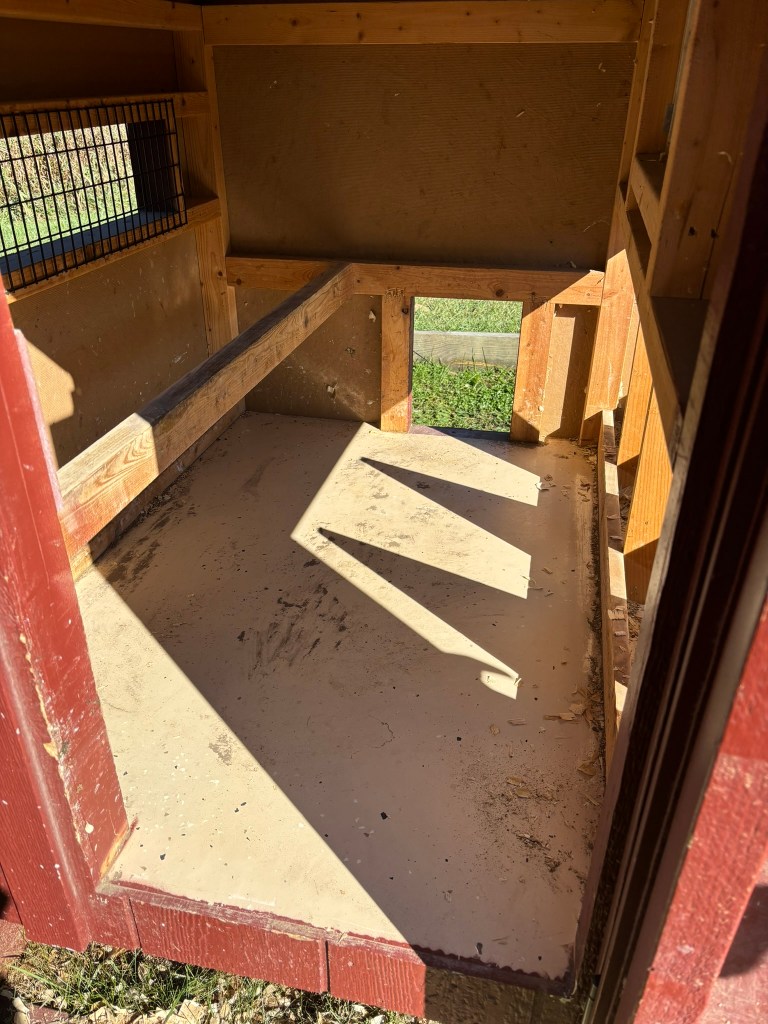
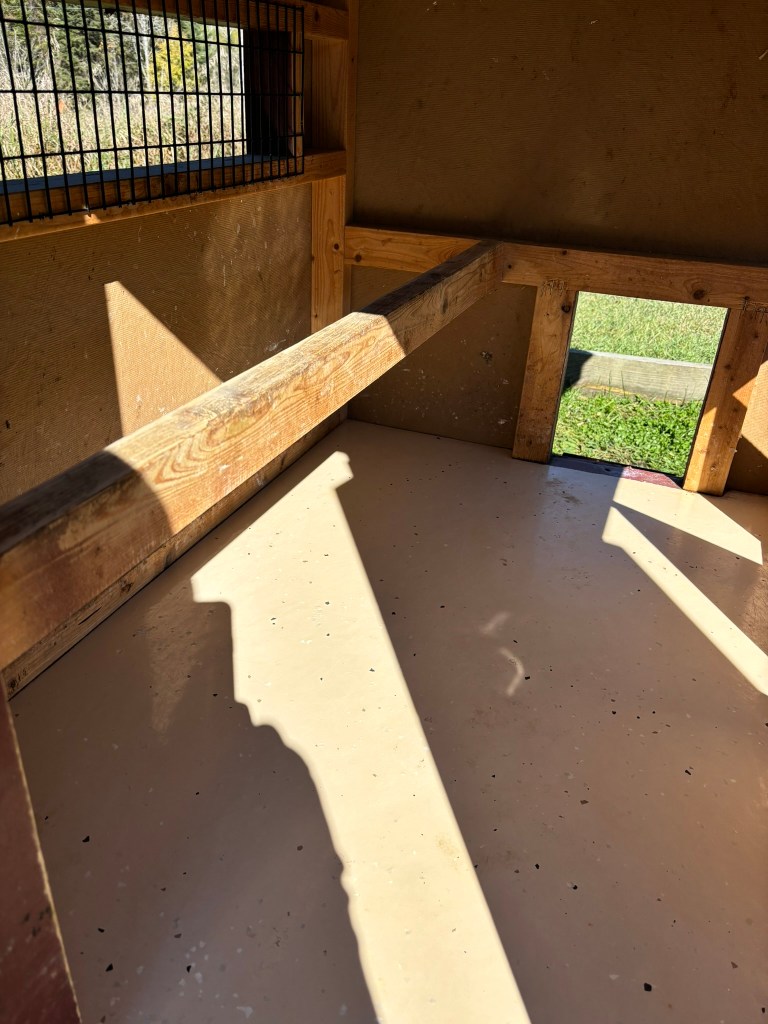
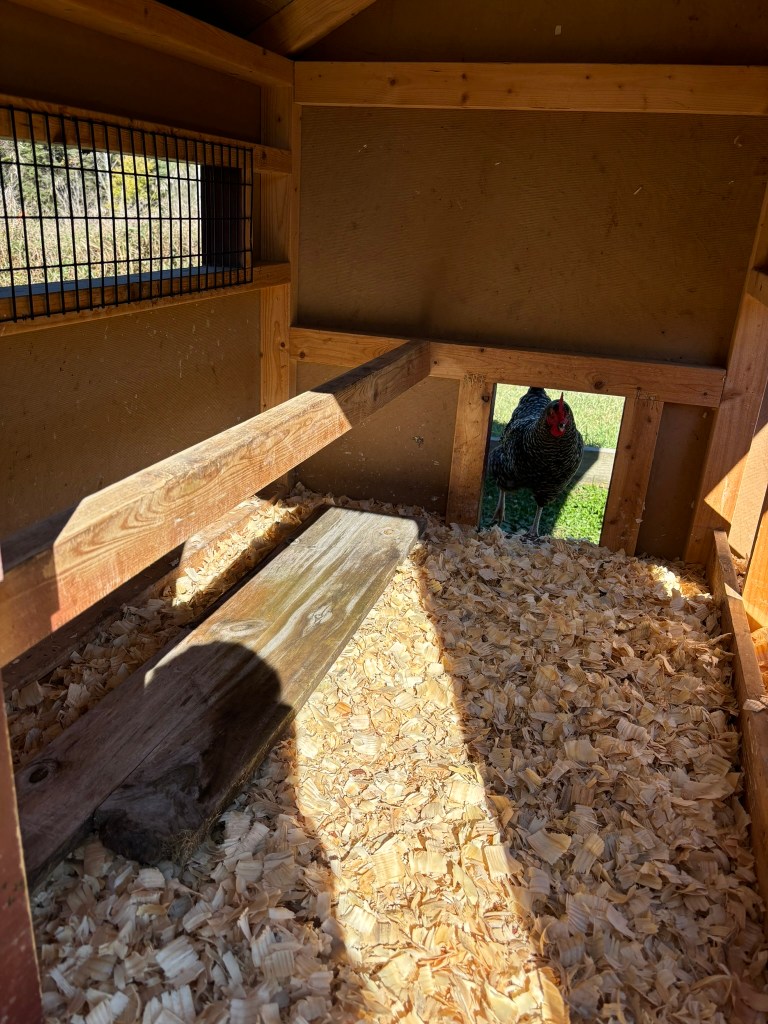
    After that, I mucked out the coop itself. This always sounds like a huge, awful job, but once it’s underway, I remember it’s really not bad.

    I swept out and vacuumed up all the old shavings, then sanded the roost bar to get off as much old poop as possible.

    Out with the old shavings…

    Then, I washed the floors of the roost area and nesting boxes with water and more dish soap. Next, I sprayed all the surfaces with more of the Elector PSP solution, paying special attention to nooks and crannies, where mites like to hide during the day.

    So fresh and so clean, clean!

    Finally, I let the entire coop air-dry for 45 minutes before piling in lots of fresh wood shavings.

    “What’s this?” Doris asks.

    I also sprayed down the poop boards, coop plank, and fake eggs we still keep in the nest boxes to encourage laying. (Each time I’ve tried to take away the fake eggs, our hens get upset and act like they don’t know where to lay. It’s ridiculous.)

    In our coop, we use the deep litter method, which means we don’t change out the mass of shavings each day. Instead, I clean most of the droppings out on a daily basis by scraping the crap on the poop board (a removeable piece of wood located under the roosting bar) into the compost pile each morning, then stirring the old shavings inside the coop and placing the cleaner board back in. The poop that remains in the coop breaks down into a nice compost, which generates heat that keeps the hens warm at night. This warmth is especially important here in the colder months.

    When it comes to coop litter, some chicken keepers believe sand is a better, cleaner alternative, but I just don’t think it would keep our hens warm enough. So, wood shavings using the deep litter method it is!

    But using deep litter does necessitate a total clean-out twice a year, once in the early spring and once in the autumn. If that doesn’t happen, the coop can become unhygienic.

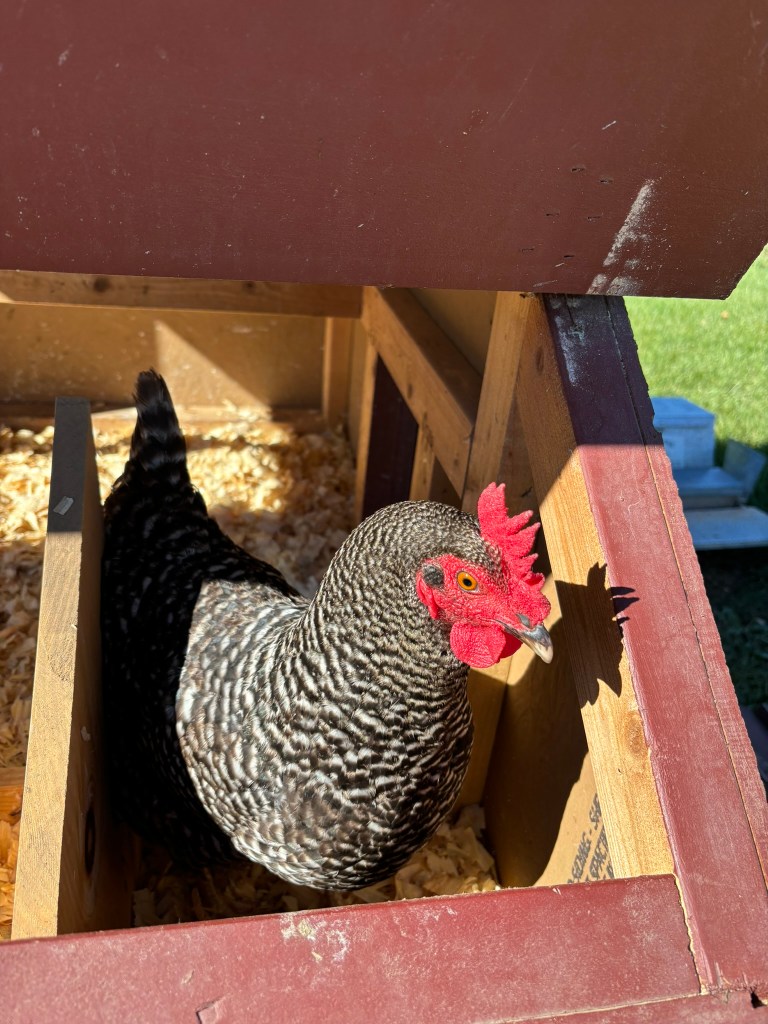
    “Looks good. I’m ready to lay an egg.”

    I’m glad those chores are done. And, though I’m a little sore today, it felt good to do some physical labor in the cool, bright sunshine. My head felt clear and my body energized.

    The work is dirty, however, and not at all glamorous.

    My life now is not glamorous in the least, really.

    Sometimes I miss having reasons to fix up on a regular basis. When I was working, I wore makeup and my Tiffany pearl earrings everyday. I got my nails done, colored my hair, and worked out on a regular basis. I looked pretty damn good, most of the time.

    Now, it’s comfy clothes and makeup only if there’s a truly pressing reason, and it feels like a good day if I’ve showered. I haven’t worked out much this year, though that’s really my fault–I just haven’t allocated the time for it. I need to change that, for health reasons if nothing else.

    This is about right, except I’m not that skinny

    My habits now probably sound slovenly, but when I’m mostly home on our little farm here in the countryside, there’s no reason to dress up. Daphne and the hens don’t care. The neighbors don’t care, and my husband doesn’t seem to mind, either. He tells me I’m beautiful, no matter what.

    Although, when I do put on makeup, he’ll do a double take and say, “You look pretty.” Ha.

    It’s all fine, though. I’m the most content I’ve ever been in my adult life, and it’s been good for me to let go of the more superficial stuff.

    I just hope someone will tell me if I start to look too unkempt.

    What have you been up to?

    See you next week!

    XOXO,

    Jenn
  • The Truly Important Stuff

    On Monday, Jer’s dad texted us this wonderful photo:

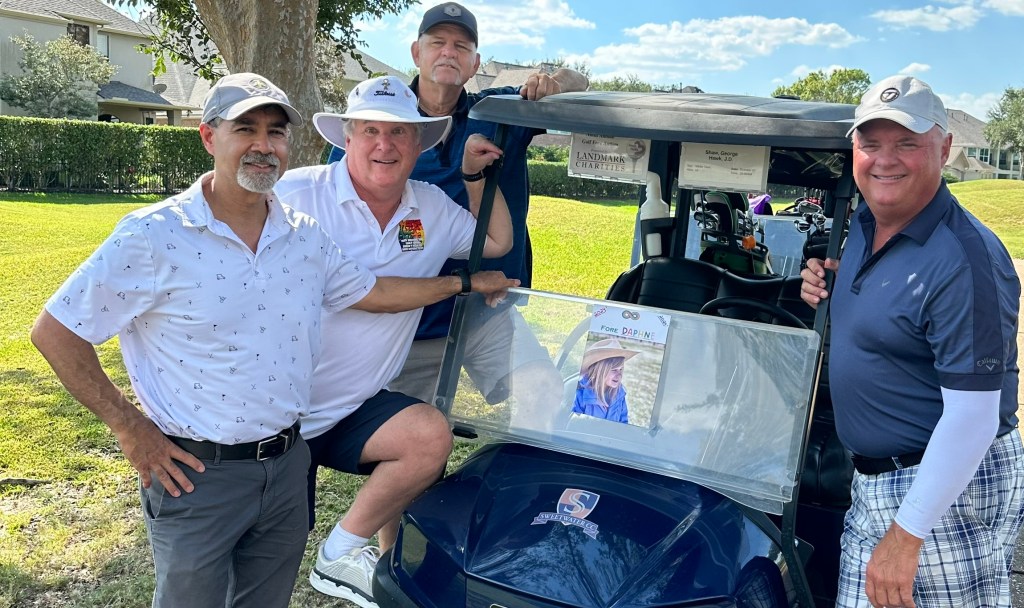
    George and Team 2024

    That’s George, Jer’s dad, in the middle, wearing the white polo with the multi-colored puzzle pieces and text that says, Just because you can’t speak, doesn’t mean you have nothing to say. Pictured with him are his dear friends and former partners/co-workers (from right to left): JD, Gordy, and Roy. Together, they made up one of several teams participating in the Hope for Three Annual Golf Tournament, held at Sweetwater Country Club in Sugar Land, Texas on October 7th.

    And you probably recognize the little girl in the picture on their windshield–Daphne, of course. George’s team participates to help all Ft. Bend Co. kiddos with autism, but it’s sweet Miss Daph who inspires them.

    George and his teammates’ participation in this major fundraiser for a nonprofit autism advocacy organization serving Fort Bend County means more to me that I can express. For five years now, George has organized and played on a team for this major event, and his efforts, as well as those of the other 240 participants this year, earned Hope for Three approximately $134K total. Most of that money, as I understand it, will go toward funding various therapies, equipment, and other support services for Fort Bend autism families.

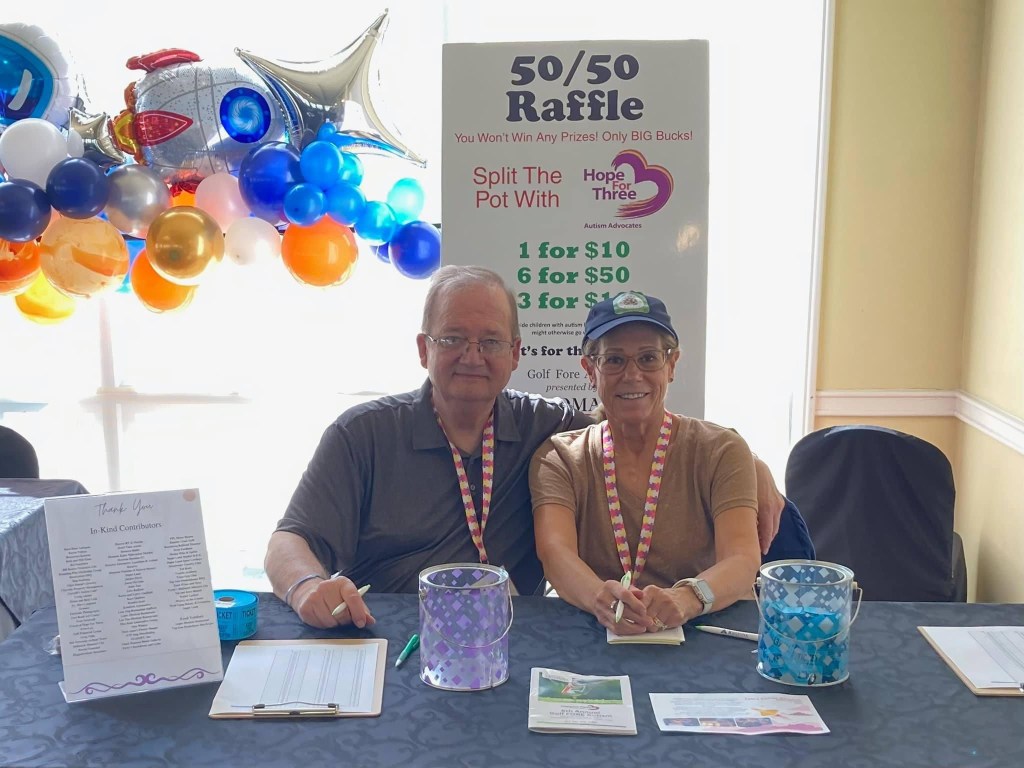
    My parents, Tim and Sally, volunteering last year. Photo from Hope for Three’s Facebook Page

    My parents, Tim and Sally, also volunteer each year in the H43 golf tournament. They sell tickets for the raffle, and this year they also set up the wine pull.

    Julie, on the far left, with several members of the Hope for Three staff, photo courtesy of H43’s Facebook page

    My mother-in-law, Julie, does not live in Fort Bend like our other parents do. But, when she was still in Texas, she worked for a year at Hope for Three as their Development Director, and for years, she sat on their board.

    Hope For Three is an incredible organization. Jer and I know first hand how expensive it can be to get the resources your autistic child needs. ABA, speech, and occupational therapy aren’t free, nor are the devices like iPads for things like augmentative and alternative communication. Even with Medicaid, a family’s expenses can run high, and even for a family with only one child on the spectrum, let alone multiple children. So, the funding that organizations like Hope for Three provide to autism families (regardless of their incomes) is imperative, in my opinion, for those families to support their children to the fullest extent possible.

    Public schools are wonderful in many ways, and they do their best, but what they can give is often just not enough.

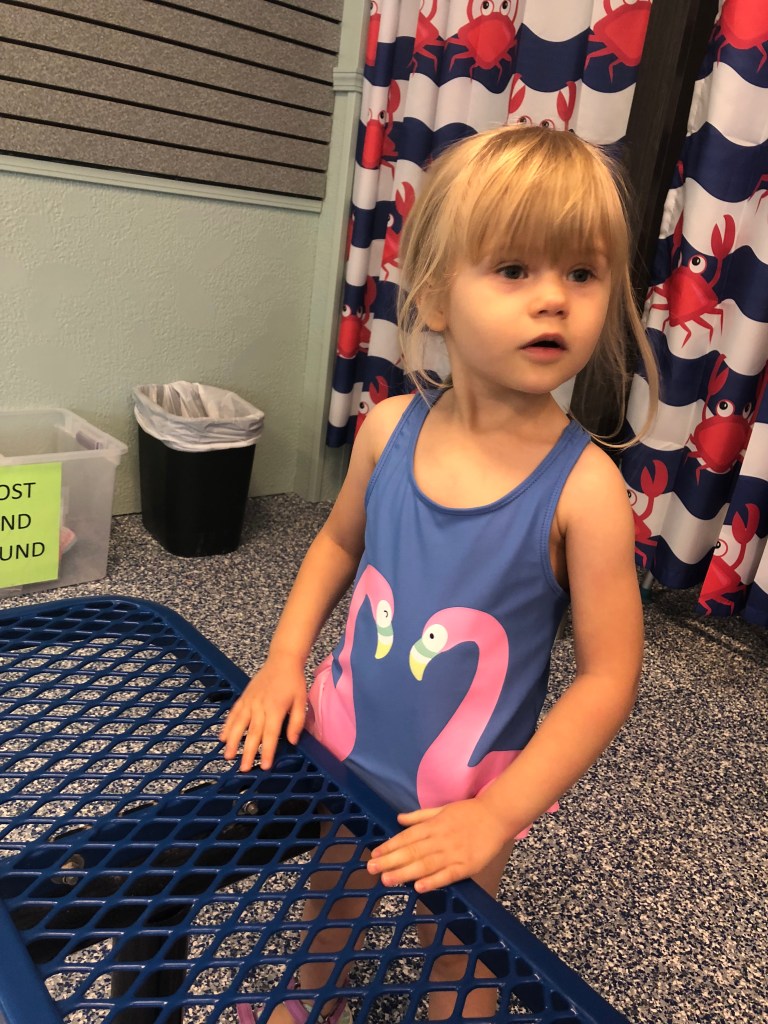
    When we still lived in Fulshear, Texas, H43 aided our family by providing grant money for Daphne’s Survival Swim lessons at Texas Swim Academy. Not only did these lessons give her a life-saving skill, they sparked in her a passion for the water.

    Three-year-old Daph, eager for her lesson

    And, had we continued to live in Texas, we would have applied regularly for funding to continue Daph’s speech and occupational therapy at Growing Speech, which we had to seek privately since the public school only provided some speech services and zero OT. We would have needed H43 to fully support our daughter.

    Aside from raising and distributing funds, Hope For Three does other wonderful things, too. They provide fun activities and other emotional support for the siblings of children with autism, often called glass children because they can feel overlooked and thus invisible. H43 works to make these kiddos feel seen and appreciated.

    Recent caregiver events, photo from H43’s Facebook page

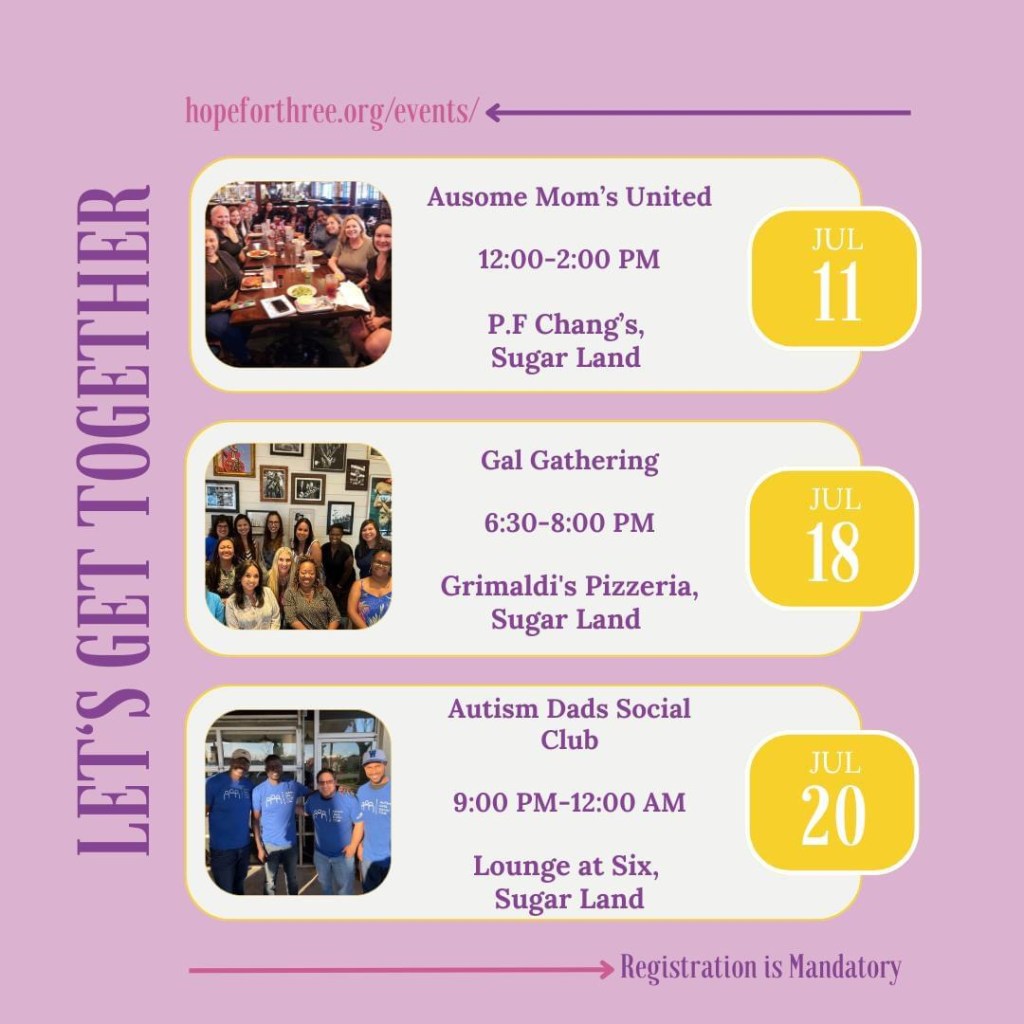
    In addition, H43 organizes informal support groups for mothers, fathers, and other caregivers of ASD children, which often meet for happy hours and dinners out. The parents and caregivers are allowed to make these gatherings as serious or light-hearted as they like.

    Training for law enforcement, photo from H43’s Facebook page

    Hope for Three also trains local law enforcement on how to identify, approach, and aid an ASD person in need–so important because sometimes an ASD adult, particularly a man, might appear violent and in need of force or restraint when that is not the case.

    Joining forces with other advocacy groups/foundations, photo from H43’s Facebook page

    They do other amazing things, too. Too many for me to adequately describe here. I highly encourage you to check out their website for more information.

    I write all of this, though, in a feeble attempt to communicate my profound gratitude and love for our parents.

    I imagine it’s not easy for them to witness our life as an autistic family. I imagine they have always wished they could do more for Daphne, or wave a magic wand to ease things. But assisting Hope for Three is a powerful way they do support us, and so many others. I am so very, very grateful for their unfailing love and unabashed support through all these years.

    We feel it even way up here, in the NEK of Vermont.

    George, Cary, Julie, Scott, Tim, and Sally–thank you. We love you very much.

    I’ve had a few reminders lately about the tenuousness of things, and they underscore how family (however one defines that term, for family isn’t always blood) and solid, loving relationships, are really the stuff of a good life. They’ve made me hold my husband and child a little tighter. They’ve helped me remain patient, too.

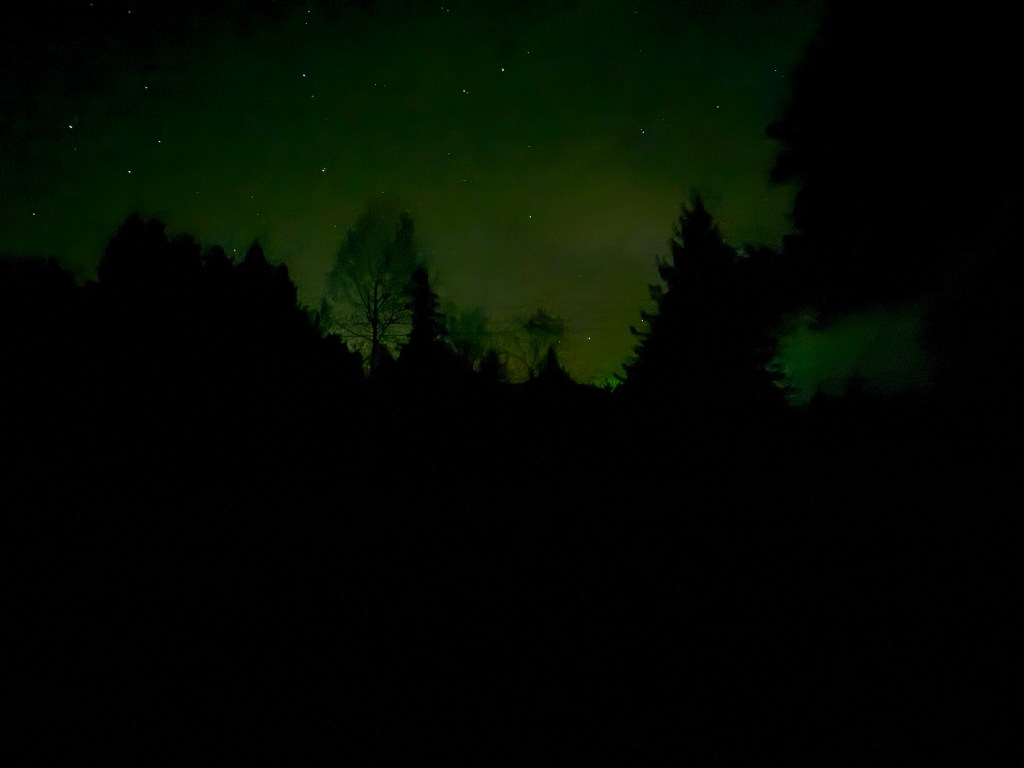
    Northern lights over Shaw’s Hill

    Reinforcing these reflections about the big things, we were able to see the northern lights this past week. Being the more adventurous night-owl, Jer went out late to look up over our hill at the sky. Had he been able to walk higher, or get in the car and drive a little farther up, he’d have had an even better view, but this was enough for now. It’s not a great idea to drive at night here, given how pitch-black the countryside is, and some of the roads around us are still washed out from the summer floods.

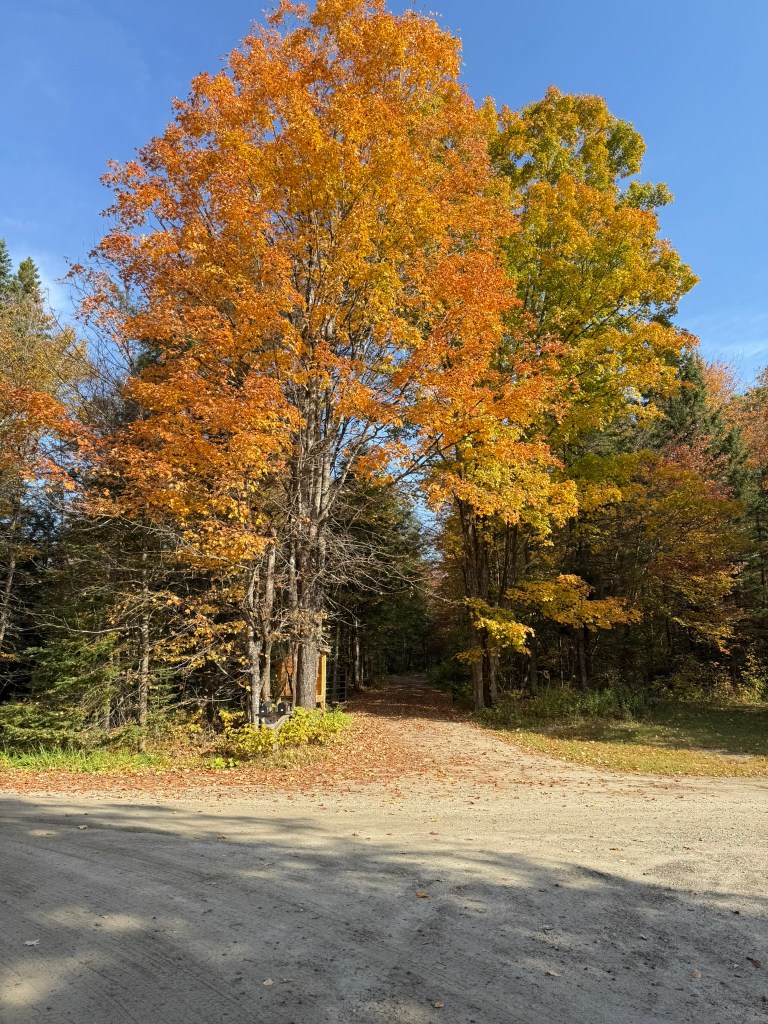
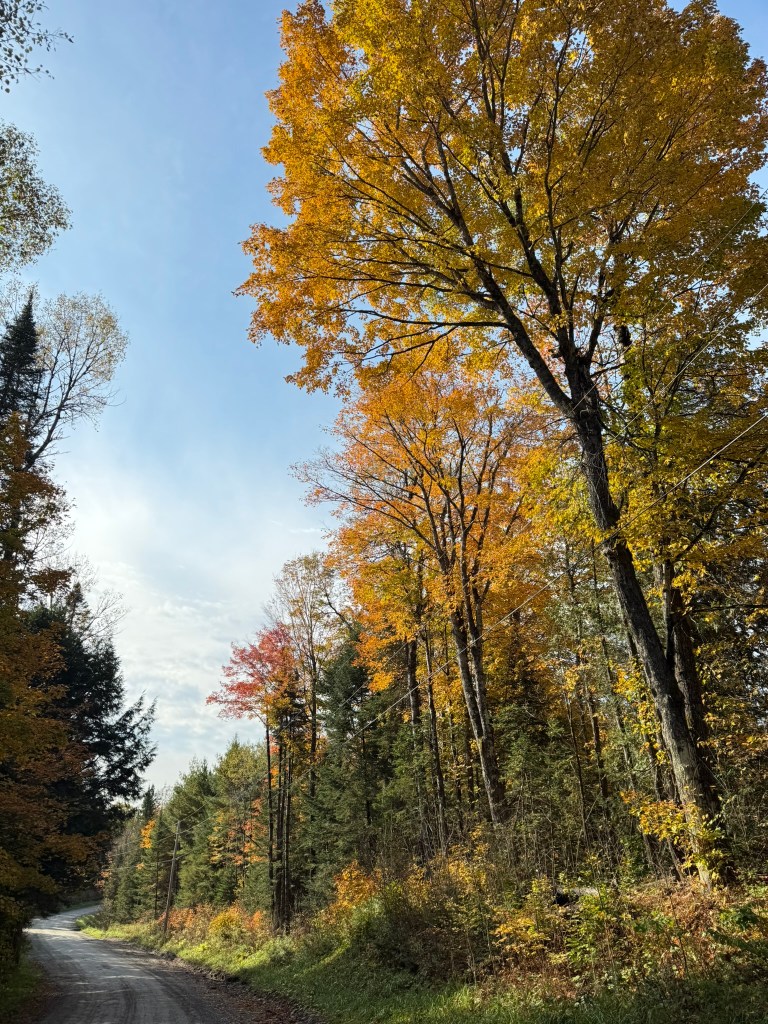
    Foliage on our property

    We’ve also enjoyed the peak in foliage. Again, a reminder that very little is permanent, and to appreciate all the good, beautiful things when we have them.

    Foliage walking up Little Egypt Road
    More foliage on our road heading up to the top of Pudding Hill

    On a quick side note, I’ve started some research into the history of autism/developmental disorders in the United States, out of interest and a desire to write about autistic families in the past. Let me say, I am so very grateful that we live in the time we do, with the family and social support we’re now able to get. Just thirty years ago, autistic children were much more likely to be written off, seen as less than and given fewer opportunities for inclusion and way fewer support systems. Few organizations like Hope for Three existed.

    Sadly, neurodiversity is a new term.

    One hundred years ago, autistic people, among others, were often institutionalized, thanks to attitudes of inequality and a widespread belief in Eugenics. They and their families, especially their mothers, faced terrible stigmas. For a time mid-20th century, it was even believed a mother’s coldness and lack of affection made her child autistic. I cannot imagine how that must have felt. To already struggle and feel helpless, with zero understanding or support, and then be blamed for it, stigmatized. If mothers of autistics back then were perceived as cold and unfeeling, I image that was both a necessary stoicism on their part and a response to the coldness they received from society. A vicious cycle.

    Again, I am grateful for our place in the here and now, and for a family that has only ever wanted to help, not blame.

    If you’re on the eastern side of the United States, I hope you were able to see a bit of the northern lights, too. And what, right now, are you grateful for?

    Talk to you next week. 🙂

    XOXO,

    Jenn
  • Welcome, Spooky Season

    Spooky season is officially underway! I’ve been enjoying all the fun, vibey posts on Insta and Bookstagram, all the festive podcast episodes coming out, and all the decorations popping up everywhere. Hubby hauled out our own Halloween decor from the attic over the weekend, and yesterday I put everything in its place.

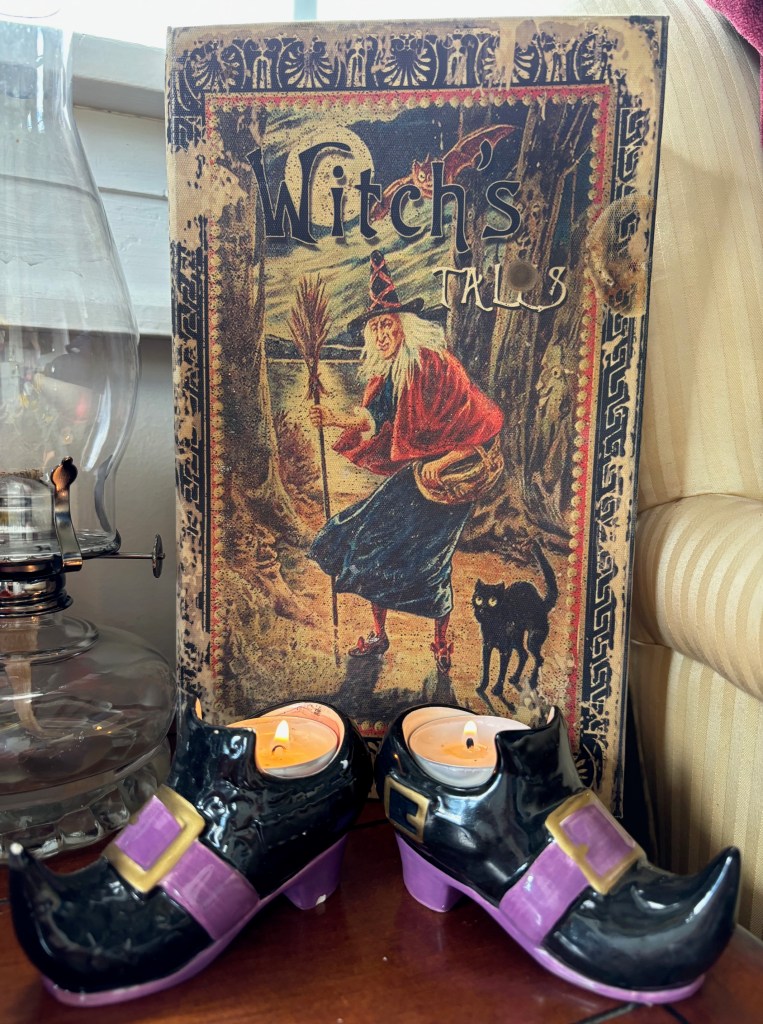
    Witchy living room

    No judgment against anyone who enjoys decorating early for Halloween, but I’ve always liked to wait until the first of the month to keep it special, and to avoid getting sick of everything before the Spooky Big Day.

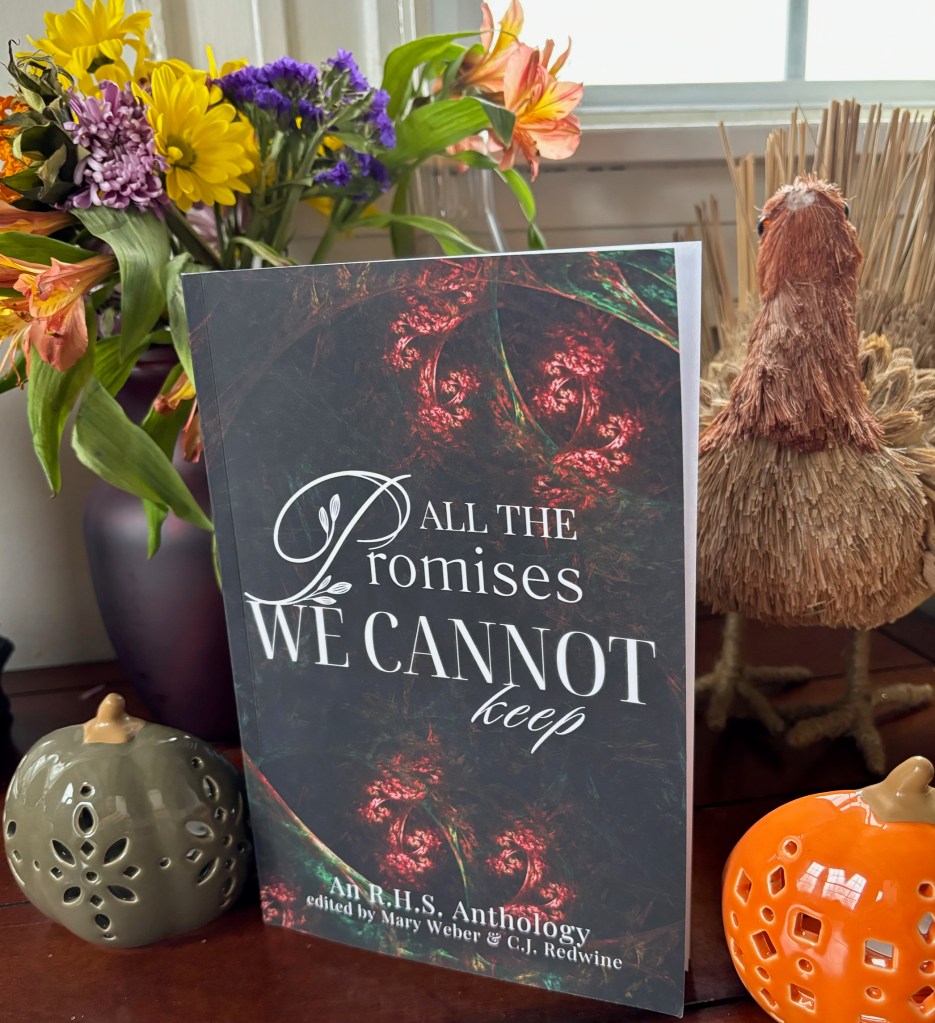
    In the spirit of the season, then, I thought I’d share some easy, fun stuff–all about my writing space, now decorated for Halloween, and all the things I love about the fiercely gorgeous fall anthology my work’s published in, The Veneficium Feminae, from Amaranth Publications.

    First, my writing space.

    My desk

    If Zoom webinars and social media are anything to go by, most writers have their own beautiful offices in which to work. I see large desks, sometimes with dual monitors, set before bookshelves aesthetically filled with their favorite hardcover books–many of them their own, if these writers are published. I love seeing these spaces. They look so cozy, private, and inspiring–beautifully conducive to word flow.

    But since we, the Shaws, live in a 1900 sq ft, two-hundred-year-old farmhouse, I have no such office. Instead, I write in our dining room, right at the table, and I am perfectly content with this.

    My dining room is actually my favorite room in this old house, and I think of it as very much my own. I selected and arranged everything in it, and many of the items are antique family pieces.

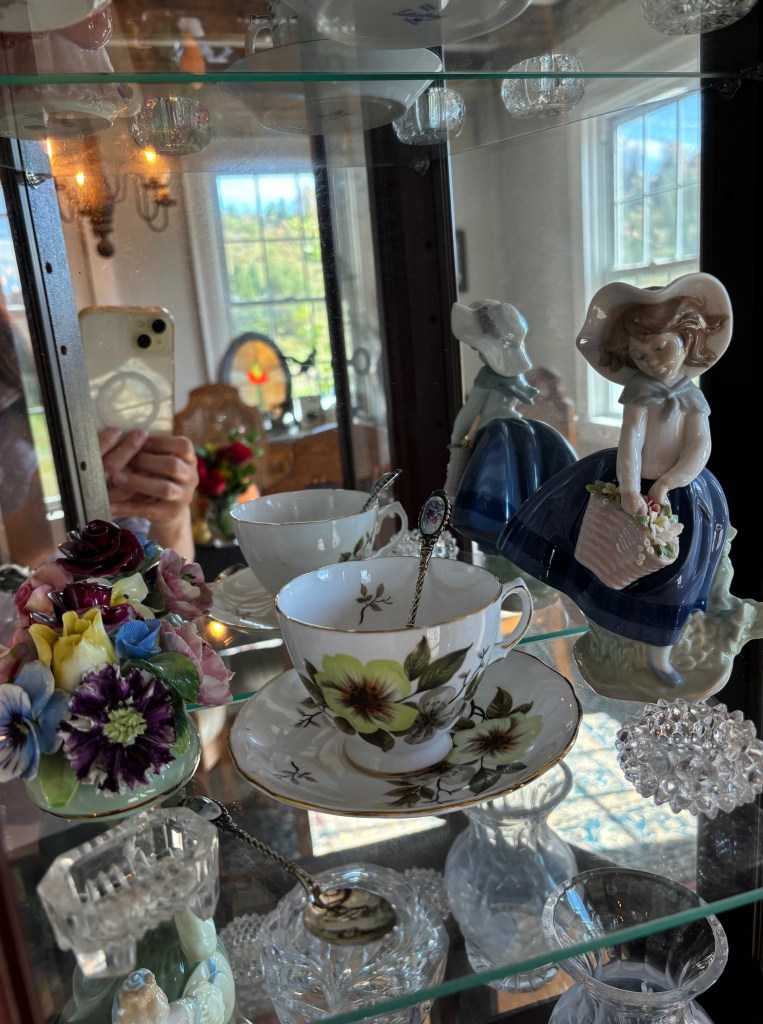
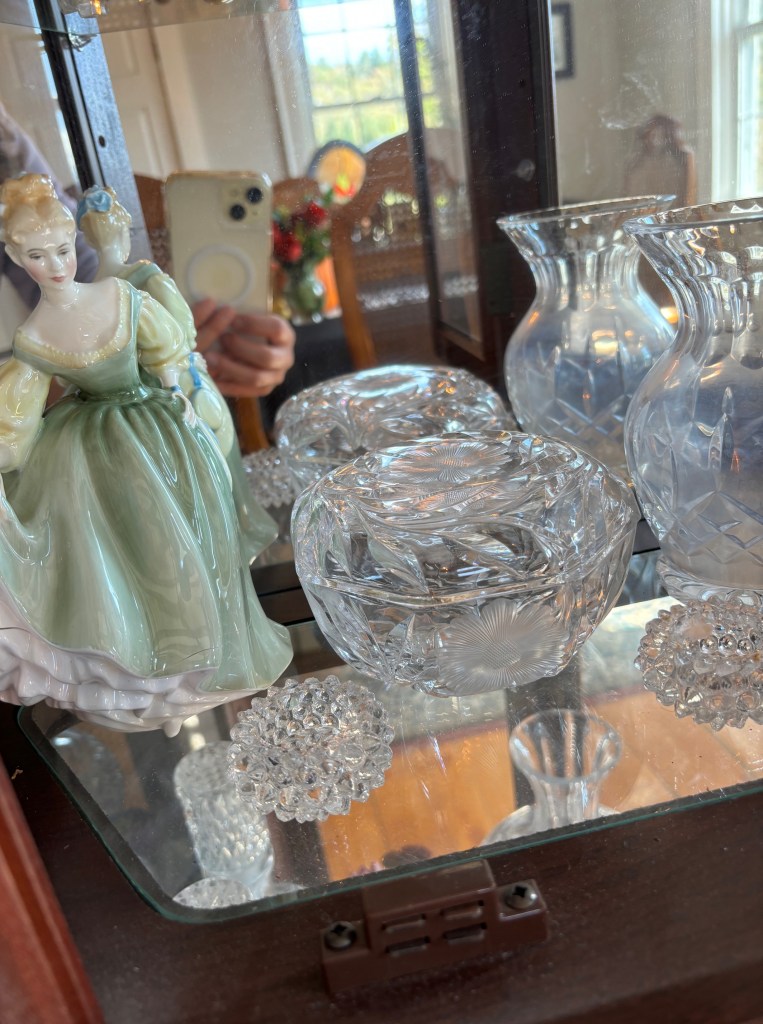
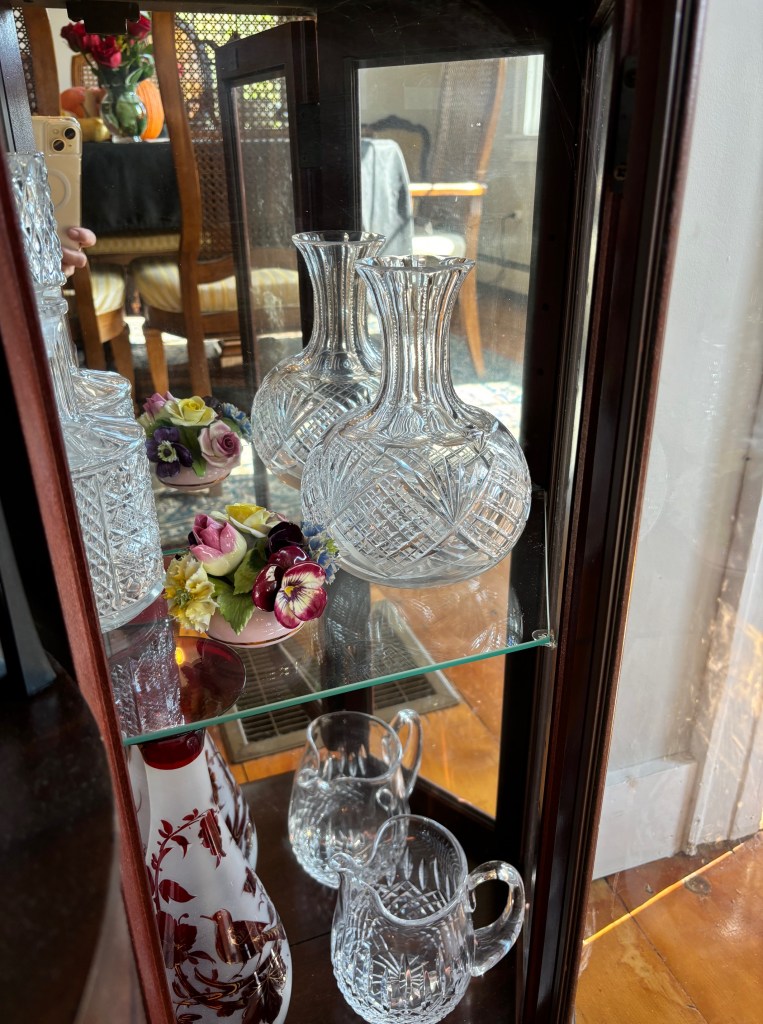
    Grandma’s tea cups
    Mimi’s crystal
    More pretty things
    Grandma’s silver tea service, which desperately needs a polish

    The story this room tells is of old, pretty things, and my vision of bucolic, historical New England, where I am now lucky enough to live.

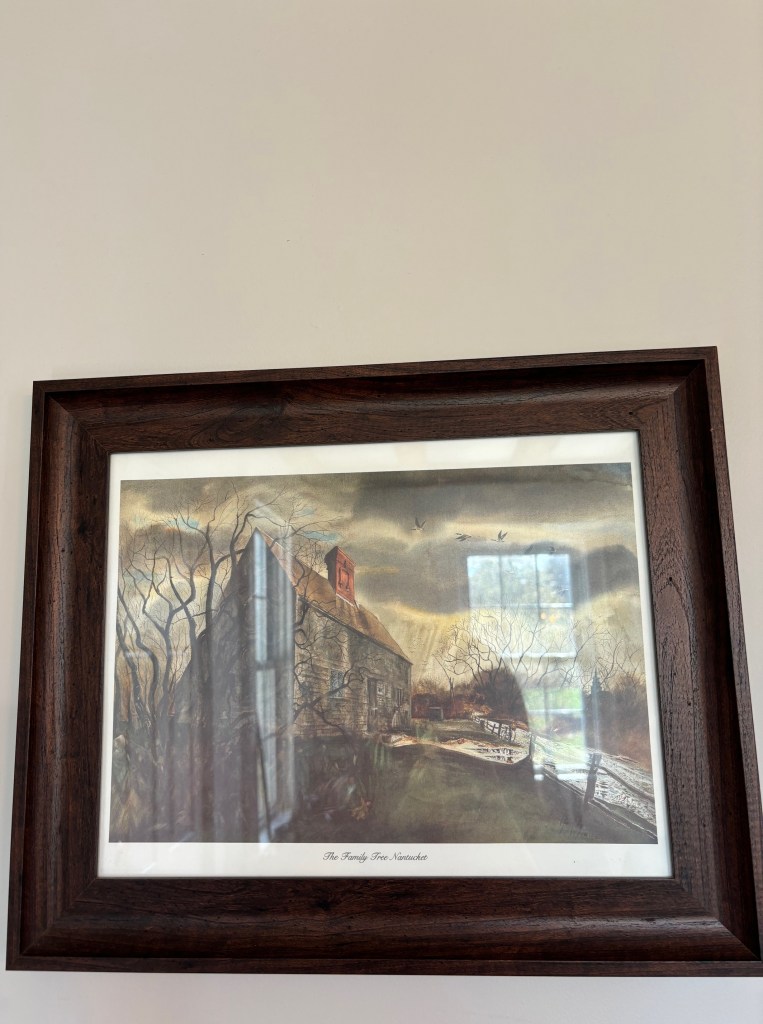
    Reprint of a painting by C. Robert Perrin (this was a housewarming gift from Jer’s Aunt Kim)
    Audubon reprint; my first impression of VT wildlife was amazement at all the turkeys
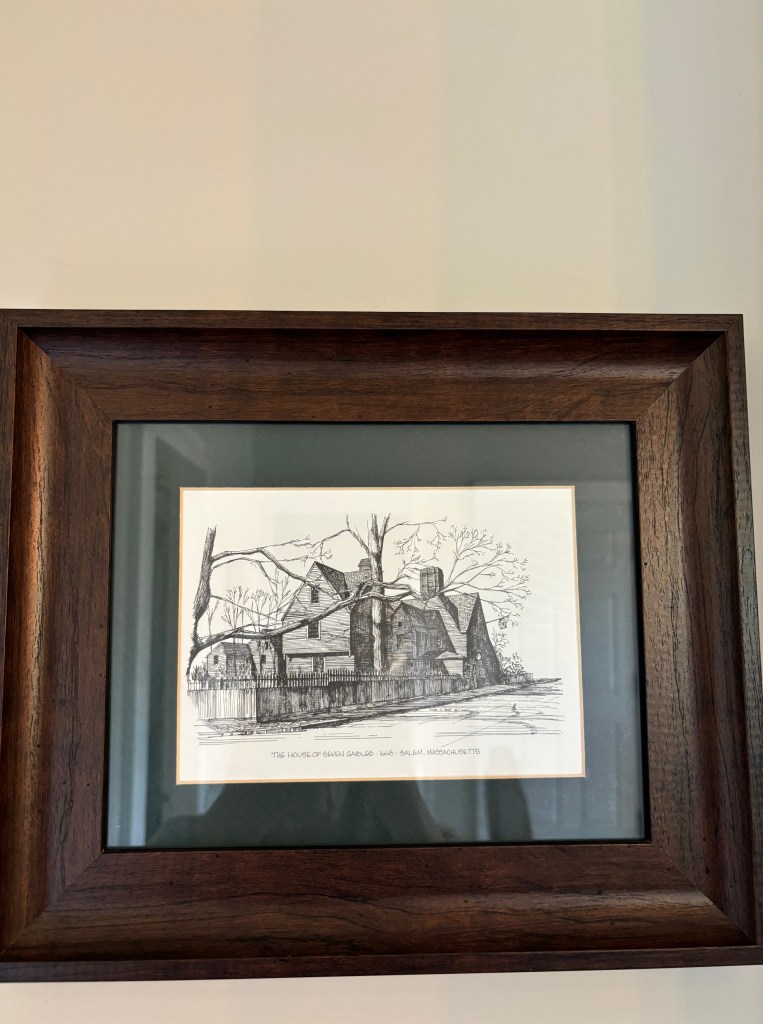
    I purchased this sketch in Salem, MA, on my honeymoon

    It might not seem private or quiet, but the space works well for me. I have a beautiful view of our acreage, looking out at the Frasier Firs growing all the way back to the tree line of a dense forest. On days when the weather’s nice, I open the window to let in the breeze, and I can hear the birds chirp.

    This spot also allows me to keep an eye on our free-ranging chickens, and I can tend to any deliveries or repair/maintenance people who show up during the day.

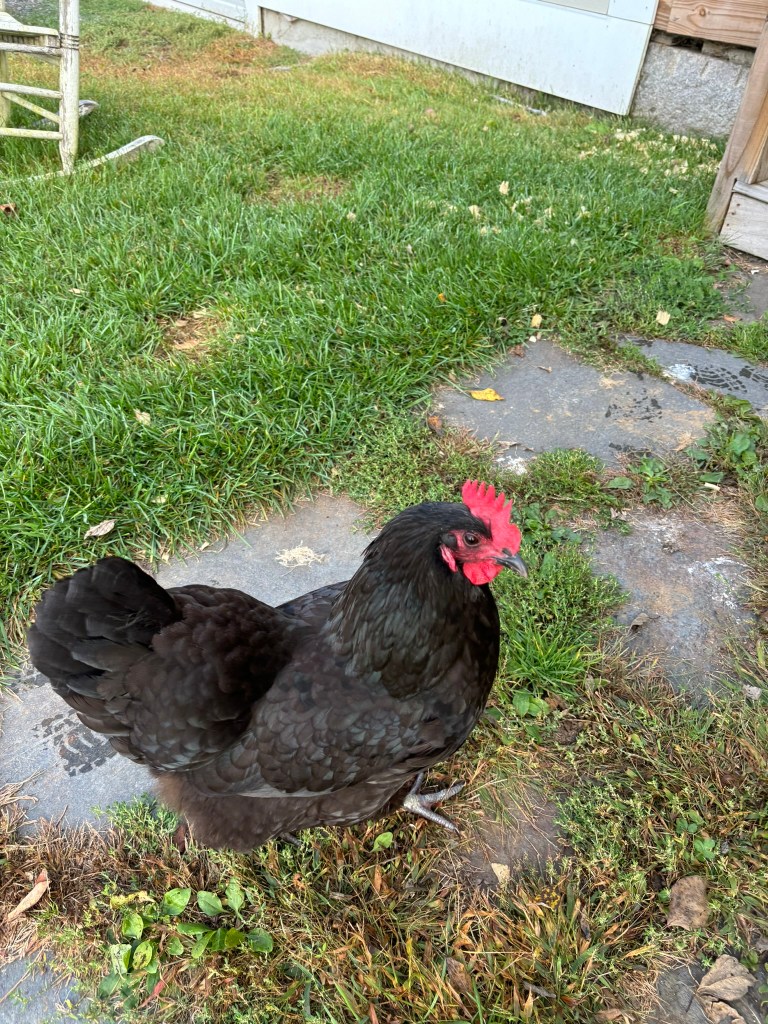
    Mildred just this morning, looking for treats like always

    I am also right by the bathroom and kitchen, so it’s quick and easy to take care of my needs, which helps sustain my concentration.

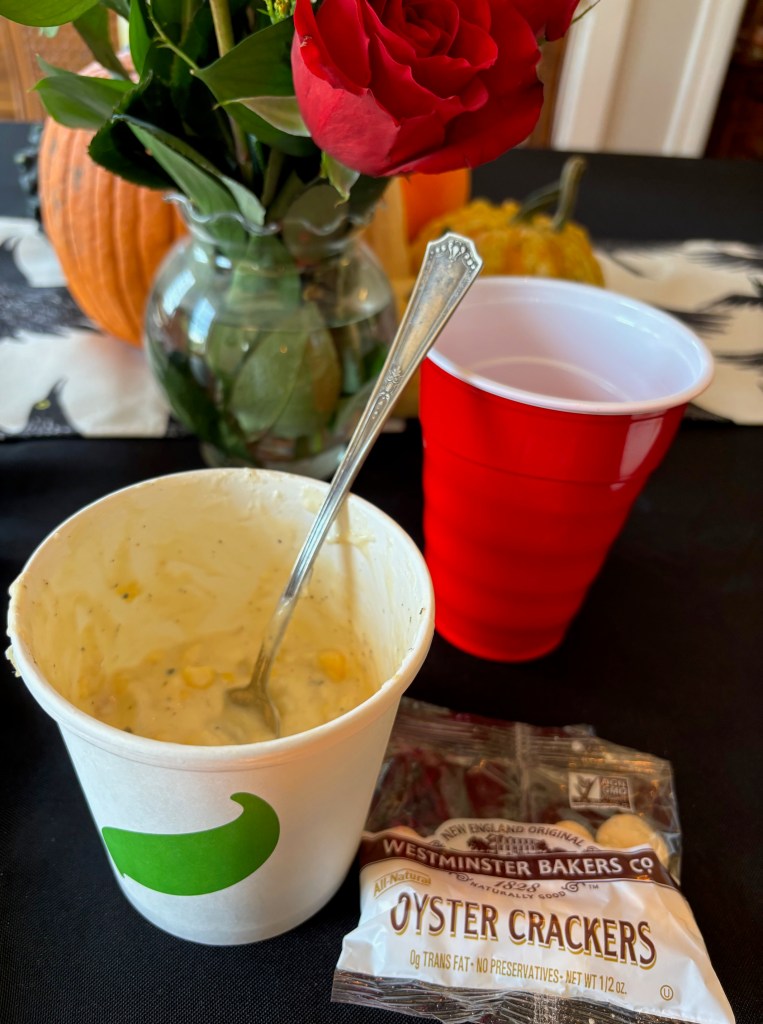
    Today’s lunch: chicken corn chowder w/ crackers from Price Chopper

    It’s easy to chat, too, with my husband as he passes in and out of the kitchen between his work meetings. In this way, we keep each other company without intruding on the other’s work.

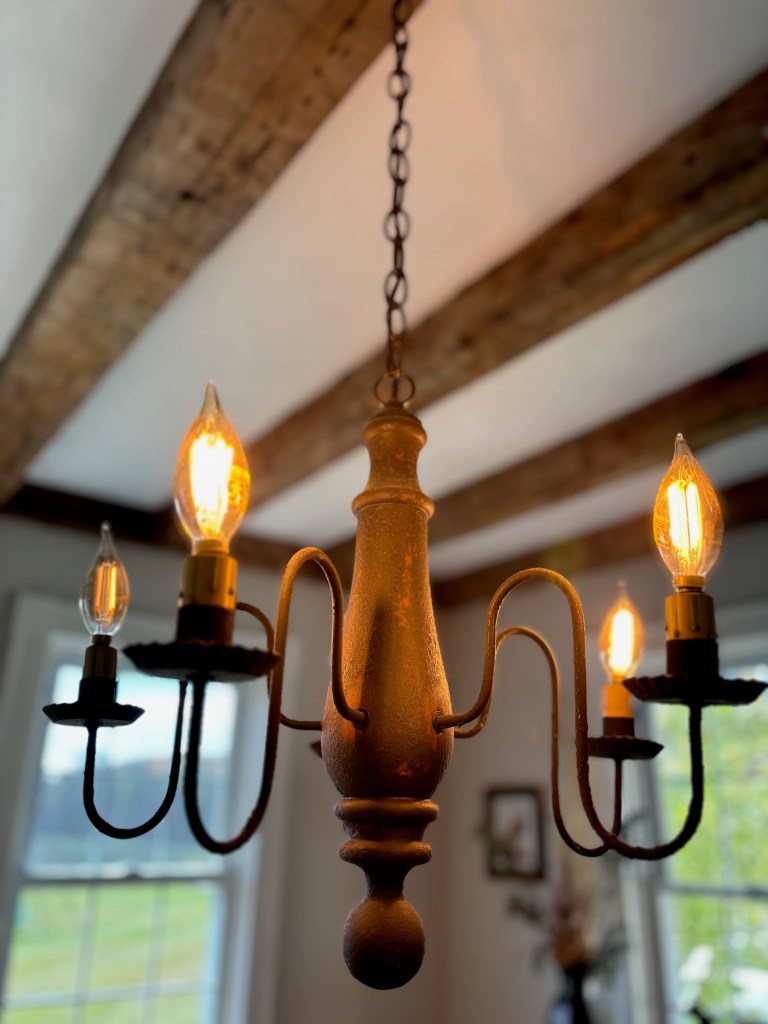
    And I can gaze up at the beautiful, old wooden beams running the length of the ceiling any time I need to channel the past.

    Old beams and a new chandelier meant to look old

    It’s a gorgeous, bright space, in short, and I’ve never found anything about it distracting, despite Joyce Carol Oates’s argument that one needs a room with no good view to keep one’s attention on their work.

    And when Daph’s at school, the house is plenty quiet.

    The only drawback I can think of is that I have to get out my things–laptop, pencil pouch, and paper files–any time I go to work, and then I usually have to put them all away again. It’s no major inconvenience, though, and it allowed me to rationalize buying a new pencil pouch from Amaranth’s online boutique, The Stack, so I won’t keep misplacing my pens and pencils.

    I am extraordinarily lucky to call this space my own.

    Now, allow me to gush a bit about the cozy-creepy stories that fill the pages of The Veneficium Feminae.

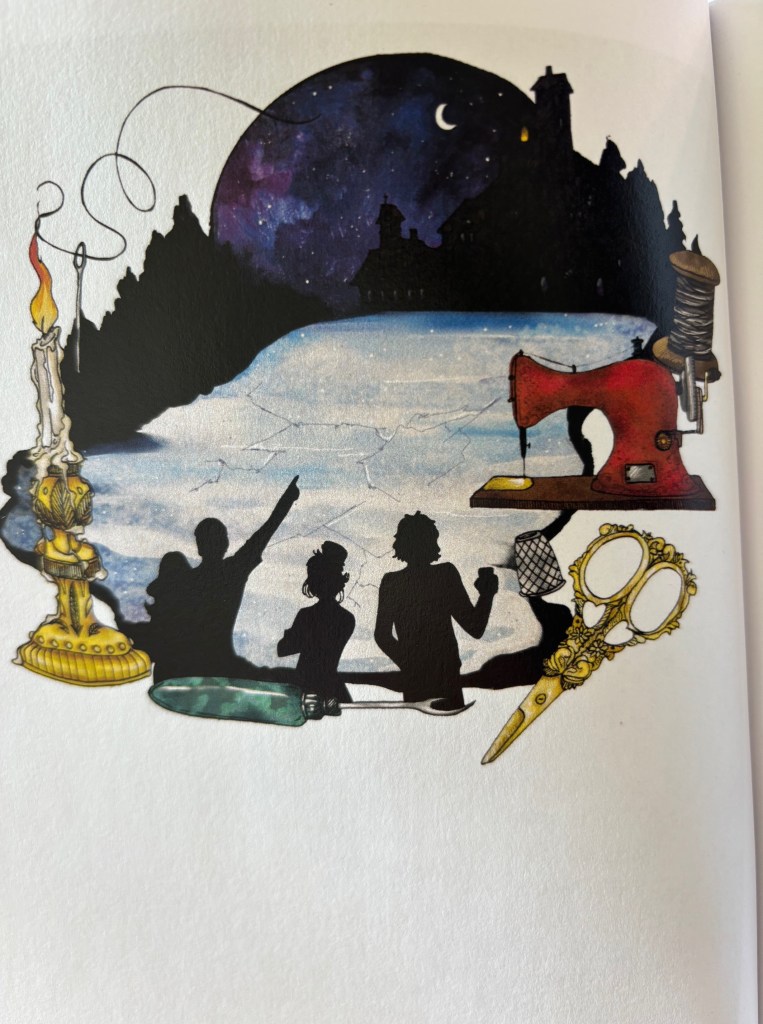
    “Candlelight” by LeeAnn Weaver

    Art by Sybil Wainwright

    “Old Lady Cornish at her sewing machine/Needs a huge needle to stitch every seam./It’s a cold, cold night and her cover’s too thin,/So she makes another blanket with your SKIN, SKIN, SKIN!”

    It’s a playful spooky legend, but is any of it true?
    On a chilly night out, four carefree friends are curious to find out. Do any of them have what it takes to confront whatever’s in that old cabin?

    Chilling imagery and a tragic backstory pull readers into this brief but haunting, melancholic tale, the piece that perfectly opens Veneficium.

    And that rhyme burrowed right into my brain!

    “Into the Mist” by June Baker

    Art by Sybil Wainwright

    A story about wicked Mother Nature.

    Kat is optimistic on her first kayaking trip in Alligator Creek Swamp State Park. She’s just moved in with her boyfriend and feels like her adult life has begun. But tucked into the natural beauty of the lake are subtle signs that all might not be well… that dark things slither just beneath the surface, threatening to upend all her hopes and plans.

    Can Kat stay the course?

    The specific details of the setting and the loneliness and fear that Baker skillfully develops in both Kat’s internal and external worlds make this story a truly immersive, slow-burn horror. Toward the end my stomach was sick with tension!

    “The Cult of Bram Stoker” by Emily Holman

    More of Sybil’s work

    Mina and Lucy are best friends… or is that all? Can they be more? It seems circumstances and timing only work against these two, culminating in a tragedy that nearly destroys poor Mina. Believing she will never see her friend again, she is visited late one night by a surprise visitor.

    And even though something’s not quite right, might she and Lucy have a second chance–this time for all eternity?

    I love this eerie and bittersweet retelling of Dracula, with Mina and Lucy as the main characters.

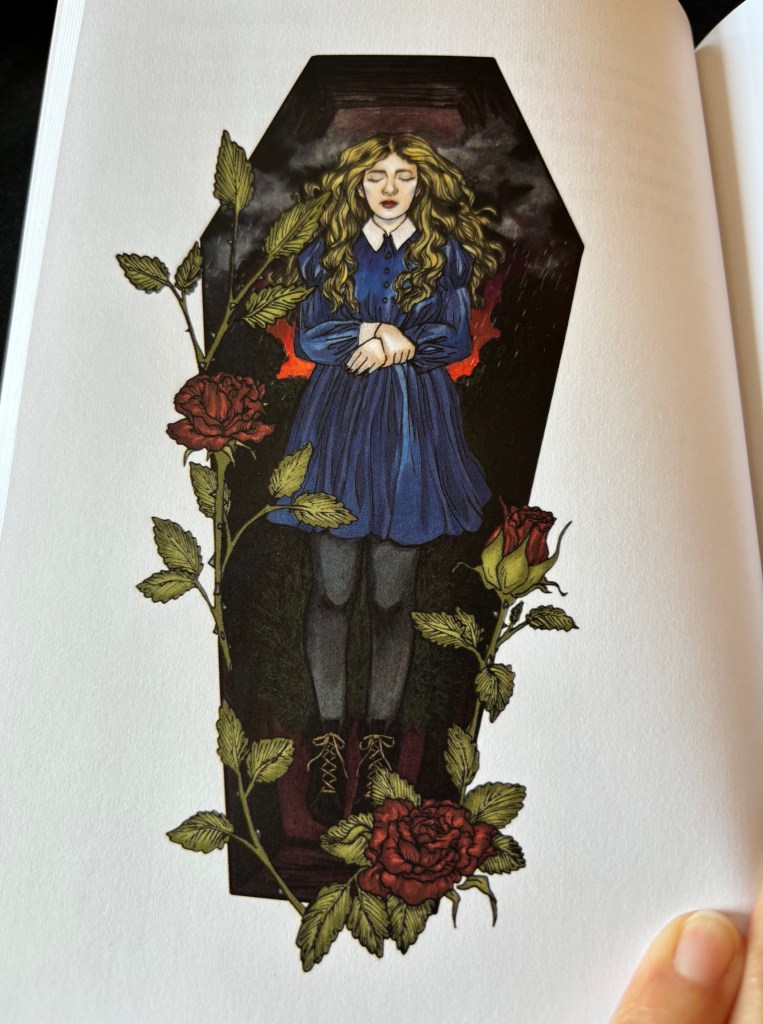
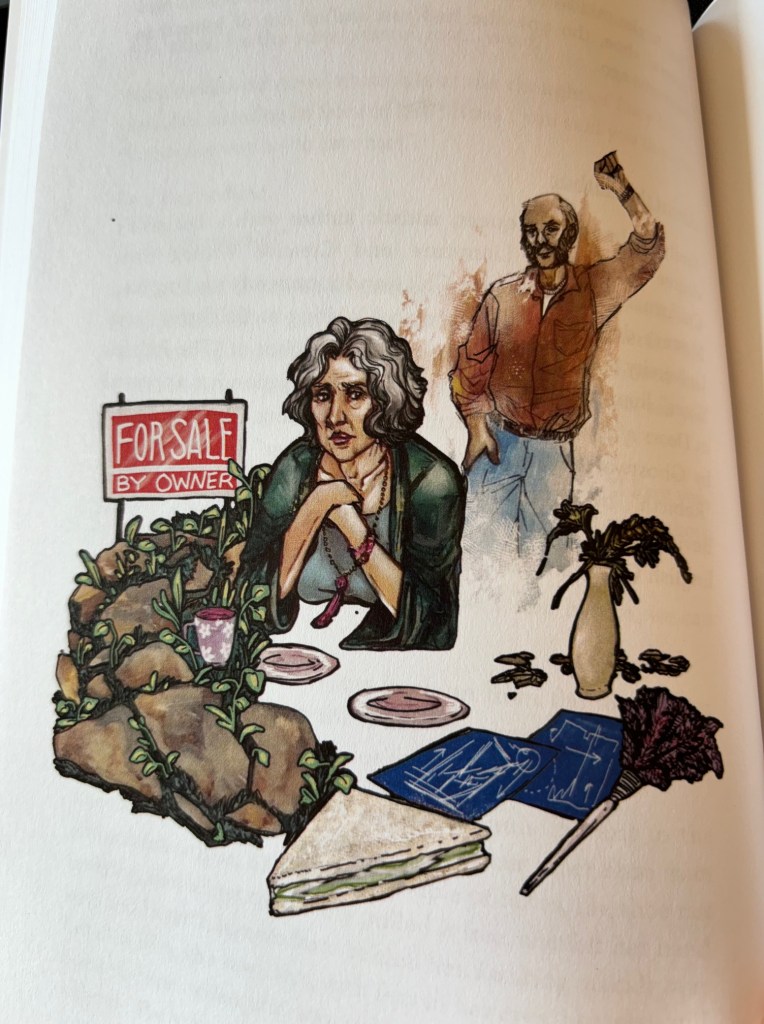
    “Unremembered” by Abel Ruiz

    And more

    Claret has lost her husband of many years, that loving and pragmatic man who brought order to the creative chaos of her life, and her grief manifests in unsettling ways. It seems that her house and garden will not cooperate with her determined efforts to move on–why do the weeds keep growing through the cracks in the flagstones? Why is that spiderweb still there, after she brushed it away? Why does she keep making her dead husband a sandwich for lunch? And why is he there, leaning against the doorframe?

    The lyrical details in this piece do a fabulous job suggesting how poor Claret’s mind unravels. Or does it? Is something else at work?

    I found this a poignant story of loss and psychological unease.

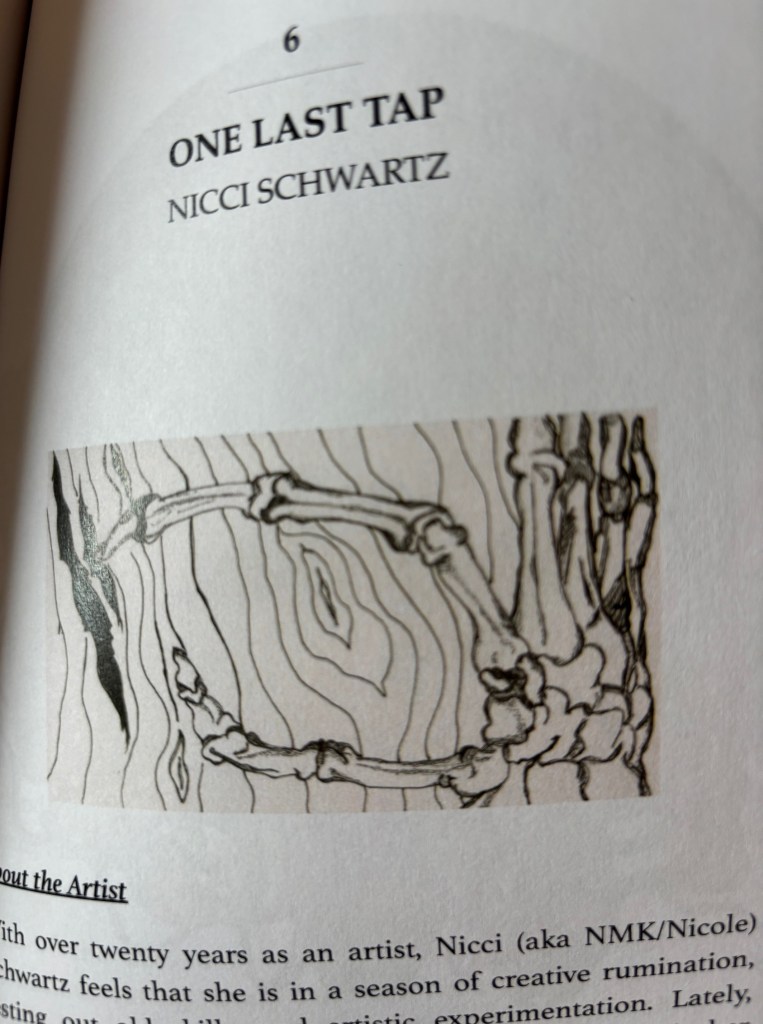
    “One Last Tap” by Nicci Schwartz

    Artist: Nicci Schwartz

    I love this artwork, too. It suits the themes of the stories well. To me, it suggests the dead trying to pull just a little more from the living.

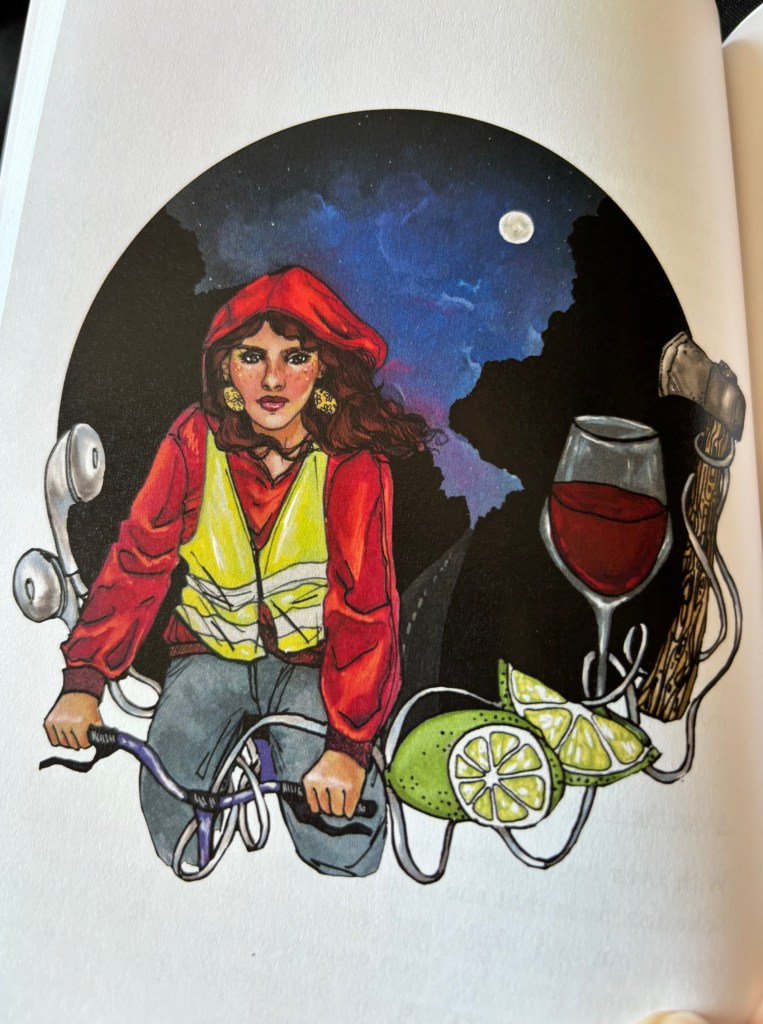
    “The Hunt” by Tera Schreiber

    And more

    Becca is a young college student haunted by loss yet trying her best to move on with her life. All she wants to do is earn enough money tending bar to pay her rent, bills, and tuition while she studies to be an ER nurse. But one night, one of her professors, a beloved member of the faculty, enters her workplace and begins to chat with her–flirt, even, in ways Becca’s not entirely comfortable with. Slowly, she senses what a predator he truly is, and he has chosen her as his next prey.

    Can she get away in time from this big bad wolf? Or will she freeze in the face of tragedy once more?

    I adore this eerie, suspenseful retelling of Little Red Riding Hood, with its strong narrative voice. And while the ending does not disappoint, I found this story tragic for several reasons, making it linger in my mind long after the last page. Amazing work!

    “Bone White, Blood Red” by Sybil Wainwright

    And more, all gorgeous

    This is the perfect piece to end Veneficium. It’s a short horror-fantasy with an epic feel. Princess Artemine is the heiress to her father’s kingdom, but her wicked step-mother wants the reign for herself and plots to have her step-daughter murdered. Thus, Artemine flees just weeks before her 21st birthday into a haunted forest, willing to die from exposure in the elements, her body undiscovered, as a way to compromise her step-mother’s legitimacy on the throne, rather than allow herself to be murdered by the Queen Consort’s henchmen.

    A strange, bone-white knight discovers her hiding, however, and takes her to an arboreal palace deep in the forest, hidden from the sun. There, Artemine is made an offer, and she faces a difficult choice. What kind of life is she now willing to live? What will each option bring her, and what will it cost?

    This tale is a rich re-imagining of Snow White. I enjoyed the romantic element and found it morbidly uplifting. The author has created an amazing world in which I’d love to see her continue Artemine’s story.

    I hope I’ve tempted you to check out this amazing anthology, a perfect read just in time for Halloween. The digital version is available from The Stack, and print versions can now be found on Amazon.

    Happy reading, and happy haunting!

    If you’re a fan of spooky season, what’s your favorite thing about it?

    Talk to you next week!

    XOXO,

    Jenn
  • Happy Fall, Y’all

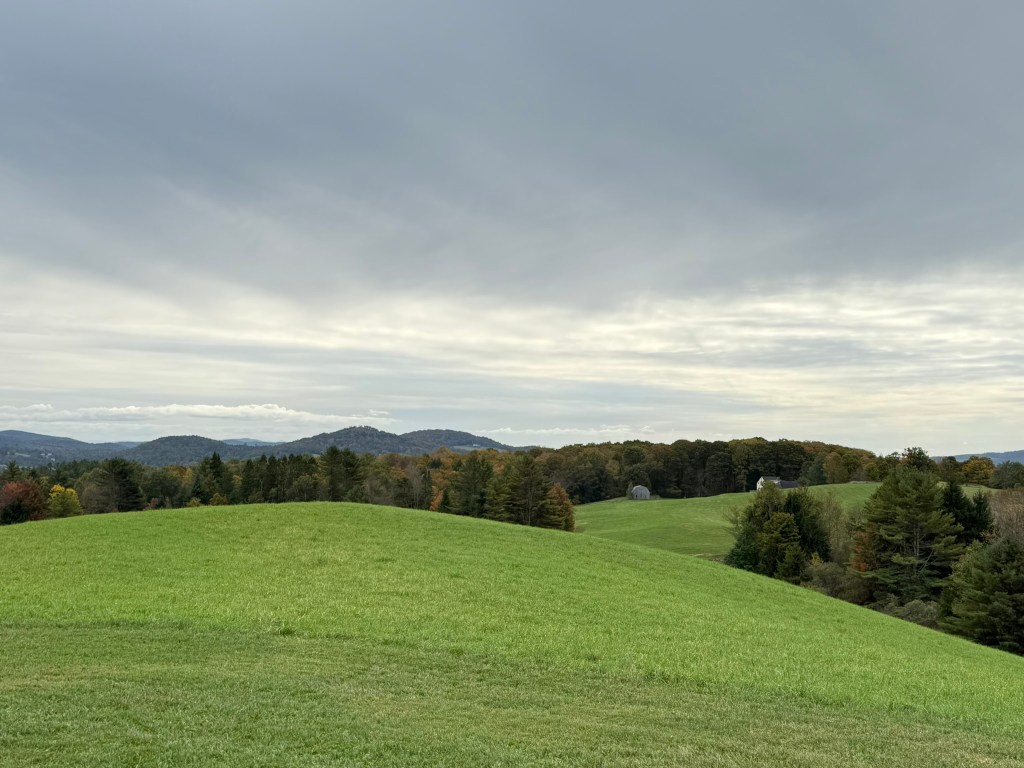
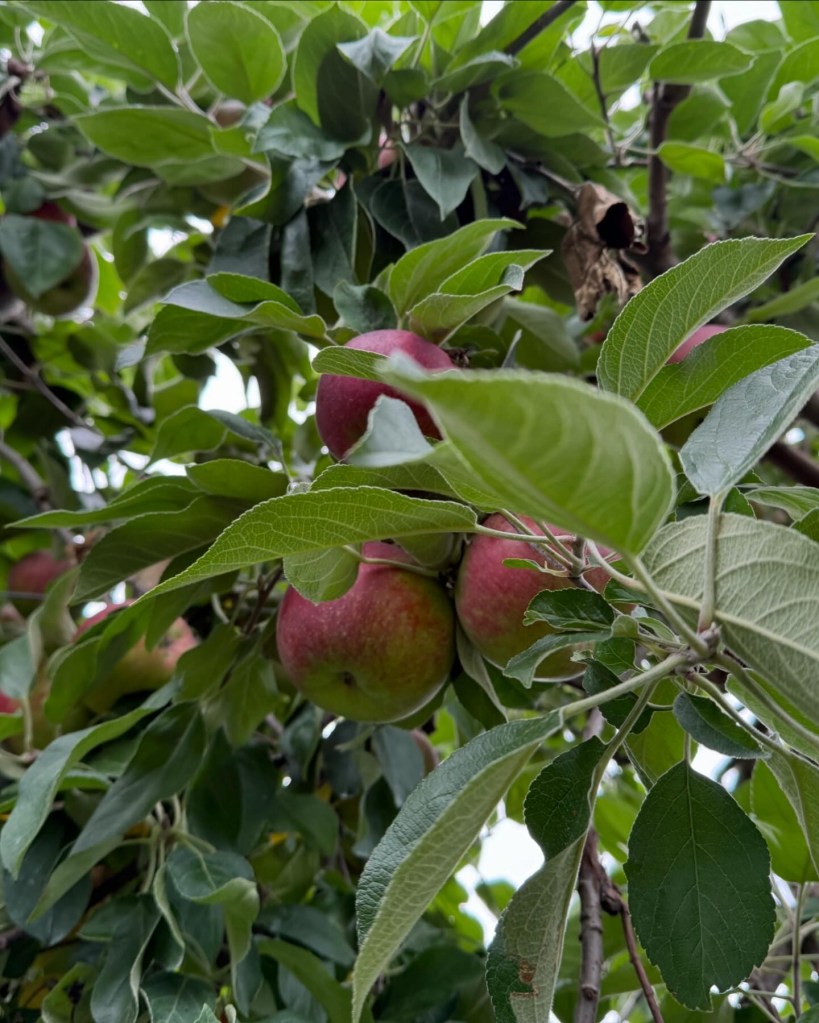
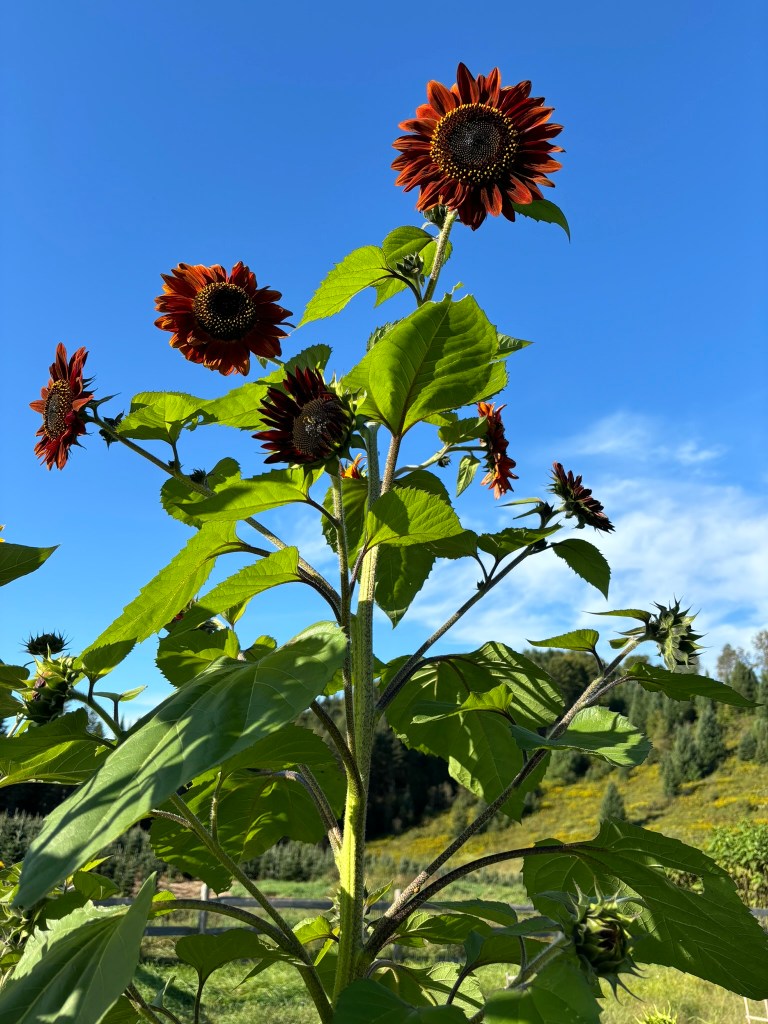
    Sunday was the autumnal equinox and of course, my Instagram feed was filled with images and quotes about the meaning and beauty of fall. That prompted me to share my own photographs of what the changing season looks like here in the NEK of Vermont.

    The leaves are just beginning to turn

    Growing up, I loved the fall season because it felt like the gateway into the best time of the year, that period filled with all my favorite holidays: Halloween (that blast of spooky-fun make-believe), Thanksgiving (the Yuletide teaser with its feast and family gatherings), and that greatest of all holidays, the toy fest that was Christmas.

    Fall meant all of that was on its way.

    The apples are ripe for the picking

    Now that I’m older, I can appreciate autumn’s symbolism. It’s the beginning of a period of rest, a time to enjoy the harvest of our labor while also considering what old things to shed and what still remains to be done– all in preparation for an eventual renewal.

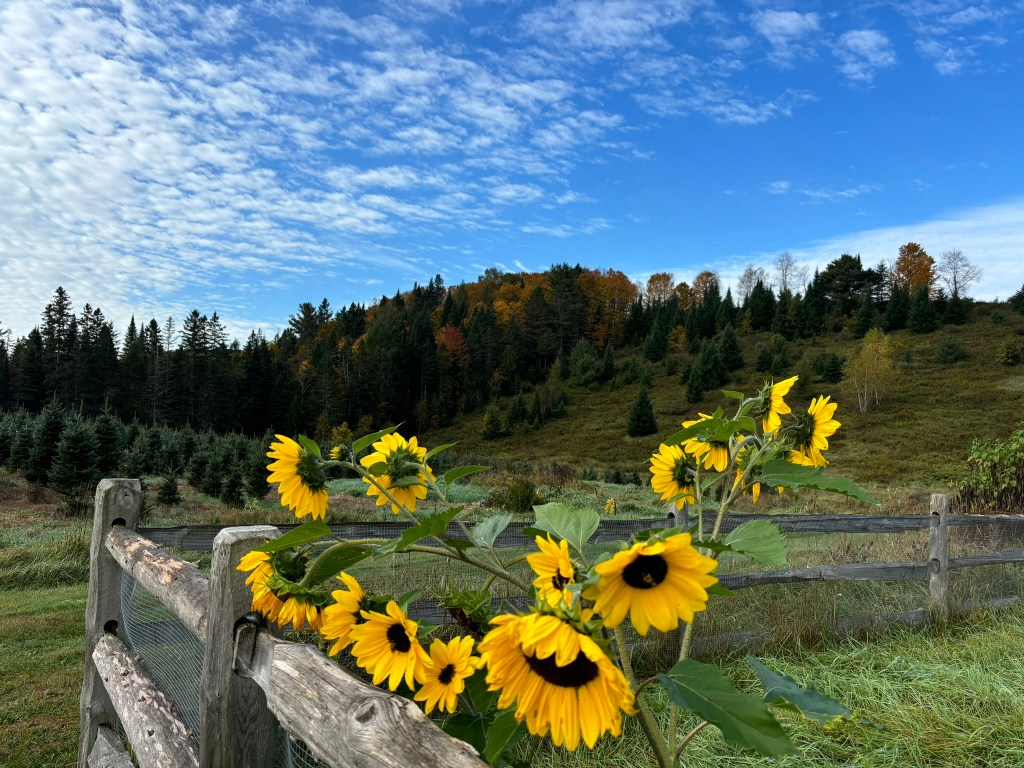
    The sunflowers are thriving
    Some of the trees are even beginning to shed their leaves

    Such ideas appeal to my writer’s sensibility, and this official change in season inspired me to revisit my writing goals for 2024.

    I drafted six goals in January:

    1. Finish the zero draft of my first novel, A Home on Yarrow Hill
    2. Revise the horror novella I wrote last October, Saltbox (a title ruined by the release of that ridiculous movie Saltburn)
    3. Continue writing short stories and submit a minimum of three for publication
    4. Slowly develop my current Instagram account to include writing content
    5. Get better at making reels for IG
    6. Launch my author blog

    With just over three months left in the year, I’m pleased with my progress. It’s really rather good.

    I’ve killed #3. In fact, I’ve submitted eight (not three) short pieces altogether, with five accepted and either already published or forthcoming. Check.

    #6 is done; I’m typing my latest post for it right now. Check.

    #4 is underway, with more writing-related content posted more frequently in the last couple months. I’m happy to report, too, that no weird, awful backlash has occurred because of it (which I’d irrationally feared), so I’m pushing past the discomfort this initially caused. I’m proud of that.

    Taking baby steps on social media to promote my work

    #5 I haven’t given much effort to, but that doesn’t concern me. It feels like the least important one anyway. Plus, I don’t really have anything to market via reels just yet.

    That leaves #s 1 and 2. Which weren’t up there at the top for nothing. But, they’re proving the toughest.

    They’re also the most important, particularly right now.

    Setting for my novel, A HOME ON YARROW HILL

    Writing the short stuff has been good for multiple reasons. It’s allowed me to improve my craft while finishing projects with relative ease. The completion is what’s so important to the learning, as Neil Gaiman says. The short pieces have also given me a few publication credits and a certain entry-level legitimacy and validation. It’s also given me invaluable experience working with, and learning from, six different editors, all while getting a look inside the professional publication process.

    An acceptance email. I’m lucky to have found publishers willing to take revisions

    But if I’m honest with myself, I must recognize now that the next phase of learning needs to happen in the context of my longer work. If my ultimate goal is to one day publish a well-crafted, engaging, and hopefully well-received book, then I need to focus on the longer pieces.

    In particular, I need to finish the zero draft of my novel.

    Ugh.

    I say that not because I don’t like it. I do. At least, I like parts of it. I still think about it on a regular basis.

    Not because I haven’t made progress. I have. I’m about 100k into the draft.

    Not because I want to give up. I don’t.

    It’s just… hard.

    I am just past the novel’s “murky middle,” I think. And I realized, long ago, that in my voraciousness I bit off way more than I, a newbie writer, can adequately chew.

    My novel is a found-family work of historical romantic fiction. It features FOUR characters, with FOUR alternating points of view. One character is a Great War veteran suffering from alcoholism and PTSD. Another character is a victim of sexual assault who is trying to make a new life for herself. Another is seeking justice for her father’s murder in the context of his newly-discovered bootlegging. And another, the most principal character, is severely dyslexic and a witness to years of her dead mother’s physical abuse at the hands of her drunken father. She will be the key to everyone’s resolutions, ultimately.

    Principal character, Amelia

    All four characters live under the same roof, helping to care for a nonspeaking, disabled relative (who we would recognize today as an autistic adult).

    If it sounds like a lot, that’s because it is. If it sounds melodramatic and potentially cringy, that’s because it probably is.

    Holy hell, what an ocean of narrative to wade into (and I won’t even go into all the research these topics require).

    I’m in well over my head now, and the floor is thousands of feet beneath me. I am staying afloat, but barely; the effort is exhausting. And that exhaustion, plus the knowledge that the draft is so stinking awful in so many ways, has kept me from working steadily on it.

    (I’ve preferred the faster, easier routes to growth and satisfaction provided by the completion of the short pieces.)

    Thankfully, I can sum up the premise of my novel rather easily: Four damaged young people, living together in rural 1920s Vermont, learn to love, protect, and heal one another.

    Ben, home from the Great War, helping Amelia improve her reading

    According to the experts, your ability to sum up your long work in a single sentence is a good sign.

    Ben’s sister Belinda, who teaches in the hilltop schoolhouse

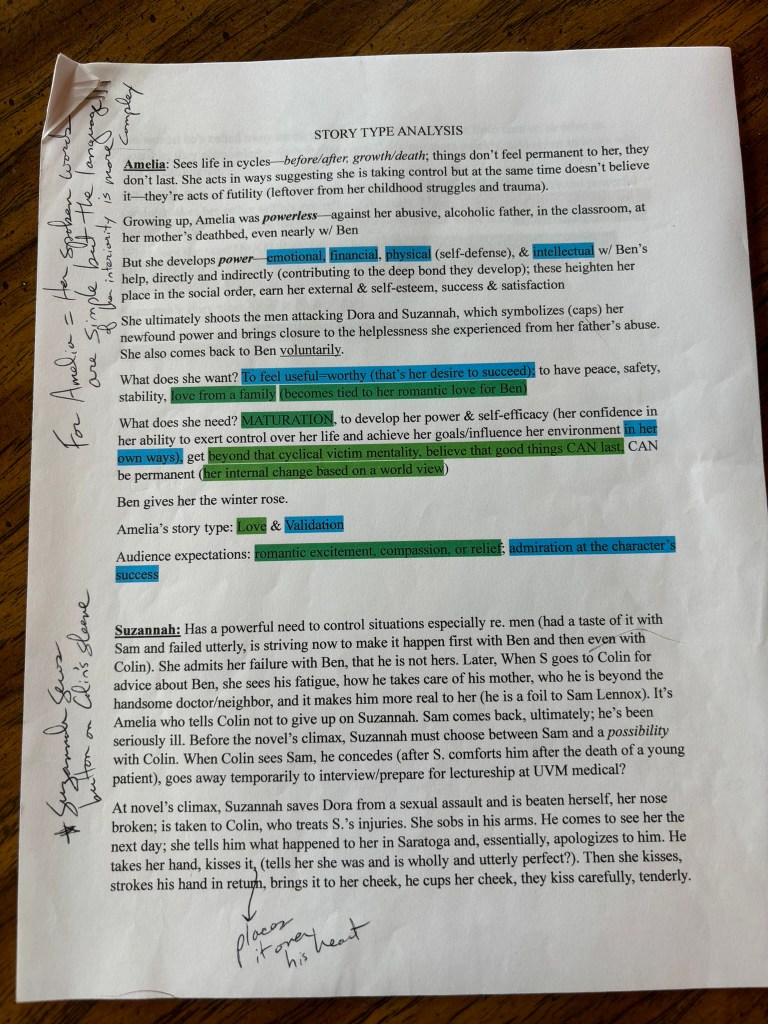
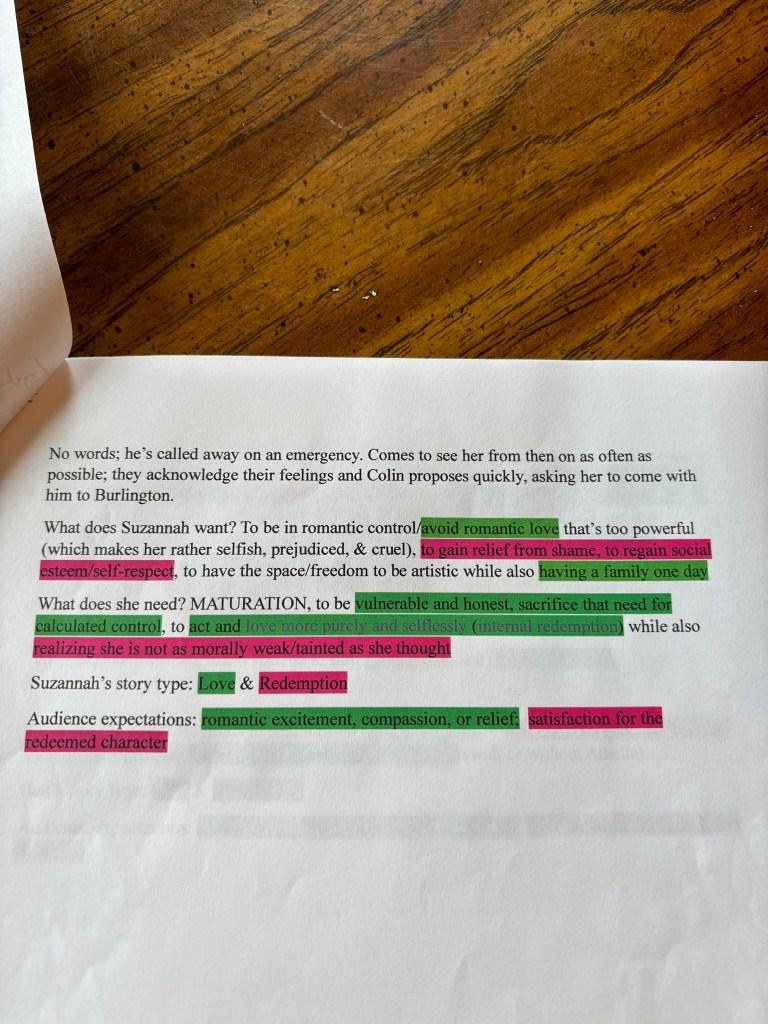
    I can also describe the kind of story it is: a found family story of love, validation, and redemption. And I have character arc notes for each main character, so there is a clear, unifying thread (I’m not so hopelessly clueless that I’m utterly drowning).

    Character and story type notes. There are two additional pages

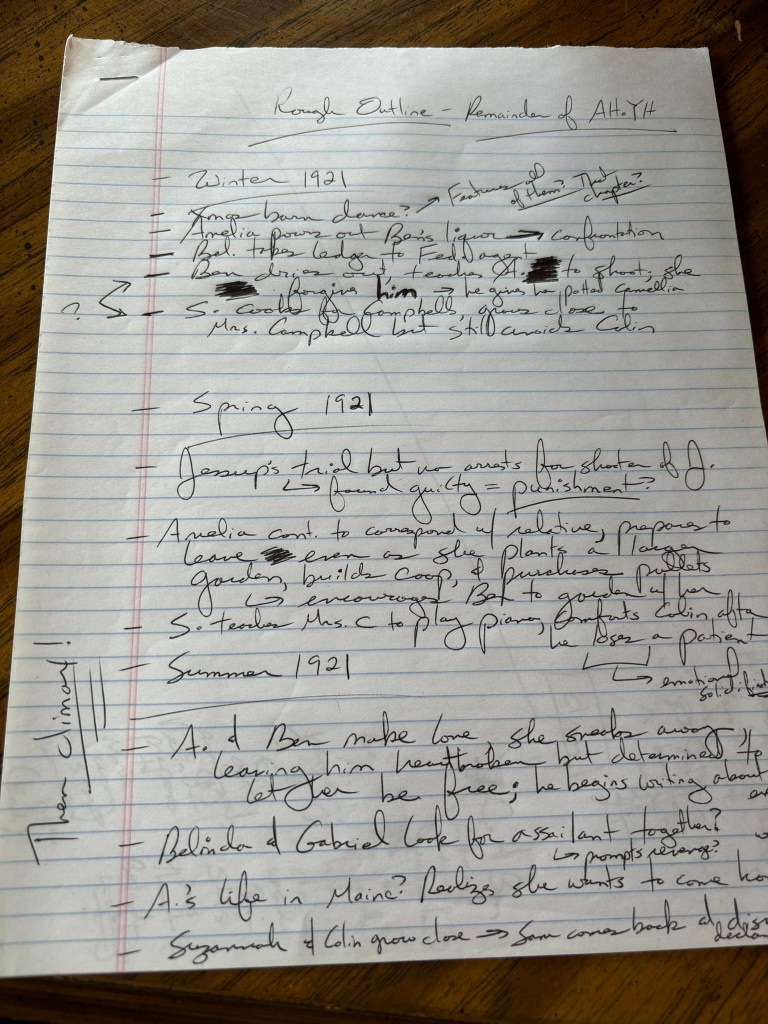
    I also have a completed, albeit rough, outline, so I know what will happen and how it will end (though I’m always open to new developments).

    Outline for remainder of draft, sloppy in multiple ways

    It is Just. So. Much.

    Way, way more than I can do well at this point in my experience. And way, way more than is probably marketable. From what I’ve heard, multiple POVs are tough to do well and can frustrate readers. Also, publishers (and probably readers) aren’t attracted to long works by new authors. I also suspect my piece doesn’t quite tick all the boxes of my genre; I need to improve my understanding and application of the conventions of my preferred genres, based on feedback from two reliable sources who are both authors and editors.

    Suzannah (Ben and Belinda’s cousin) with Dr. Campbell. Here is the romance subplot at work: that cycle of attraction and resistance

    So, I’ve been avoiding my novel.

    But that’s not how I’m going to learn from it.

    I feel like it’s best if I push through and finish a god-awful rough draft by the end of December. After that, I might never go back to it. But, I’ll have a much better idea of the scope for an effective novel (something much more focused and specific than what I’ve tried to do with this one). I feel like that understanding, that better orientation, will prove invaluable. That will be the payoff, the true learning. That will lead to a second, better manuscript.

    Author Jodi Meadows (from her own IG, @unicornwarlord), who has been vocal in talks and on social media about the value of practice. Her first published novel was her 17th manuscript! She encourages new writers to learn rather than rush to publication.

    When I started this novel, the longest piece I’d written was 30k (Saltbox). I just didn’t know what the scope of a true novel looked like in the planning, and I started this work for NaNoWriMo last year with the sole intention of getting to or exceeding 50k. I did that but, oh God, the end was nowhere in sight. (I think I underestimated my ability to develop a single MC’s story in 50k words, and that’s why I chose the multiple POVs, which was way too much.)

    I did want to keep going, so I did.

    Now, I just need to NOT give up. I want to see this behemoth through.

    Wish me luck!

    Do you have any advice? I’m trying to remind myself that it’s ok for this zero draft to be awful. It’s supposed to be; it’s the completion that counts, right now. In fact, as Savannah Gilbo, a popular book coach, suggests, I shouldn’t do any revising at all while trying to produce an initial draft. Pausing to revise only slows one down, and effective revision can only happen once the piece is done and the writer can see the big picture clearly.

    Is there anything else I should remember that might keep me going? Don’t hesitate to let me know!

    XOXO,

    Jenn

  • Managing Those Big Emotions

    Hi. Let me start by assuring all friends and family, we’re fine. Our situation is not dire, and our family unit remains strong.

    However, in the spirit of honesty and transparency, I do want to share a little more about our recent struggles with our autistic daughter’s behavior. I believe such honesty is important because it sheds light on what some of us are challenged with, and that increases autism understanding and acceptance. It might also help another family feel less alone, or it might be an opportunity for a reader on their own autism journey to share some wisdom with me. I always welcome that.

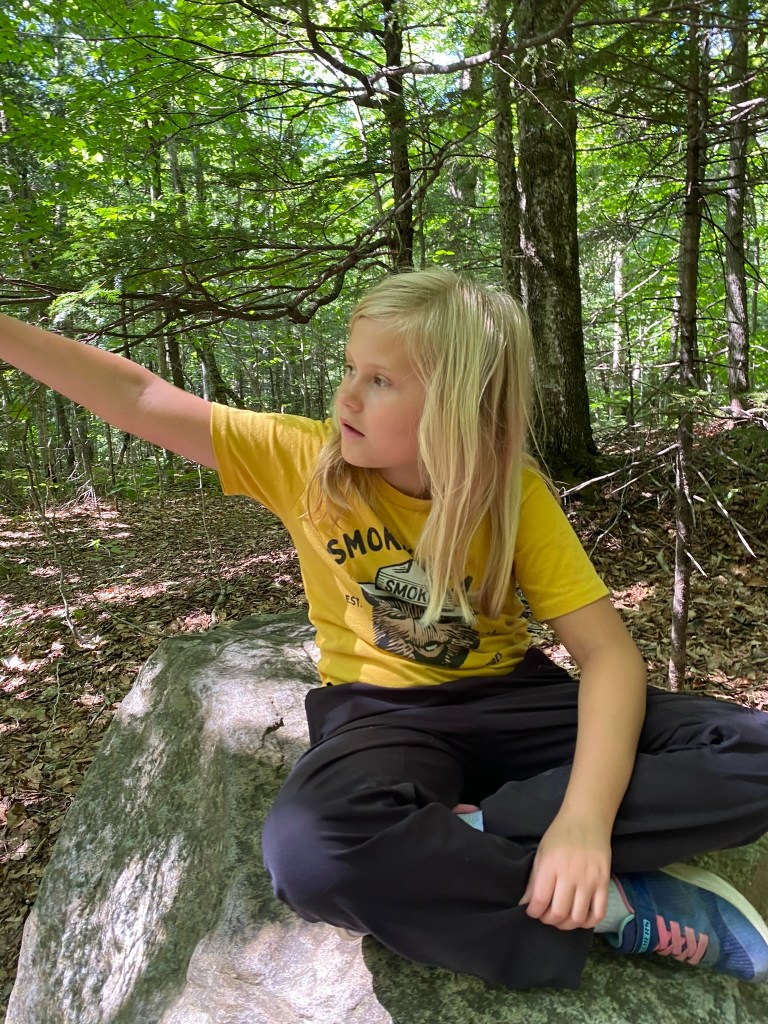
    Miss Daphne

    So, here we go. Again, I don’t mean to alarm anyone. I just want to be truthful and authentic.

    When Daphne was little, she was compliant and almost always happy and sweet. She was rarely disobedient and never aggressive. We didn’t really have to discipline her. If she did something she shouldn’t, we simply redirected her and she obeyed. That was it. I got used to that and was grateful for it. It felt like a small piece of luck, or perhaps a small favor, on an otherwise unforeseen and sometimes-frightening journey into the world of disability.

    I remember thinking, we can work on everything else–the delays, the challenges, the fight for services if it comes to that– and it will all work out in its time. If it doesn’t, we can adapt. As long as Daphne’s happy, that’s all I care about.

    Happy kiddo circa 2018

    It made the shock of her diagnosis bearable, and we had eight years of relative peace.

    It wasn’t until the summer of 2023 that she got moodier. She was grouchier and cried a lot more often, sometimes without any apparent reason. Her dad and I struggled initially with a lot of impatience and aggravation until I talked to her pediatrician. As it turned out, Daphne was on the cusp of puberty, and her poor little body was flooded with hormones. Thus, the mood swings. It made sense, and I accepted our daughter’s more-erratic emotions as our new normal. At least she didn’t self-harm or hurt anyone else, I told myself. I worked on being more patient with her and giving her more structure as needed.

    A little moodier

    Over the past few months, though, she’s become aggressive. She’s bitten and thrown both her AAC and play iPads, destroying three of them (she is now allowed only an AAC iPad). She’s begun to slap her own head occasionally, too. And, she’s begun to lash out at her caregivers, particularly me and her one-to-one aid at school (I’ll call her Miss G, for the sake of her privacy).

    This is the hardest part of Daphne’s change in temperament. Her pinching, kicking, scratching, and occasional biting not only cause me anxiety and physical discomfort, they’re emotionally painful. She tends to get hostile when I’m helping her with her personal hygiene, like brushing her teeth or hair or helping her shower. Sometimes it happens when I’m helping her get dressed. It’s made me start to dread these parts of our day.

    Bite she gave me yesterday

    Worse, I suffer massive guilt when she scratches, hits, or bites her aid. Miss G is a paraprofessional, so she’s paid utter peanuts for work that is physically and emotionally taxing. She does NOT deserve such treatment, no matter what my daughter’s challenges are. Thankfully, that hasn’t really happened yet this new school year–Daph’s had a good start this fall, thankfully–but I’m sure we’ll have incidents.

    Daphne gets rough with Miss G when she doesn’t get her way immediately or when she doesn’t understand something. For example, there was an incident last year when the students had to go back inside from recess because the ground was too icy. Daphne didn’t understand why they had turned around and gone right back in. Out of frustration, she bit Miss G as her aid was guiding her back through the doorway. Miss G showed me the mark when I picked Daphne up from school.

    My worst fear is that Daphne will hit or bite another child. A classmate, or someone outside with her at recess. Even though an adult is always beside her, her mood can change fast, and she can turn on you with little warning, which also makes all of this so troubling. It’s sometimes hard to anticipate when she will get rough.

    If she hurts another student, I don’t think we’ll be able to keep her on her general ed campus. We’ll have to consider alternative schools.

    I believe this aggression is a result of a combo of things: the hormones of puberty, a greater understanding of her differences, the development of her own will and desire for autonomy, and her limited communication. I don’t believe there is any medical issue behind this, though of course I don’t know that for sure. I try to keep my eyes open for any physical/health-related concerns. We see none, however, and her doctor verified that her physical growth this year has been “excellent.”

    So, if it’s just growing up that’s causing this, then that’s good news. I want my daughter to have a will of her own. I want her to desire autonomy and independence. All of those things are healthy and give me hope. I want her to be her own independent, capable person.

    If she could, I think she would tell me, “Back off, Mom!”

    I’m trying to encourage that, too. I’ve begun to ask her if it’s ok for me to brush her hair, or help her wipe, etc. She seems to like that, and if she signs “Yes,” I’m less wary of touching her. I’ve also been encouraging her to wash herself more in the shower. I’ve told her, once she can get herself clean, she won’t have to tolerate me crowding her. She has signed “Yes” to that, so I think she understands it.

    Yes, Mom. I don’t want you all up in my business.

    We just need to help her learn how to manage her anger. And we, her parents, need a clearer idea of how best to discipline her.

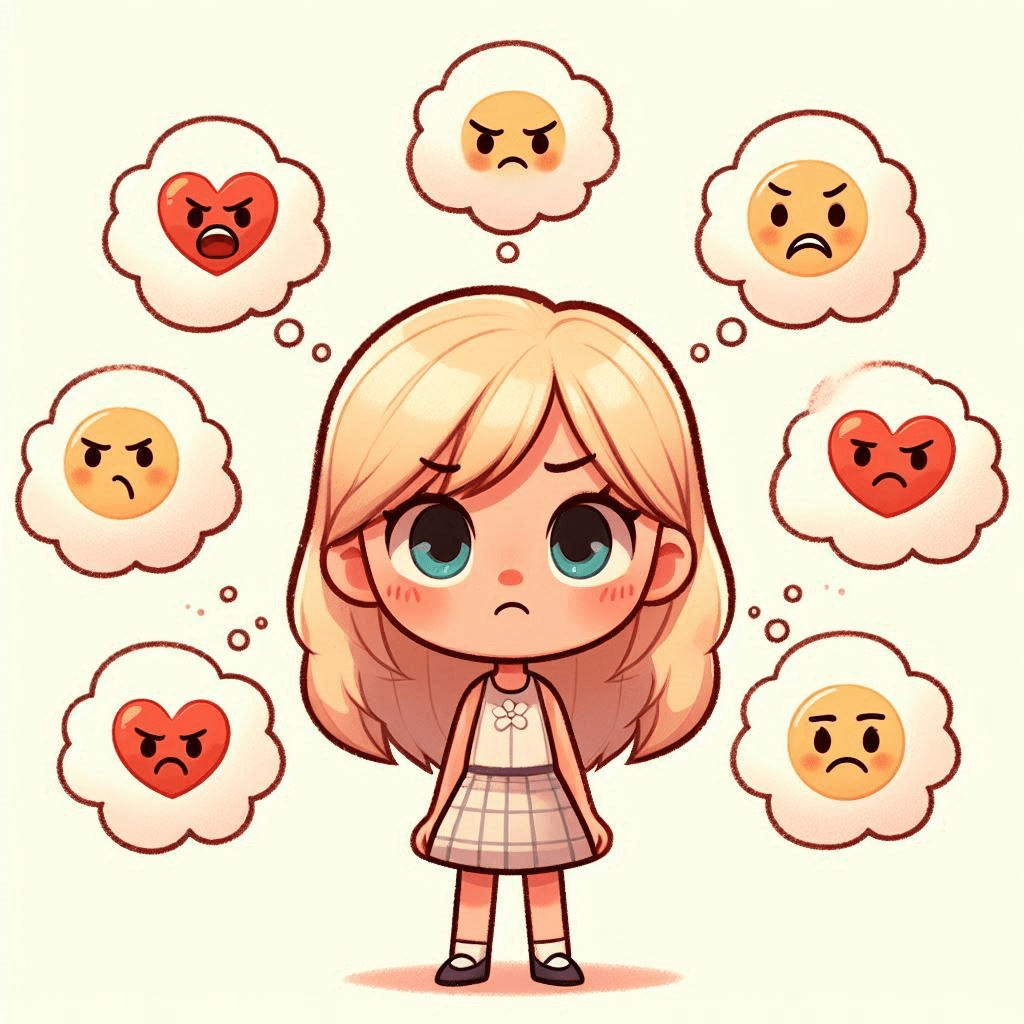
    These are my challenges right now. All people feel anger and frustration; they’re natural human emotions. And all kids (and some adults) need to learn how to regulate these big feelings.

    It’s a lot

    With Daph, though, it can be hard to tell what’s wrong and to gauge just how much she understands, given that she can’t tell us precisely how she’s feeling or what exactly made her angry. She does sometimes say “Frustrated” on her talker, which is great. We’ve worked hard to model these emotion words so she can identify and communicate them when she’s feeling a certain way. And that’s a good step, but it still doesn’t give her a specific, safe way to redirect all that frustrated energy. This is what we’re specifically lacking right now. We need the right anger management strategy.

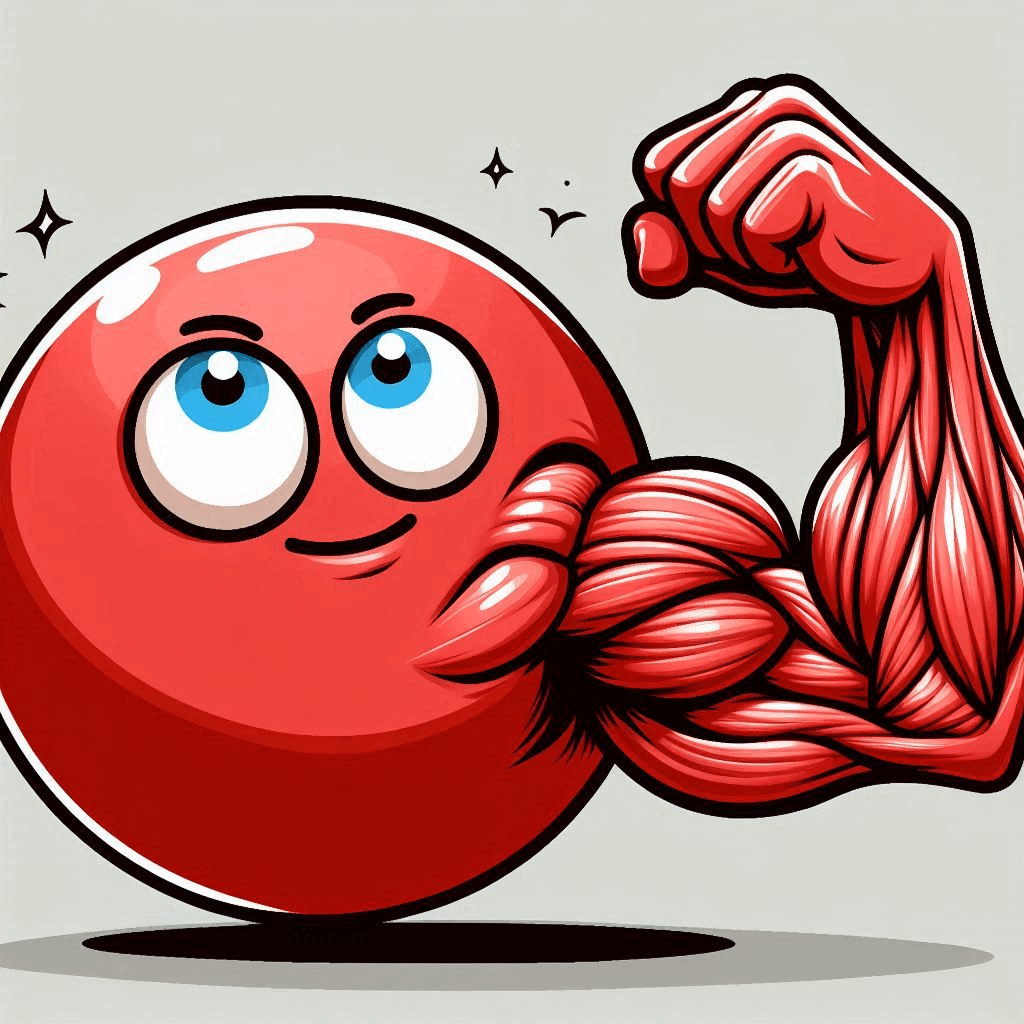
    Last year, her OT suggested she use a squeeze ball when mad. Jer order a few this summer, but when they came we realized they were the kind filled with a jelly substance, and Daph’s jaws are so strong, she bit right through a couple of them, coating herself with the substance and even ingesting some of it. That was a failure, obviously, and then we went through that two week period of incontinence, so in the midst of all that, I didn’t replace those balls with anything better. I’m still open to using this coping strategy, but we need to find the right ball. A super-strong, most-durable-on-earth kind… not sure if any of those even exist.

    Yep, this one. We need this one

    My first monthly meeting with her school team is this Wednesday, so that is a question I will ask them. Can they recommend a specific, hands-on anger management tool or technique? And, how do we best discipline her, so we’re not inadvertently punishing her for something she can’t help, like a lack of understanding or an inability to specifically express herself?

    Our current discipline method is giving her a time-out. If she gets so angry that she’s stomping, kicking, scratching, pinching, or biting, her dad sends her upstairs to her room, and we temporarily take away her iPad if she has bitten or thrown it.

    That way, her consequence is removal: of the thing she threw or the person she hurt (me), plus alone time, which she doesn’t like. It also gives Jer and me the opportunity to cool down so we’re not tempted to scream at her or spank her.

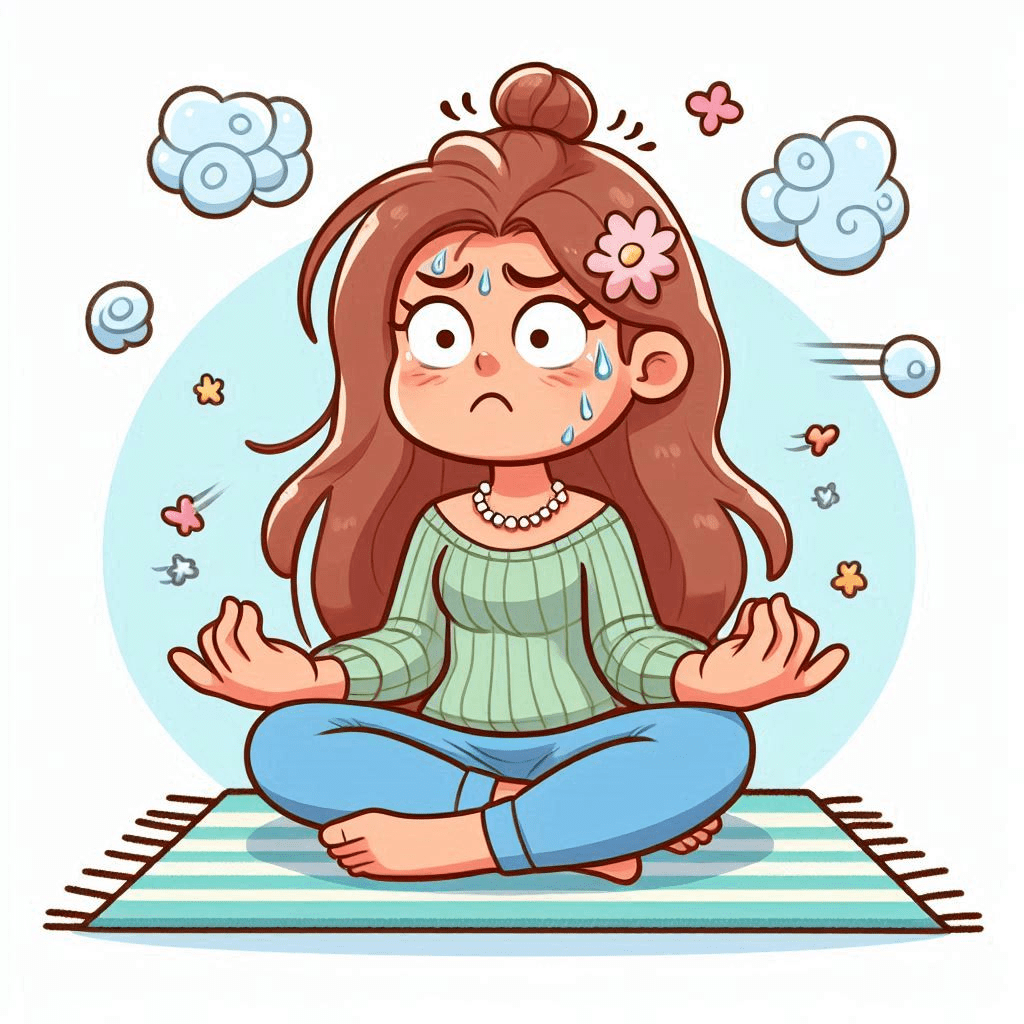
    I am a vessel of infinite peace and love

    It’s tough for me to remain calm when she tantrums; it still amps me way up (though I’m working hard to self-regulate) and then I want to respond with harshness too, which is terrible modeling. Plus, I feel like reciprocal aggression erodes our healthy bond as a family, and that is the last thing I want to do. We need to remain tight and trusting of one another in order to navigate all the rough patches in our lives.

    I will update you on her team’s advice.

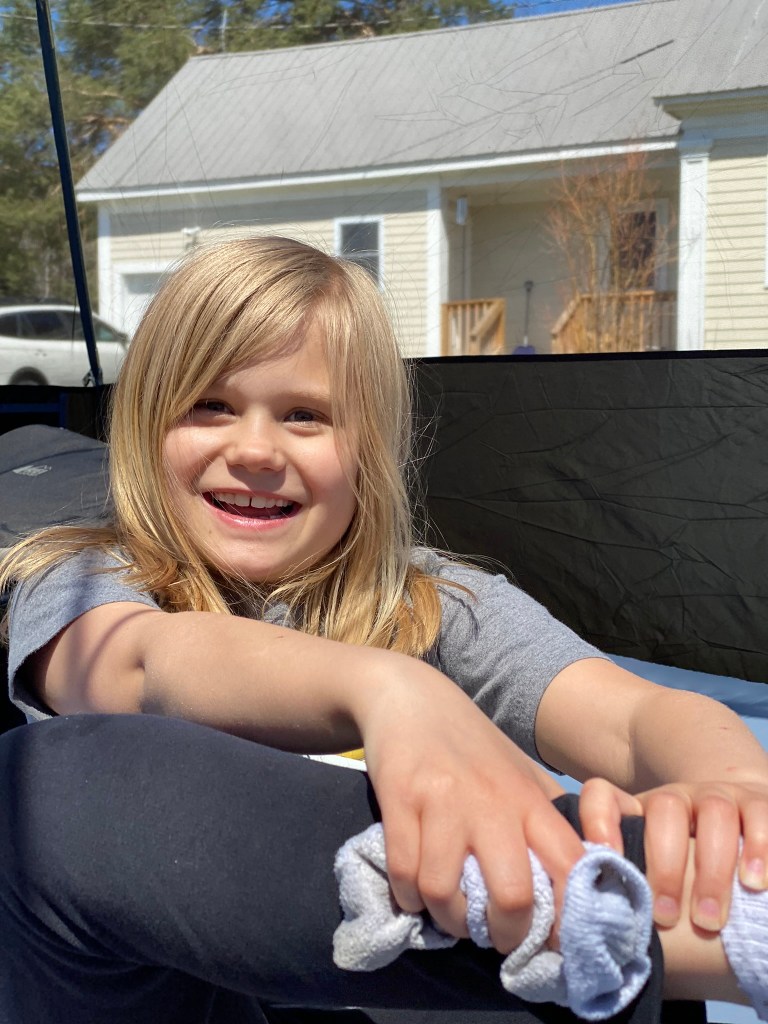
    It is hard to believe she can be so unhappy when she smiles like this

    We had a nice day this past Sunday, but it was also a day typical of our lives now.

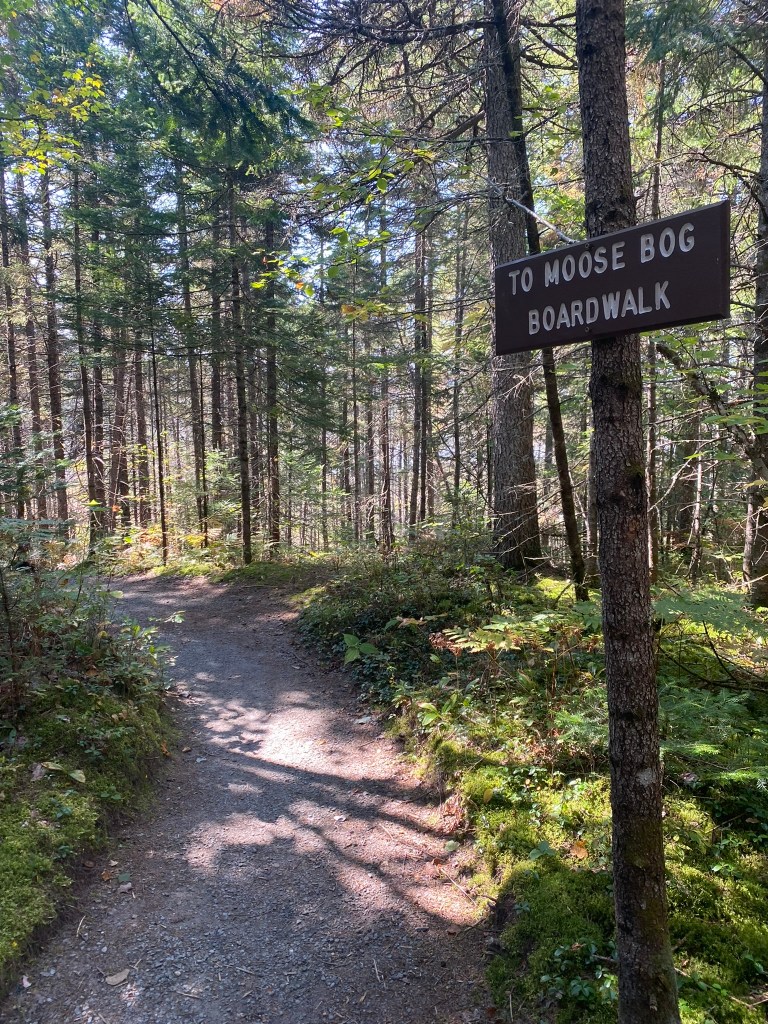
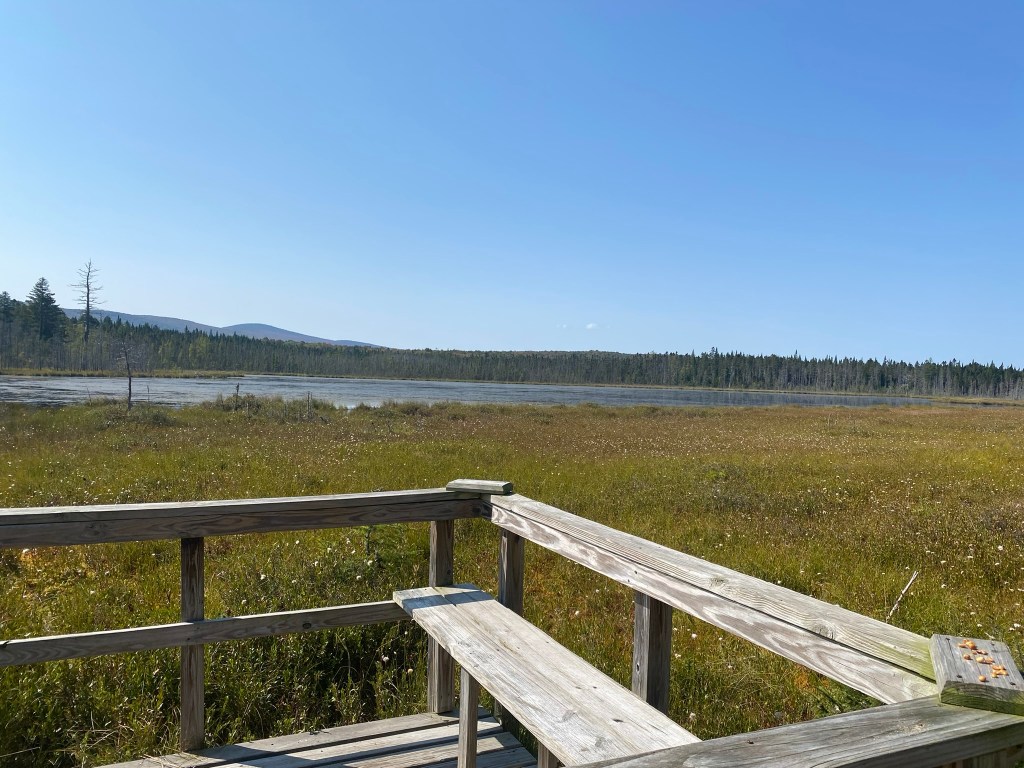
    We went for an easy hike out in the forest around Island Pond, down to the Moose Bog Boardwalk.

    Nice, easy trail. That’s about all I can handle

    Daph seemed fine during the first half.

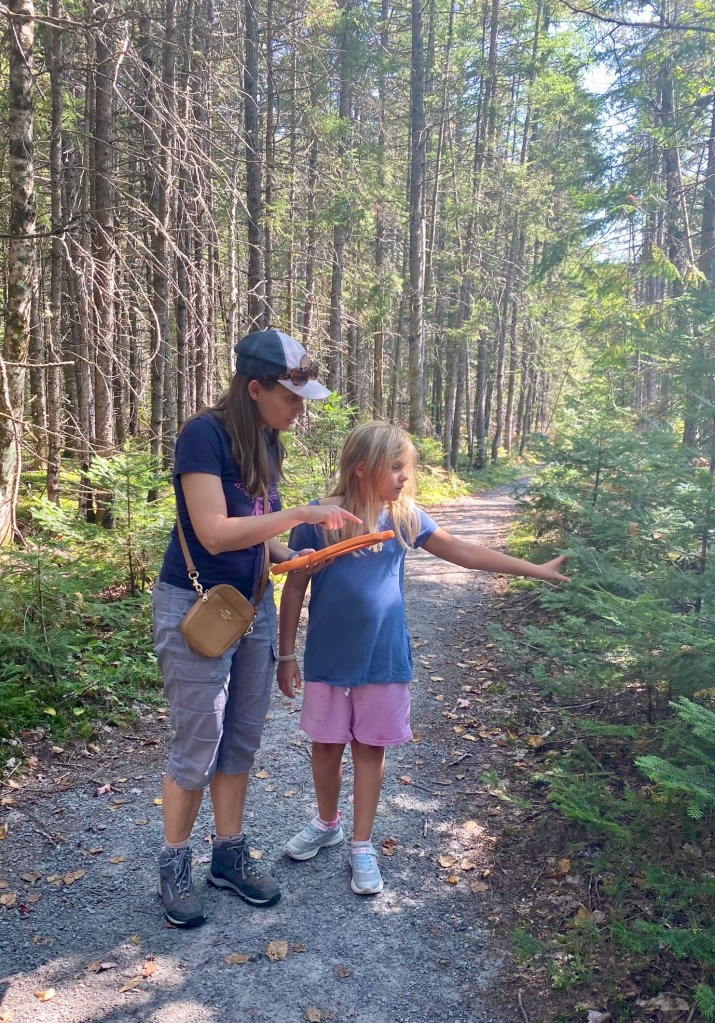
    Naming things on her talker

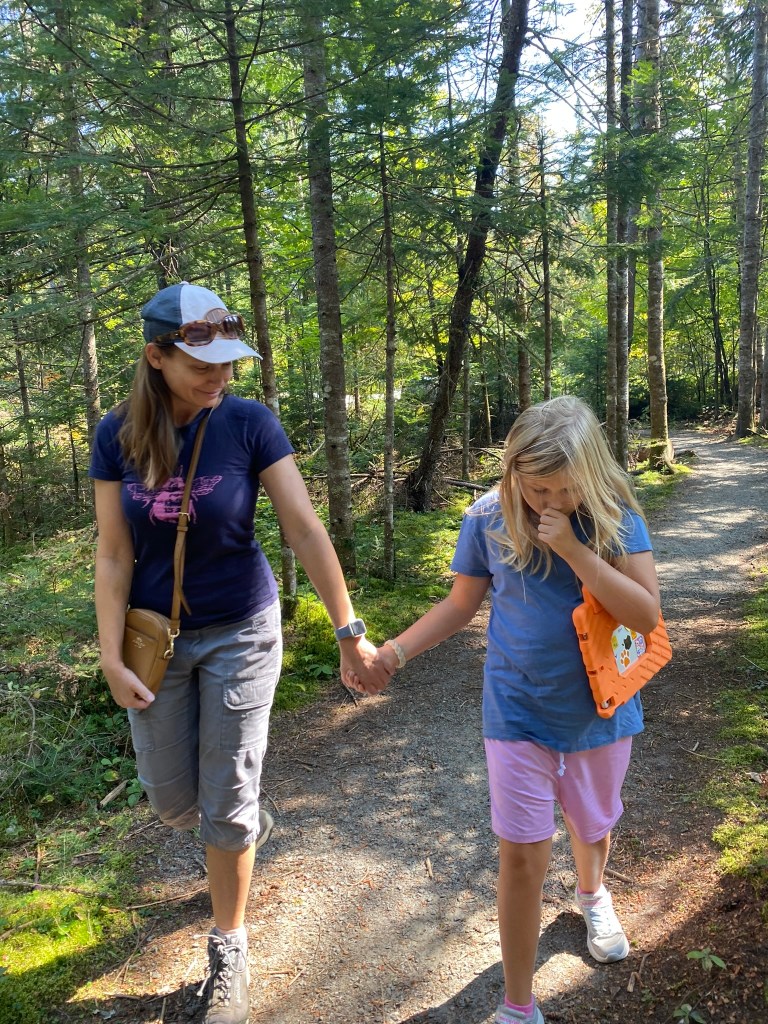
    But as we approached the swamp, she got agitated.

    This is starting to suck, Mom.

    I think she was expecting a lake she could swim in. She halted, wouldn’t go any farther, and started to stomp and whine.

    Pretty but not a swim spot

    Another family was already there, sitting quietly waiting for the birds to land on the dock and eat the peanuts they’d put out for them. Realizing we were intruding on their nature watch, we immediately turned around, ushering an increasingly-angry Daphne away. I felt guilty for the intrusion and disappointed we couldn’t stay for a longer look. We had to coax Daph back along the trail, and my stomach clenched with fear that she would start to scream and bite. She complied, ultimately, but it put a damper on things. I felt that live wire of guilt and anxiety running all the way through my body.

    That’s basically our new normal.

    Just a nice picture

    Like I said, we’re ok. We’re just in a rougher phase, but we’ll get through it. It will take a little more consideration and work than her dad and I have ever had to do, but our daughter’s welfare is our first priority. I just have to tell myself that it’s ultimately not my fault. That I’m not a rotten parent and I can figure out how to help her. My inferiority complex wants to rear its ugly head in this context, too.

    One day at a time.

    I hope all is well with you. Again, feel free to share anything you’d like.

    See you next week.

    XOXO,

    Jenn

  • Published, and Published Again! Eeek!

    Hello! I’ve got a post full of updates for you.

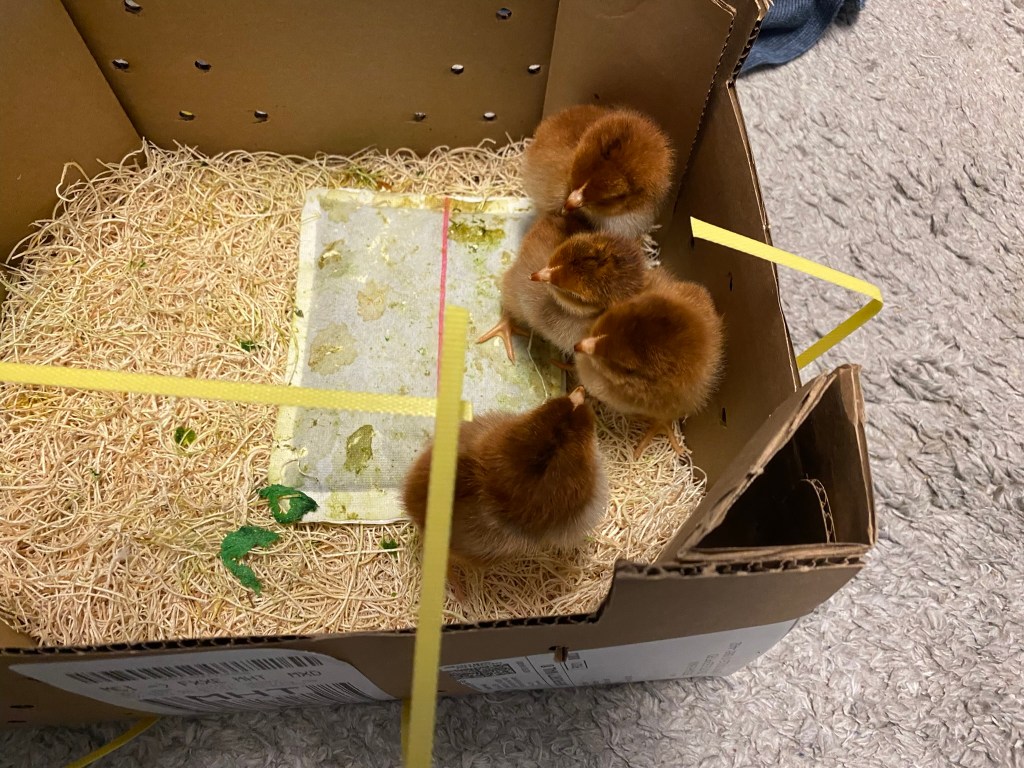
    First, our new chicks are here! They arrived at our post office early Friday morning. As soon as we’d dropped Daphne off at school, Jer and I headed over to pick them up, our fingers crossed that all three had made it here alive. After all, two days bumping about in a cardboard box with nothing but some green gelatinous substance to consume when you’re a newborn baby is kind of rough.

    Brand new babies!

    All the peeping from their box reassured us that most of them had made it, though. And, lo and behold, when I pried open the lid at home, we saw not three but FOUR frantic red chicks. Yep, they gave us an extra, just in case one didn’t make it, according to the explanation on the packing order. I suspect, however, that’s a convenient excuse for offloading a male chick. If I had to wager, I’d say we will have another rooster in our flock.

    I’m a girl, I promise!

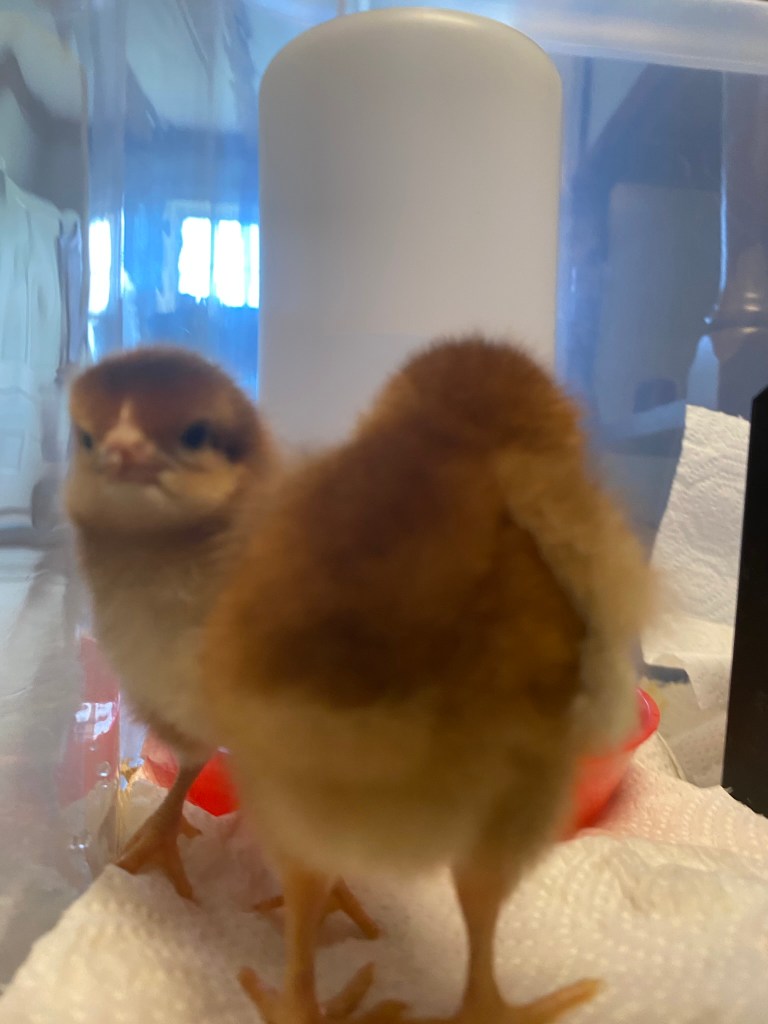
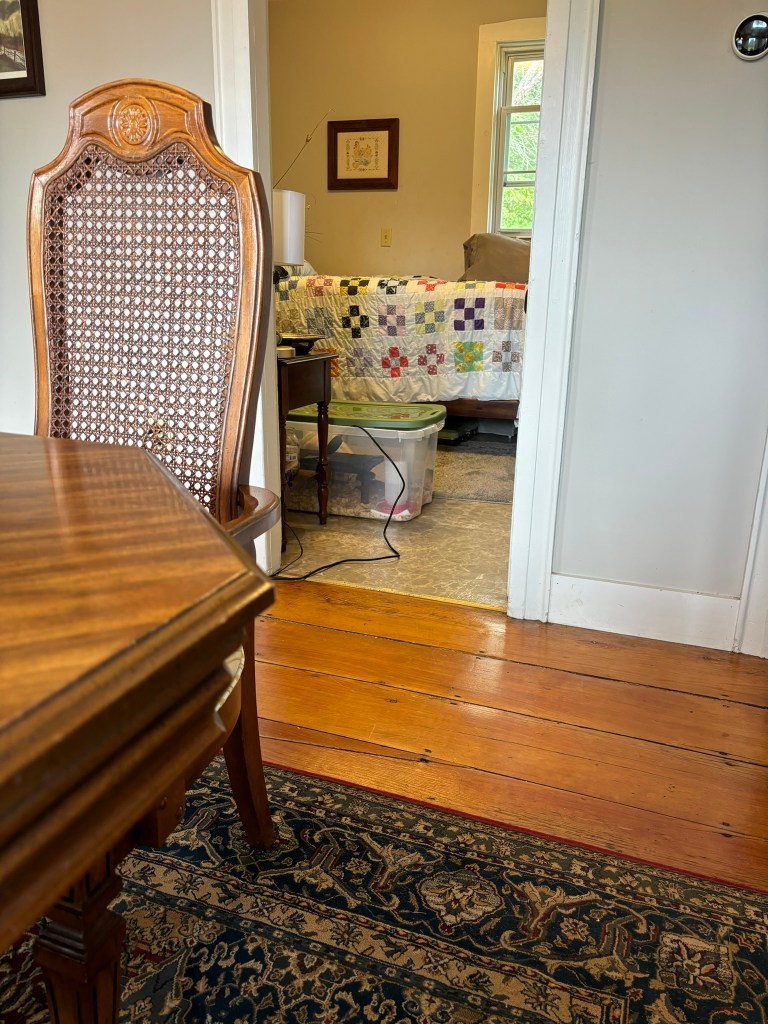
    The chicks are thriving, I’m happy to report. They are energetic and are eating, drinking, and pooping like mad. I see no obvious signs of weakness or illness, so they’re off to a good start. They’re currently living in their brooder in our guest space, where they have their special chick starter-food, their water, their heater, and paper towels over their wood shavings so they don’t try to eat the wood.

    I change their towels and water at least three times a day, and though I was afraid I’d find this annoying, I’m enjoying taking care of them. I’d forgotten how much I like brooding chicks. They’re soft and adorable, and their little peeps are sweet. I can see them from my spot at our dining room table, where I often work. They’re great company while Daph’s at school.

    Keeping me company

    On a writerly note, my short piece of contemporary fiction, “In Dreams and After,” was indeed published on August 21st in the debut issue of Paper Cranes Literary.

    Beautiful print copy

    As exciting as that was, I also experienced a strange discomfort when I read it in the digital edition. It had been a while since I’d looked at this piece, and seeing it in such a beautiful, official medium after that length of time, “completed” so to speak, I was acutely aware of its imperfections. I noticed some inconsistencies in both its style and ideas, and I felt a little embarrassed. My immediate response was, oh gosh, this wasn’t ready!

    Too late, of course. It was published; it had found its forever home. It was what it was. Though I loved it and did feel a lot of pride in it, I also wondered if I’d somehow been hasty. I saw how I could have made it better, but I also remember feeling like I had done everything possible for it at the time I submitted it for consideration.

    It’s also important to remind myself, the editors of the magazine said nothing about any deep structure issues when they notified me they’d accepted it. They were complimentary of the piece before noting they would only make a few line edits for clarity. So, the issues with content must not have been as obvious or evident as they felt to me when I read the publication myself. Still, I was uneasy.

    Contributor announcement

    I talked about it with Jer. He used to write a pop culture column in Houston’s Envy magazine, and he promised me my feelings were normal. He said when he was first published, he would go back and carefully read his article after it came out, and he’d always find something wrong with it, things he wanted to change: a different word here instead of that one, or cutting the last two sentences of a certain paragraph because they were unnecessary, or ironing out a slightly-awkward phrase, etc.

    My advice? Once it’s out, don’t read your work, he said.

    Really?

    Yep. Take a quick scan if you need to, he replied. Make sure everything is there or look at any line edits they made. But don’t read it carefully or thoroughly. Don’t reread it to experience it because you will always find something objectionable. Why do that to yourself?

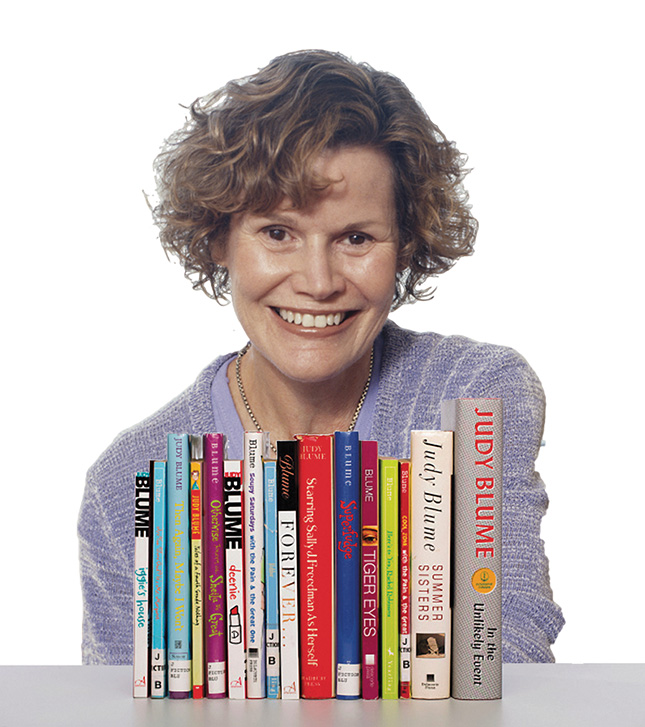
    I think he’s right. Plus, his advice reminded me of something Judy Blume said in her Masterclass on writing. She talked about the importance of reading your work out loud before it’s published so you can hear how it sounds and edit for fluency. She learned this the hard way, when she began doing audio recordings of her novels and would try to rephrase things in the studio because she realized they sounded better a different way, and the editors shut her down. It was too late, they told her. She had to read everything exactly the way it was printed on the page.

    Cool lady. Credit: Toronto Star via Getty Images

    I realized, in retrospect, Blume (a best-selling, award-winning icon) experienced what I was feeling and what Jer was talking about. So, yes, my feelings must be normal.

    It’s just a common, and hard, truth: If you look closely at your published work, you will always find things you want to change.

    There is no such thing as a perfect story, after all, even when it has made its way through multiple self and peer reviews, through the submissions process, and across an editor’s desk. All you can do is the best you can in the time you have to work on that piece. Then, you have to resist this perfectionism once the piece is out in the world. All while being grateful that anyone wanted to publish it at all.

    You have to let it go, let it be. You have to recognize it has found its home–a beautiful thing–and believe that someone will like it, even if it’s just one person. That’s the essence of publishing, truly.

    You have to understand, too, that your imperfect published piece is an artifact of where you are currently in your writing journey. So, if it’s more flawed “than it should be,” that’s okay. It’s evidence that you’re on a path of learning, of growth. That’s also a beautiful thing.

    I am telling myself these things while working to get comfortable with them.

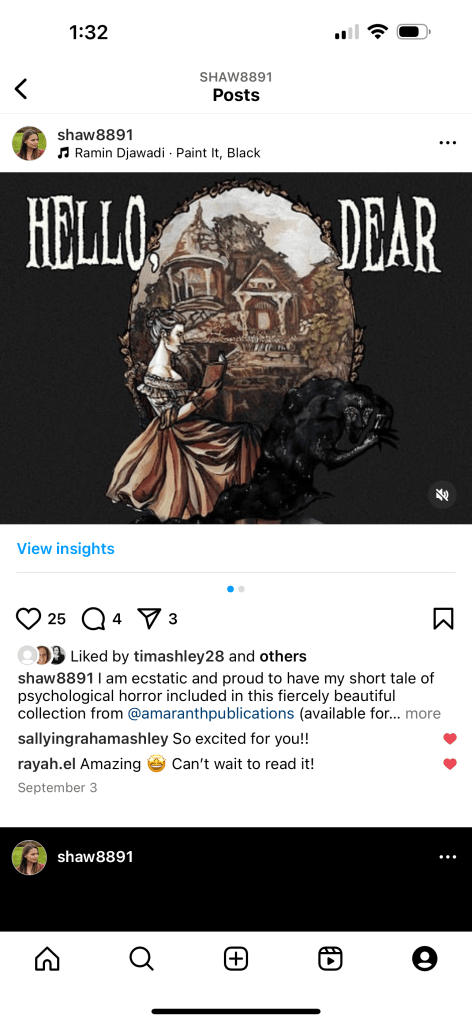
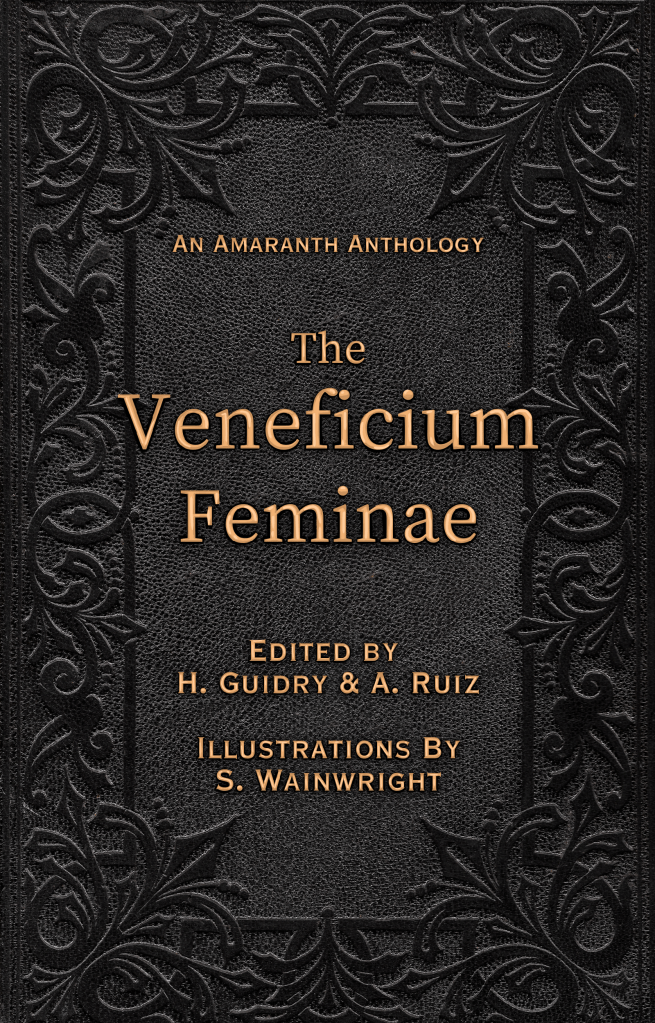
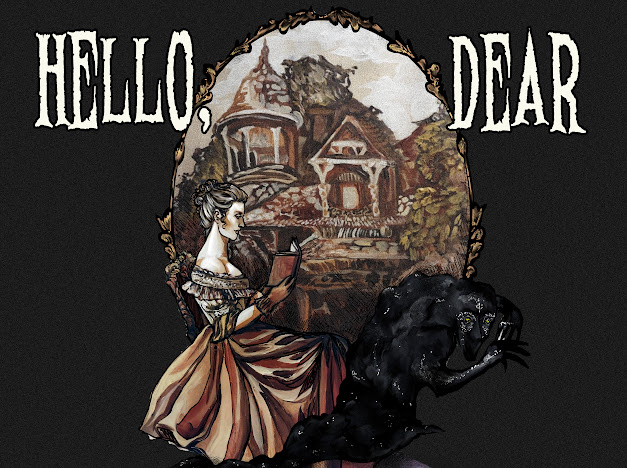
    Luckily, I didn’t feel as much awkwardness when my next piece was published less than two weeks later. “Hello, Dear,” my ghost story, was in fact published by Amaranth in their fall anthology, The Veneficium Feminae.

    Fiercely gorgeous cover

    I experienced a different sort of anxiety with this one, however. More pre-publication nerves than post-. I’d resubmitted my story with the suggested changes to plot (and then some) and felt good about it. But, I heard nothing back from the publisher. No acknowledgment of receipt, nothing about the forthcoming pub, nada.

    I didn’t reach out to ask about it because I didn’t want to be needy or annoying. I want to be professional, first and foremost, with everyone in the publishing world, regardless of their work style. Some people are more pressed for time and less communicative than others.

    But, as the days crept closer to September 1st (the proposed pub date), I thought, Oh Jeez. Maybe they didn’t like what I did. Maybe they changed their minds!

    Fine, but wouldn’t they tell me?

    Wait, would they?

    They were under no obligation to me. They were a small press; they weren’t paying me. I hadn’t signed a contract. They owed me nothing, really.

    For days, I checked my email and social media feverishly, looking for some indication of what was happening.

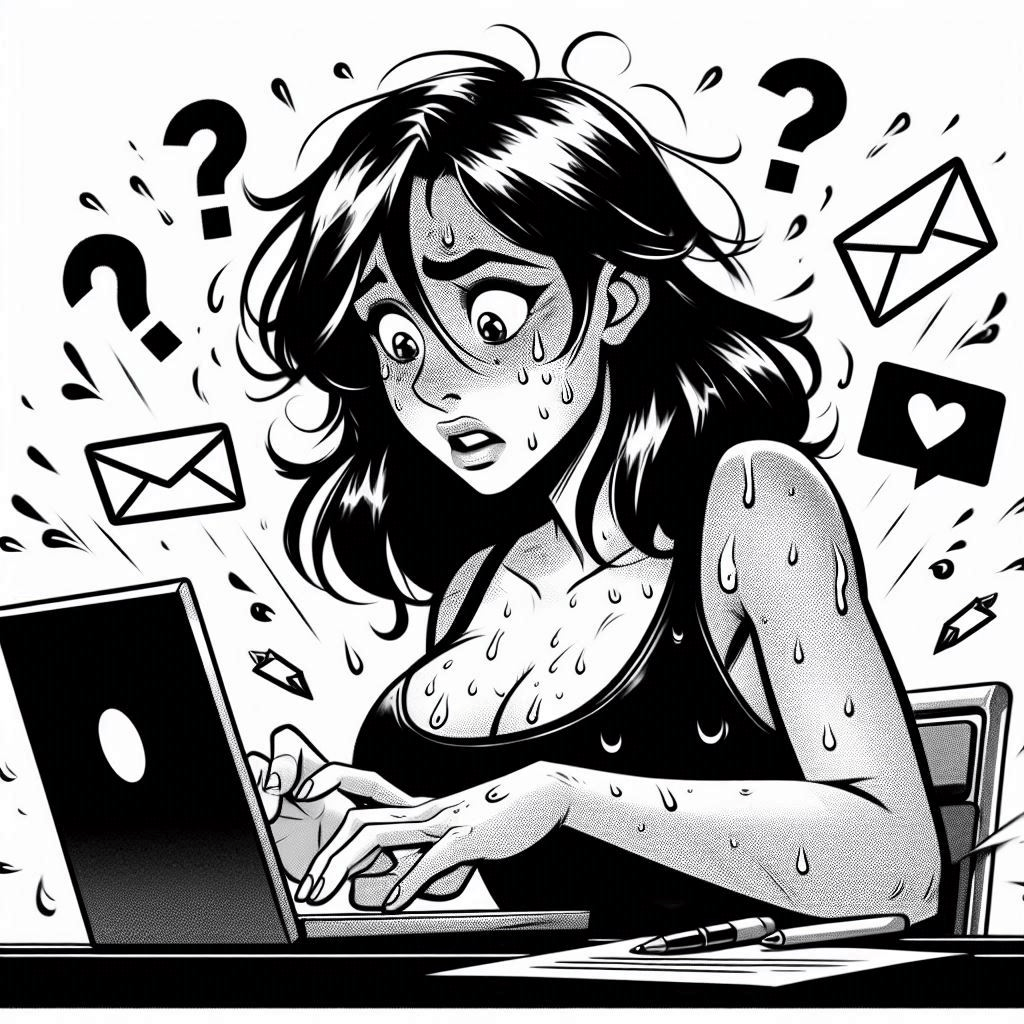
    Wow, DALL-E. I wish my boobs were that big.

    Even on the day of September 1st, I saw nothing, and the weight of impending disappointment threatened to crush me. I couldn’t put it out of mind, even with everything else going on.

    Finally, on the morning of September 2nd, I checked my email and saw the notification that the book was live. It was also the first time I saw the title and realized what the editors had done. They’d derived from our seven accepted stories a unifying theme of feminist horror. Suddenly, their suggested revisions made more sense. Those suggestions had indeed made my story more interesting and satisfying, but they’d also made it fit the overarching theme much better.

    This is AI, not anything from the anthology. But it’s definitely the vibe the book is going for

    I was thrilled and so, so relieved! But then, I couldn’t get into the folder containing our e-copies and promo materials, which included custom artwork for each story. I thought I would lose my sanity completely! I had to email the editor to request access to the folder before I could see anything, and that meant waiting another whole day. The suspense nearly wrecked me, but finally I got in for a look.

    I was flattered to see they’d made very few line edits to my story. It was also easier to read in publication this time around; I didn’t agonize over it the way I did with “In Dreams and After,” though of course I know it’s not perfect. (It’s arguably a little slow in the beginning, and the part post-first encounter with the old woman might drag on a bit too long. There are also a couple of formatting errors, though I don’t count those as mine.)

    I was able to enjoy the success a little more easily this time.

    I love the artwork for my story, too.

    Gorgeous artwork by @sybilwainwrightauthor

    Granted, it’s not entirely precise. I’m not sure if the artist only went on descriptions of my story instead of reading it herself, or if she was trying to convey the essence of it without giving too much away. I’d like to think the latter, but regardless, it’s beautiful and it’s based on my original story and it’s not something I had to commission and pay for myself. How many new authors can say that?

    So there you go! Several updates, plus my publication angst. But I am now indeed a published author of three pieces, with two more due out before the year ends.

    It is a solid start. And, overall, I’m having a good time. Writing is immensely satisfying, and that’s ultimately what counts.

    In the meantime, I’m taking a break from brand-new projects and submissions. I want to focus instead on finishing my longer works-in-progress. That’s where my next phase of growth needs to happen, if my long-term goal is to publish a well-crafted, engaging novel one day.

    Happy fall, y’all! Please share with me any tips for overcoming post-publication perfectionism, if you have them. I’m sure they’ll help!

    See you next week!

    XOXO,

    Jenn

  • We’re Having Babies!

    Hi! Fuzzy chick babies, that is. And we’re having them shipped to us–yes, in the mail!– on Friday or Saturday of this week.

    As I’ve mentioned before, our first real step into homesteading was getting hens. Raising chickens for their eggs (a superfood) was a major part of our plan to better provide for ourselves, and we kept hearing that chickens are easy; they’re “the gateway drug” into livestock-keeping. As with gardening, I was ready to try chicken-tending, but I was skeptical. I feared all kinds of disasters befalling these poor poultry at our inexperienced hands–disease, injury, loss, death in the harsh winter elements, deformed eggs (why that, I don’t know), you name it.

    But, those six, sweet, original babies–five hens and one rooster, it turned out–arrived from the Murray McMurray hatchery on August 29, 2021, and they were healthier and hardier than I assumed. As soon as I heard their frantic peeping from their ventilated box in the post office, I was in love.

    Sweet Baby Mabel (a black Australorp)

    We named the girls after our grandmothers and great-grandmothers: Barbara, Doris, Beverly, Mildred, and Mabel. We named the boy Marty; he had been Mary Ruth (after my father’s mother), but you can see the issue with that.

    Baby Rhode Island Reds, Plymouth Rocks, and Australorps

    Those chicks grew quickly, took on personalities of their own as they found their places in the chicken hierarchy, and proceeded to bring us many benefits aside from the eggs they eventually laid (in February the following year). They ate nasty bugs like ticks; they turned the compost when they jumped in it to play, their droppings provided wonderful green material for that same compost, and they gave us affection and hours of amusement. There aren’t many things funnier or cuter, in my opinion, than a hen’s derpy waddle-run.

    Into the Big Girl Coop

    Once our chickens became pullets and a cockerel (those are the precise terms for teenaged poultry), they were big enough to live in their outdoor coop, and they learned right away to take themselves to bed when the sun set–that’s instinct, really. They also weathered their few issues and injuries well–getting egg tied, cutting their combs on the metal treadle feeder, or losing a chunk of feathers to the jaws of a marauding dog or fox. They always healed and bounced back. They proved easy to keep, even for newbs like us.

    After a lot of discussion, we chose to purely free-range them.

    First official day free-ranging: FREEDOM!

    This means, they have nothing between them and the wilderness once they’re out of their coop each day–no fence, no run. This does make them more vulnerable to all kinds of land and aerial predators, but it also keeps them healthier and happier. They are able to roam our expansive property and do exactly what chickens need to do–scratch and peck in the dirt for all kinds of goodies after dust-bathing and shading themselves wherever they please. Over time, they have learned to stay close to the coop and house (treat-training with a bell aided that). Now, they are as free and relatively-safe as can be.

    Beautiful, happy Doris post-dust bath

    That summer of 2022, we did lose two of them–Mabel one evening to a fox, and Marty one day to another fox while we were vacationing in Rhode Island.

    Mabel laying an early egg

    This hurt, but we knew it was possible. We’ve always missed them, but miracle of miracles, we went two more years without losing any more chickens.

    Marty the Rooster restless for spring

    This was due in no small part to my husband’s efforts. He is super-vigilant, listening for sounds of distress when he’s at his desk and then running out to scare away foxes, bears, and hawks. He once used Daphne’s playground ball to whack a fox in the side, scaring it away. He’s since upgraded to a .22 rifle.

    I have to brag for a minute about the time he actually shot an approaching fox. It was February of last year, and we were all home sick with a nasty flu. I was getting over it, so I was up and about, bringing my husband and child water, food, and ibuprofen. Daph and Jer were curled up in the master bedroom together, and Jer’s temperature was 102–as high as I’ve ever seen it. He was wrecked.

    I happened to look out our witch’s window and see a grey fox heading down our hill to the west of the house, no doubt after our happily-oblivious hens.

    “FOX!” I shrieked, out of panic more than anything. I didn’t really expect Jer to do anything about it, sick as he was.

    But my husband shot up. He flew downstairs barefoot, grabbed that rifle, and proceeded on the first try to hit that fox right in the hip–all in under less than a minute. I know because I was watching out the window, and the fox’s hindquarters jumped just before it took off into the Christmas trees, back to the woods where I assume it bled out because we never saw it again (sad, yes, but we had to protect our livestock).

    Goddamn, I thought, overcome with awe. That is some hardcore pioneer shit.

    Sorry, my inner voice is rather crass sometimes.

    And in that moment, I found my husband especially attractive. Didn’t see that response coming, either!

    About right except Jer wasn’t smiling. It upset him to shoot that fox.

    Anyway, I say all that just to underscore how hard he works to protect our flock. He’s so good at it, too, I half-expect nothing to ever harm our chickens again.

    Sadly, that’s not realistic, or fair.

    When we came home from a trip to Lebanon on Saturday, August 24th, we couldn’t find Barbara, our Plymouth Rock alpha hen (and the only one who had never been attacked by a dog or fox, to my knowledge). I looked in the coop, thinking she might be laying an egg–not there. I looked around the back of the house where she liked to dust bathe–not there. I looked under our giant lilac bush where she liked to rest–not there.

    Good girl Barbara, always on her chicken-dad’s lap. They were solar eclipse buddies

    Jer came out and looked for her too. Finally, he found a concentrated pile of black-and-white feathers around the side of the house, and we realized a hawk probably got her. We’ve had several hawks circling lately, and our crows, usually great about chasing them away (since they’re a threat to the crows’ young), have been strangely MIA.

    The attacker didn’t appear to have been a fox, since in our experience with previous attacks, there are usually feathers scattered everywhere, tracing the path the fox took with the struggling chicken in its mouth. Not the case this time.

    It broke my heart; it still does. I miss Barbara.

    Barbara concerned about her sister’s underage drinking

    She was our good, capable girl. Our one in charge, who, protectively, took on some rooster behaviors after Marty died–like waiting until her sisters had their share of treats before biting an apple core or sticking her own beak in a bowl of mealworms. Our one with the loudest, proudest egg song. Our one to jump in our laps first when we sat in a patio chair.

    *Sigh*

    Jer said, let’s order some new chicks.

    After all, he believes the best way to honor a lost pet is to get a new one, sooner rather than later. They’re not replacements; rather, they’re testaments to the love and joy our previous pets brought us. What better way to honor a deceased fur or feather baby than by giving fresh love to a new one needing a forever home?

    I vacillated about getting the chicks. School had just started, and I’d just gotten back all my precious free time. Did I really want to spend part of it caring for baby chicks? It would mean multiple brooder cleanouts a day, checking for pasty butts, and spending daily time with them if we want them to get comfortable with us.

    But, I finally told Jer to pull the trigger on the order. I needed something to help me refocus on homesteading.

    So, we ordered three new chicks last week. They will be here just in time to grow big enough to leave their brooder and enter the grown-hen coop before winter sets in.

    We’ll be there soon!

    We have almost all our chick supplies ready to go–I just need to find the brooder heater in the shed and test it to make sure it still works, and I have plenty of time to do that.

    I’m excited for this new opportunity. It should be a little easier, given that we have experience raising chicks. Their brooder will stay in our mudroom, and I’m planning to spend a lot of time each day with the babies, holding and talking to them so they bond with me quickly and grow up to be as affectionate as their older sisters. I’m thinking I’ll listen to podcasts to pass the time with them.

    I will share pictures of our fuzzy babies next week!

    Until then, enjoy the beginning of fall. Any chicken/homesteading tips you have, please feel free to share!

    I’ll be back next week with some fun writing updates.

    XOXO,

    Jenn

  • All I Can Muster

    Greetings on this final Tuesday of August!

    It’s easy to forget I’m as much a creature of habit as my daughter. Yesterday, while she was enjoying her first day of school, I walked around the house a little stunned at all my free time. I was so overwhelmed by the leisure, paradoxically, that I couldn’t bring myself to do much more than the weekly grocery shopping. Even today, as I work through my to-do list, I feel foggy. So, I’m gonna keep this post short–just a couple of quick updates about my writing only because I don’t have enough working brain cells to do more than that.

    Before things in the story take a horrific turn…

    Snow globe story–I’m still enjoying this one, but it’s sitting at 12.6 K (max word count is 10K), and I haven’t even finished the rough draft yet. I’m close–I think I can finish it by Thursday, but that will only leave me two days to condense and edit the piece for submission. With so little time to revise, I don’t see how the story will be good enough by the 8/31 deadline, so it’s looking like I will not submit it for consideration to this particular anthology.

    That’s a bummer, especially because I like the premise, and the beginning is strong. There’s a kernel of a great story there. But, I’m telling myself it’s not good in the long run to submit something just for the sake of submission and just because it’s technically done. That seems like a bad habit to fall into. Anything I submit anywhere ought to be decent, and it needs to stand a chance.

    I think there’s a tendency among newer writers like me to rush to publication because we feel it’s validating, or we like the currency it gives us on social media, etc. But that’s an urge to be wary of, given that ultimately we want quality out there in the world, not necessarily quantity (and not more rejections than we’ll inevitably get). The publishing world is small, I keep hearing, and all the pieces we submit bear our names. We want our names associated with our stronger work.

    Yep. Maybe later for this one…

    If I don’t submit this story, I can finish it more leisurely and set it aside to revise later, and the effort will still be worth it in terms of practice. Giving this piece time and distance will only make it better, and who knows what publication opportunities might arise down the road?

    Ghost story-– Remember how I mentioned a while back that I planned to submit a ghost story to a spooky anthology? This was the same story that got critiqued during my virtual writing camp. Well, I received an exciting email on Saturday, August 17 from Amaranth Publications announcing they’d accepted it! I was thrilled when I read the first line, then realized they were suggesting revisions. They wanted me to make it more horrifying–“really lean into the fear and violence”–which was fair given it’s for a Halloween collection.

    Great image from Unsplash… this is exactly how I imagine the story’s setting

    In the original version, the protagonist–a drinker with a temper and terrible self-esteem– has a scary run-in with a ghost in an old bed and breakfast, and he leaves the place resolved to get help. I thought of the story as Scared Straight: Haunted House Edition. The editor, however, wanted me to make the guy (who is a piece of shit) irredeemable and have him meet a tougher end.

    DALL-E is struggling with letters and actual flowers, LOL

    At first, I was a little taken aback, even miffed. Then I considered, hey, they like something about this enough to consider publishing it, so if they tell me to jump, at this point I’m gonna ask, how high? I’m no Joyce Carol Oates or Chuck Wendig, so I trusted their suggestions would make the piece better.

    Digging into my edits that first evening was tough (it probably didn’t help that I’d had two beers prior to opening my laptop; apparently, I’m not Hemingway either). But, after a couple days working to incorporate these changes in a natural, cohesive manner, I realized I loved the new version of my story–the editors were spot-on. My parents (who never read the original version) were both awesome enough to read it and give me some feedback on the confusing parts, too, so I had a healthy measure of confidence before resubmitting it. Now, I’m just waiting to hear back from Amaranth. The publication date for this anthology is September 1st, which is fast approaching, so hopefully everything will go as planned.

    That’s all I’ve got! I hope you’re handling all the seasonal transitions in your life more smoothly than I am. As always, feel free to share tips or suggestions!

    ‘Til next week!

    XOXO,

    Jenn