Read Part I here.
Read Part II here.
Part III: One Year Later
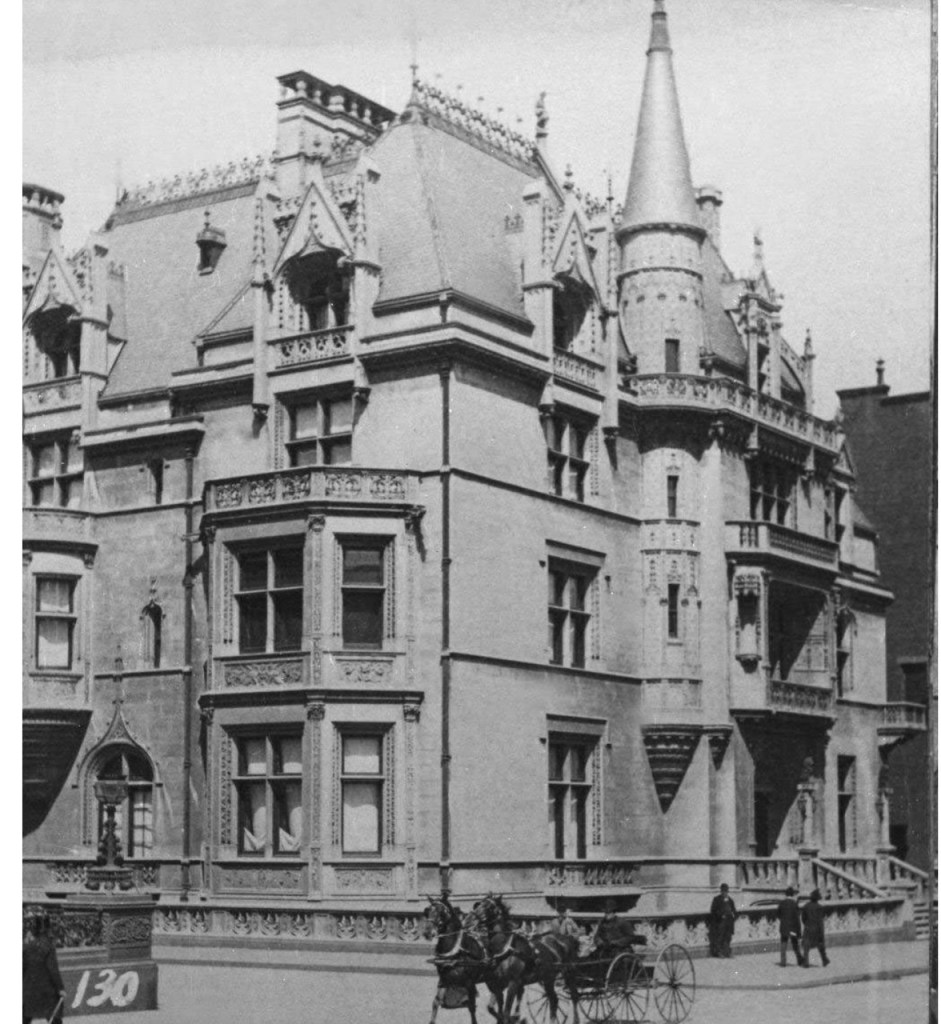
From americanessence.com
February 14, 1897
One year after the disappearance of Katherine Williams
New York City
The day was as heavy as Molly had feared. It reminded her that, although time moved forward, that progression was hardly perfectly linear. No straight, smooth arrow. Rather, it felt like hundreds of smaller, circular links. An awful chain that looped back on itself repeatedly, even as it spiraled forward in agonizing slowness.
That day, no one could escape it. That noon, no one had words precise enough to capture, let alone assuage, that agony of the Williams household. It was a pain that extended below even the stairs, beyond the white-tiled, copper-potted kitchen and into the dim, claustrophobic servants’ nook. There, in that slow hour after morning duties and before luncheon, many of the staff congregated, drawn by a need to share the collective burden.
Above them leered a low-burning gasolier. Before them were set vegetables and well-seasoned meat, but no one had much appetite.
“Did anyone see today’s headline?” Peter, the kitchen boy, asked.
Some heads nodded, others shook no. Stirring her coffee, though she’d added no milk or sugar, Molly kept her brunette head still.
“ ‘On Anniversary of Heiress’s Disappearance, NYPD Maintain Case is One of Missing Person’,” read the assistant chef, after slipping the day’s paper out from beneath his plate, unfolding it gravely.
“Sly,” said Peter wryly.
Hargrove, the butler, cut his eyes at them both before resuming his futile occupation with a set of lists.
“I can’t believe the police have kept the body quiet all this time,” Peter continued. He snorted. “Mr. Williams must have paid them handsomely.”
“Enough,” said Mrs. Mason, the housekeeper, setting down her fork. “We none of us know if that was actually Miss Katherine, it was rotted so badly. And, as far as the public is concerned, that body was never dredged from the reservoir. Remember that.” Her brows shot up at them all in a look that rivaled her mistress’s, in those former days of Miranda Williams’s powerful household reign.
It was a good reminder, Molly thought. All the servants had been forced to sign legal agreements to remain permanently silent about everything related to Katya’s disappearance, on pain of being fired and sued in court for all they had. It had worked, but they’d signed those papers almost a year ago. One day after Katherine vanished, when her parents hired a lawyer, no one else, to help them manage the emergency. The Williamses rarely spoke of the agreements, so it was possible to forget what a powerful threat they were. But those legalities, however silent and invisible, hung over them all like an enormous, fatal net, and they had no expiration.
Molly herself had fantasized several times about escaping that net. Of quitting her work for this family altogether. However, from the week Katya disappeared, and just a day after their guest, the Earl of Worcester, fled their household for the sympathy of the Rockefeller parlor (claiming only that he’d been jilted), Mrs. Williams had insisted Molly remain. Despite her threatening tone, she’d given Molly a new position and a substantial raise, and Molly had borne it. To do otherwise would have raised even stronger suspicions, and she could not allow that.
The head chef now shook his thick gray head. “I’ll say it again. It was a crime they waited so long to report her missing to the police. All that time they spent handling it on their own, all those weeks they denied it to their friends, to the world that she was missing. Maybe, if they hadn’t been so concerned with scandals, appearances…”
He didn’t need to finish; they all knew the rest. Katya would still be alive. The officials would have tracked her down, rescued her, and prosecuted the people responsible. Or, at the very least, verified that darkest of possibilities: that she was in fact dead.
The uncertainty was torture, and not at all helped by the false sightings and fraudulent ransom notes that poured in once the Williamses finally made their daughter’s disappearance public. It was killing her parents, particularly her mother.
Molly now worked as a second lady’s maid for Miranda Williams, and she’d born witness to the ghost Mischa had become—chronically ill, unable to stay out of bed a full day. She no longer attended social functions, was no longer any kind of real member of New York society.
“Please, Mrs. Williams,” Molly pled on a regular basis. “Come sit at your vanity so I can brush your hair.”
Often, the woman kept her ashen face turned into her pillow, her once-rich mass of dark locks knotted and dull on the pillowcase, the roots shiny with grease.
“Can you at least sit up please, ma’am?”
Nothing.
Molly’s work no longer required any real labor. She was paid to plead with her mistress for as long as Mischa would tolerate it before she dismissed her.
Mr. Williams kept away from the house. He either quartered in his office or spent long weeks hovelled up in his hunting lodge on Long Island. House rumors were, he was planning a long journey overseas, without his wife.
“Maybe that body truly wasn’t Miss Williams’s,” said a chambermaid, her voice wavering, pulling Molly back into the present.
“Who else could it have been?” asked the assistant chef, gesturing with a fleshy hand.
“Dozens of others!” shot Mrs. Mason. “Any number of prostitutes, or drunken beggar women, or some poor girl who crossed paths with the wrong person, some wicked sinner like that depraved Jack the Ripper over there in Whitechapel, in London… Not our Katya, who was alone for such a short while. How is it possible someone snatched her in just a dozen feet of sidewalk?”
“That friend of Mr. Williams’s told the papers, ‘We New Yorkers rarely notice much,’” said the assistant chef.
“Phfff!” retorted the housekeeper. “What about the way she was dressed—that Doucet gown and that gorgeous sable coat? Her hat, her muff? Someone would have noticed a killer wrestling with a woman that well-dressed. And the snow? There were no tracks. I don’t know what happened to her, but that wasn’t her body.”
“Yet,” said the butler, finally drawn in, “She’s most likely dead, isn’t she? Even if that wasn’t her corpse, remember how nothing was missing from her rooms? Where was the evidence she was running away? No clothing or jewelry gone except for those pieces she wore, no other items taken, no charges to her family’s account…” He stabbed the tabletop with his pencil. “What else could have happened, except that someone got her, somehow?”
Silence thundered over the small, dim nook. Molly’s face flamed, the walls shifting around her.
No. She willed her body to coolness and passivity, though the truth burned in her throat.
Keep to the script.
As usual, everyone’s eyes fell on her. She’d been closest to Miss Katya; she was the last person with her. Always, sick to her stomach, Molly maintained the same story. She’d stuck to the engagement plan: After the family carriage left the park, heading back to the Williams residence to take the men to the luncheon, Molly stayed behind as instructed, not far, while Miss Katya made her way around an empty curve in the sidewalk, toward the place where the earl waited a few hundred feet out of sight. This was the scene the lady wanted to enact for the sake of the occasion, Molly repeated, and she had just done Katya’s bidding. Mrs. Williams would have been there to escort her daughter except she’d gotten so sick the night before.
House rumors flew about that, too. About the bottle of arsenic found misplaced, as if taken from the housekeeper’s cabinet and not put back properly… that someone had poisoned Mrs. Williams with a very small dose… But not a word about that was ever breathed to anyone outside the Williamses’ front door. No one even made a peep about it to the private investigator.
Now, fighting the urge to grip her cup, Molly looked cooly at them all, despite the phantom flames engulfing her. Just as she’d looked steadily, first, at the Williamses, then the lawyer and private detective with their cold, penetrating eyes, and, later, at the police. Innumerable times.
“You know my story,” she said, and sipped her coffee. Miraculously, the liquid made its way down her throat.
“Enough, ENOUGH!” snapped Mrs. Mason. Everyone jumped.
That was the end of it.
It hurt too much anyway. It oppressed them all.
Guilt was an insidious thing, and it snaked its way through even that lowest floor, affecting everyone with a strange, illogical sense that they were in some way, somehow, culpable too.
But that afternoon, a “household errand” compelled Molly beyond Fifth Avenue. Wrapped tightly against the cold, the sturdy Irishwoman traipsed deep into another part of the colorless city, tiny as an ant among the looming buildings, to the postal box where Miss Katya had sent her secret letters.
Their agreement had been that Katya would keep the box and, if she could, mail a signal to Molly. Something letting her know she was alright. That had been Molly’s one iron-clad condition, when she’d finally agreed to aid the Williams heiress who was also her friend.
One of her few friends, given that Molly was a childless widow, her own siblings, nieces, and nephews long moved away. She had worked for the Williamses her entire adult life and watched little Katya grow up. Had heard her play that piano, in all those stolen moments when Molly lingered, unseen, in a doorway of the ballroom. Those lush, trilling notes had soothed Molly’s loneliness. Relieved that soul-crushing doldrum so that even she—raw and common and thick-limbed as Molly was—could fly for a time above hair pins and corsets and endless sorting and mending, escaping that erosion of spirit that was born of meaninglessness without end.
The first time she experienced it, something broke open inside Molly’s chest—a spill of molten gold so powerful, so saturating she brought a hand to her bosom. Her arms and neck had prickled, and her eyes welled as Katya’s passionate playing lifted her up.
Up, through something sublime.
Though Molly sometimes doubted the existence of God, that moment was precious evidence, for Katya had channeled something directly from Heaven.
It united the two of them. Every distinction that had ever stood between them, every difference and delineation, of class, culture, education, that had felt so real, so cast in iron, melted away. They were simply two human beings transcending themselves together in a moment of silent, ecstatic joy.
That had been it, what made Molly decide. No one deserved to live in a cage. Certainly, not this gifted young artist, even if her captivity was beautiful and safe.
At what price?
Some things were too expensive, even for a Williams.
And so, Molly and Katya had begun to strategize. Formulating the most careful of plans, minute and thorough in all the logistics: a wardrobe change, the right kind of heavy cloak and hat, the best errand boys (ignorant of and unknown to the family) who Molly could bribe to dispose of certain packaged garments. A train ticket west for a 1:00 pm departure, sharp.
But, Molly had her condition. She would help her, but Katya had to let her know she was well. After that, Molly would burn the evidence.
“I cannot live without knowing,” she’d told her young mistress. “Don’t ask that of me.”
Molly had found a way, somehow, to check that box every other week for nearly a year. For 364 days, there had been nothing in it—no letter, no parcel, no object, no cryptic, bare-boned message. The mounting silence had stolen sleep from the servant, robbed her of her appetite, forced her to her knees every night to ask God’s forgiveness for her part in it all.
Especially after the private investigator located Henry Bauer in Athens. Searched his house, interviewed his colleagues, all of which yielded no sign of Katya. Worse still, when the police looked for him too, months later, and discovered he’d resigned at the end of the spring ‘96 term and gone somewhere unknown. Molly knew all of that only because the housemaids were adept at eavesdropping.
Yet, something had told Molly not to confess. To wait, have faith, and give Katya a long, solid chance. Molly would know in her heart when it was time to give up.
Today, she’d decided, was the final day.
If nothing were there, Molly would cease checking that box. She would accept that Katya was very likely that body found in midsummer, weighted down in the water. For it had been a dark-haired female, and the exact length of Katya’s height. Molly might even go straight to the police and suffer whatever the repercussions would be.
Swaddled in a wool shawl and wearing a worn toque hat that covered her ears, Molly trudged her chilly way through the bustling streets, invisible to the swarm of chortling or tight-lipped pedestrians concerned only with themselves. Amid stinks of manure and rotting trash ripe despite the day’s bite, she found her way to the freestanding metal box, one of many that had appeared on the city’s streets over the years.
This one stood shadowed in a back alley littered with dirty snow, surrounded by chipped red brick. It never saw the sun, obscured as the rays were by the buildings.
At the alley’s grim entrance, Molly paused. She might put this reckoning off. Might go on telling herself Katya needed more time. Might continue her same routine, trapped in that circle under Mischa’s net, the guilt eating away at Molly more than any boredom or forlornness ever had.
She stepped into the dimness. Feeling more than seeing, it was such a familiar movement, Molly slid the skeleton key into the postal box’s lock. She turned it; the square door opened smoothly.
Forcing herself not to squint—for desperation scared away luck, didn’t it?—Molly saw, instead of darkness, a tease of white. An envelope, its face nearly blank. No return address.
“My shockin’,” she whispered.
She tucked the envelope inside her shawl. She locked the box again and left the alley, making her steady way to a little café in a safer yet modest part of town where, in rare private leisure, she sometimes liked to have a meal.
At a table in the corner, she sat down, pulling the toque from her head and the envelope from her shawl. Heart banging against her breast, she slit open that piece of mail with an icy, trembling finger.
Inside was a single creased sheet of…something. When she unfolded it, she saw the top had been snipped off. One side had butcher’s paper glued over it, as if to hide whatever was beneath it. But on the other side was… a list?
It took Molly a minute to decipher it. Though printed in a foreign language—German?—it looked like a list of musical instruments and their players, with a single name and title at the very top.
The sender had considerately circled the two most important names. In the margins, they’d translated the odd words into English.
The name and title at the top: Harry Percy, Conductor.
Farther down, Kate Percy: Piano.
Beside the top name was scrawled a short note: Isn’t that a good joke? His idea, not mine.
And then: All my love, always.
Molly’s head shot up. Her eyes streamed. A massive phantom weight, one she’d grown so used to she’d forgotten it was there, lifted from her shoulders. In fact, she felt herself rising entirely out of her body.
She gazed out the café’s large picture window. She dared not study the note too closely. What if the words dissolved? Or morphed into something else, the way things did in dizzying nightmares?
Outside, the sun sliced through the winter clouds, casting the street in an incandescent gold.
Molly dropped her eyes to the note; the message did not change. She lifted her gaze once more, her chapped cheeks damp.
A bird landed lithely on the ledge of the café’s window, peering through the glass at the customers inside. Molly couldn’t see its color well, but she imagined it was green and yellow.
Yes.
And now she, Molly, could go too.
Perhaps to Pittsburgh, where her youngest sister lived with her large family, toiling as a seamstress. With all those generous wages Molly had hoarded, she might help them. Now, she might make a difference for them too, as Katya had for her.
Yes, she thought. Yes, yes.
You brave, wonderful woman.
All my love to you, too.
THE END
Happy Valentine’s Day!

