Hi, friends! Today is my fifteenth wedding anniversary, and I’d planned to write a short tribute to my loving, nearly-perfect husband, but my daughter’s not having it.
So, to get my final post for July live in as little time as possible, I’m sharing a previously-written review of a book I just finished. Next week, I will effuse about the best decision of my life: to marry one of the most wonderful men I’ve ever known.
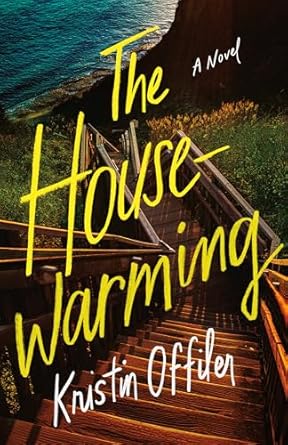
Told through multiple points of view, this mystery follows estranged friends Callie, Meg, Tess, and Lindsey as they are drawn back together on the five-year anniversary of their friend Zoe’s disappearance. At the same time, zealous true crime podcaster Patricia Adele (who initially ruined their lives in the wake of her own exploitative investigation) also reappears. Patricia has a book about Zoe’s case in the works, and she’s ready to barb them all with fresh questions and provocative new leads, even as Callie, the group’s default leader and original Judas, plans a special housewarming memorial to honor Zoe on Block Island, where the girls had their final summer trip together and where Zoe was last seen.
This novel is the story of four grieving friends still trying to put their lives and, tentatively, their friendships back together. They face opposition not only from Patricia but one another, as each brings her own secrets and confessions to the party.
This book is nearly perfectly paced, as a mystery ought to be. Nothing ever dragged, and I ate up each chapter as the author breadcrumbed tidbits and planted a few effective red herrings. I also enjoyed all the details of the Rhode Island setting—the houses and beaches of Block Island, plus the one-way streets of fancy, touristy Newport, with which I’m familiar.
The novel also does a nice job questioning whether true crime blogs and podcasts are an ethical form of entertainment. Patricia’s desire to feed her own amateur investigations and speculations to her fans drives her intrusive, insensitive behavior, even as it comes from a strange, sad place of personal alienation and has a clearly negative impact on Zoe’s friends and family. It’s a timely, relevant issue, considering how real-life bloggers like Turtleboy affect cases like Karen Read’s. I’m a true crime junkie myself, and the novel made me consider whether my love for these podcasts is in good taste, and whether these influencers pose a real threat to the justice system.
Karen Read and blogger Aidan Kearney, also known as Turtleboy. Image from the Boston Herald
The best thing about The Housewarming, however, is its exploration of and ultimate tribute to female friendships. These women feel real, and my heart broke, then mended, over all the ways their shared tragedy and time both together and apart evolved their relationships, just as it does in real life. This book struck me as a kind of love letter to all the girls’ girls, all those who grew up with a tight-knit group enjoying their own little traditions and intimacies and struggling with their inevitable secrets and betrayals as life reshapes them.
In this spirit, I love how the missing woman, Zoe, is given a voice at the very end, her single chapter creating a bittersweet clarity and poignancy that made my chest ache. Readers find out enough about what truly happened to her, and who Zoe actually was, to feel satisfied, while the story retains a haunting, realistic degree of ambiguity. There is no single, neat bow to tie everything up, and I appreciated that.
My only real nit-pick with this book was my feeling that Patricia the blogger’s story was incomplete. Her point of view is given a chapter once at the beginning and once in the middle, and I wish she’d been allowed one more chapter of her own at the end, perhaps to complete her own arc or provide a glimmer of something she might have learned or how she might change (or not change), or to plant the seed of something she might have realized based on what she witnesses at Callie’s party.
I recommend this thoughtful, seasonal book for anyone who loves mystery and women’s fiction. Congratulations to Kristen Offiler for a strong debut!
Hello, rejection, my old friend. I’ve come to talk about you again.
But, as promised, this post is brighter.
Last week I lamented a difficult rejection I got early in July. Suffice it to say, it was for a short horror-romance I felt good about. I’d worked hard on it, and I thought it had a good shot. I also really wanted the validation from that particular small press.
This week, I’m feeling better. The sting is almost gone, and after three weeks reflecting, I’m reenergized for two reasons.
First, I get more time to make my story better.
If I still like it, then I’ll dive back in to make it more tense and propulsive, particularly at the beginning. If the editors only read the first few paragraphs of each submission, I can see how they might have thought mine was too slow.
Having listened to a fabulous podcast on effective scene work, I’ve already considered how I might intensify the conflict in that initial scene while still laying the foundation for the female main character’s arc. Right now, things are nearly perfect for Carly in those opening paragraphs; I think there’s a lack of effective tension.
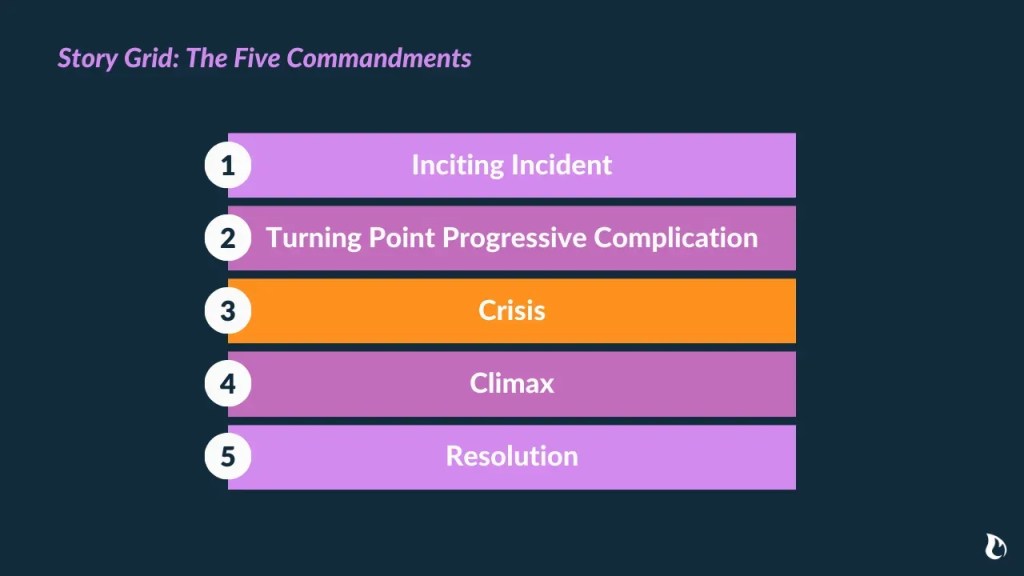
These five elements must be present in every single scene. Image c/o campfirewriting.com
Such revisions could also improve Curran, Carly’s love interest and the story’s primary antagonist. Right now, I suspect he’s rather bland, especially at the beginning where he’s just pleasing Carly. That’s a definite failing because his awful backstory and inner struggle (despite the glow-up he’s experienced) make him absolutely ripe for deeper characterization, even in the story’s first section of dialogue. There’s opportunity for him to resist Carly because he desires her yet senses there’s something deeply wrong with him, so he wants to protect her, too.
Honestly, this challenge excites me. If anything, it will be fabulous practice for writing well at the scene level, even if this story never gets published.
Conflict! Conflict is the key, always. It’s the driving force, what compels the story forward, what gets readers turning pages. There needs to be enough of it, even at the very beginning. Even if it’s subtle.
More time also means the opportunity for professional feedback. I’d love to have a minor (translation: available and affordable) developmental editor who specializes in adult horror/speculative fiction review this story and tell me whether or not it lands. If it doesn’t (it probably doesn’t), someone who can tell me what might enable it.
What might ensure the story’s ultimate resonance and target reader’s satisfaction? Is either the A story or B story not clear enough? Is the horror element not awful enough? Is it missing a romance beat? Is the pacing off? Is there too much focus on one aspect and not enough on another? Does it suggest insensitivity regarding either of its harder topics (bullying, erotic asphyxiation/sexual assault)? Does this genre mashup just not work?
I truly think I can make this piece memorable and gratifying, and I’d love to start down a horror-romance path as a possible niche, if there’s promise here. While I can make additional self-edits with fresher eyes, ultimately I’d rather not rely solely on my own judgement, even as I’m reading Shawn Coyne’s The Story Grid right now (a method he claims can help writers edit their own work more objectively). I feel like I’m doing what he’s describing, but this self-perception could be totally distorted. It wouldn’t be the first time. I’d love a professional to weigh in, somehow.
So, there it is. More time, in this case, is a gift.
The other reason I’m feeling better is broader, more philosophical.
Generally speaking, rejection is protective.
Not just for the publication, but for the writer too. It hurts one’s credibility if a piece is published when it’s not ready, or the author herself isn’t ready. Even on a small scale, we want effective work out there in the world; we really only have one shot with a reader.
I already have some experience knowing a piece is in print when it needed more time. It’s not a good feeling. If we’ve already put in the effort to create something thus far, we ought to muster the patience to keep going, if that’s what the story needs. We need to delay that instant gratification, digging deep if necessary, to keep the big picture in mind, that long game. Our later selves will thank us for it.
And sometimes, rejection exists to remind us of that. Though it might feel like a slap, it’s not. It’s a pat on the head and a “shoo” out the door: Thank you, but go, please. Make this better.
I’m reminded of some advice from author Clare Beams, which I have printed and taped into my writer’s portfolio (yes, I’m the nerd who does stuff like that):
“Be as patient as you possibly can–and then try to be one degree more patient than that. This path is a wonderful one in many ways, but it is long, and will feel long, for just about everyone at one point or another. Taking the time to get the work itself exactly right–to craft the absolute best possible version of this piece of writing that this version of yourself is capable of producing–is something you will never, ever regret.”
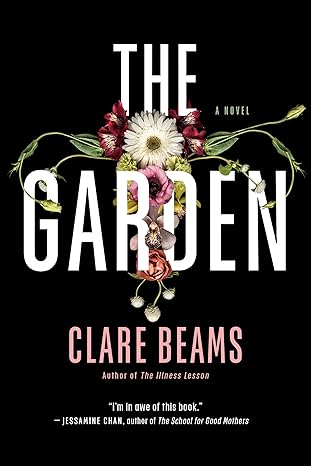
Beams goes on in this same Writer’s Digest interview to describe the time and revisions it took to get her novel The Garden just right:
“The first glimmers of the idea for this book came to me in late 2018. I sold it as a partial manuscript to my editor in early 2021, and submitted a full draft to her about a year later. She and my agent and I then all jointly decided the book was sapping some of its own hauntedness by dipping into the wrong head for big swaths (at that time the book had two main points of view), and that the whole thing needed to be told from Irene’s perspective. This was absolutely the right course of action, though it was daunting—I wouldn’t say it represented any kind of change in my original vision for the novel, but rather a change in my sense of how best to capture that vision. The various subsequent rewrites took about a year.”
This is a fabulous example: a single novel six years in the making, involving a collaboration that resulted in major, “daunting” revisions to improve its execution. The praise for this book, however, speaks volumes about the value of that time and effort. Though I’m a newb to all this, I don’t think what Beams describes is exceptional. I think such time and effort are the professional norm.
So, I am hopeful. Rejection is normal, even beneficial, and my armor is getting sturdier, my patience better. I plan to get back into this horror-romance soon, while Daphne still has one more week of extended school year and I still have some time to myself on these summer mornings.
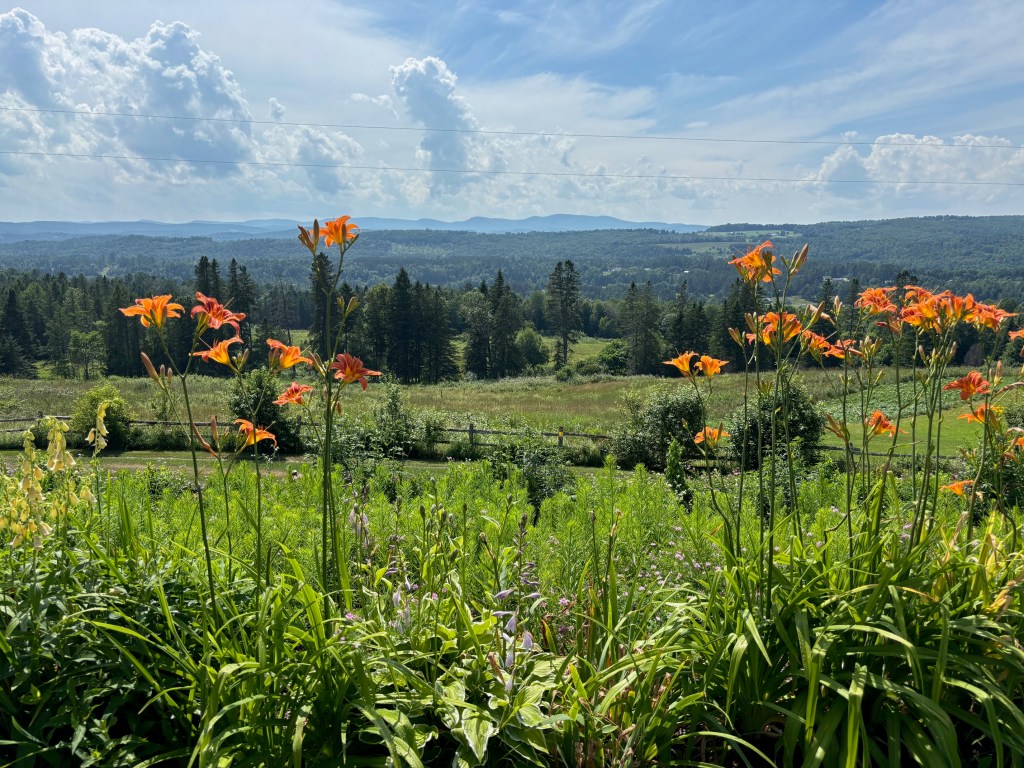
Summer view from the top of Darling Hill
If, in the long run, anything interesting develops for this project, I will be sure to update you.
In the meantime, please feel free to share any other reasons why rejection is good. I’m sure I’m overlooking something.
Eight days ago, I opened my email and saw at the top of my inbox the notification I’d been waiting two months for.
Dear Jennifer, Thank you for submitting…
The salutation sickened me.
I knew what the rest would say–that this small horror press was passing on the story I’d submitted in late April.
I sat there for a minute, a little stunned, comprehending the implications. I considered deleting the message and trying to go about my day. But of course, I couldn’t resist clicking and reading the entire form letter because there was an irrational sliver of hope that it might just surprise me. That, maybe, this press didn’t start their acceptances the same way everyone else did, with Congratulations!
Such wishful thinking.
Sure enough: Unfortunately, we are passing on your piece at this time.
This wasn’t my first rejection of the year. I’d had another one, about two weeks prior, from a literary magazine with a 10% acceptance rate for my contemporary story, “You Should Have Stayed.” I’d expected that one, but since my story fit their theme, and I’d revised it thanks to some excellent and encouraging professional feedback, I figured it couldn’t hurt to try. When that notification arrived, I felt I’d done all I could and was proud of myself for trying. That particular note was longer and warmer, too. I’m not entirely sure it was a form letter.
This one was shorter and more terse. A definite form letter, and it stung.
The sting is lessening, thankfully. Now, it’s more like an occasional smarting, since I’ve had several days to reflect on it–and, blessedly, not the luxury of time to wallow, what with a camping trip, family in town, a kiddo to take care of, and a husband on the mend.
Now, I can calmly articulate why it hurt and why, on the flip side, it’s quite likely a good thing.
Sunset on Maidstone Lake in northern Vermont. Photo by hubby
First, the more obvious: why it felt like a wound.
I worked hard on this piece, a 6K spicy horror-romance. I labored at it for most of March and April, scrapping my first attempt entirely and letting it evolve into something simpler and much better. I trusted the process and became emotionally invested in the characters, which I felt was a good sign. I was on to something. For sure.
The call for this particular anthology was also a brilliant opportunity to try my hand at a newer blend of genres, one with all the primary romantic beats but with a narrative shaped by the horrific. In this case, a woman trying to come to terms with a difficult past just as she discovers, one terrible night, that her amazing new boyfriend is actually a werewolf ready to tear her to pieces. And not in the mind-blowing sexual way, though they do have great sex before things go south.
No, this wasn’t a typical paranormal romance. No sexy shifting, no Omegaverse, no knotting. It was much more old-school American Werewolf in London style, much more horror-driven, and much more emotionally compelling (or so I thought). The shifting is torturous and frightening, a brutal and irrational affliction, and the suffering man needs help. My female protagonist, who finds a surprising new strength and redemption, is there, in the end, to save him, even as he helps her too. It’s Carly’s story primarily, though, and I loved her arc. I still love her.
Image I created on Microsoft Design while writing my story. I’d hoped it might be a sample to give a character artist so I might commission something way better, if the story got accepted.
Now, though, I have to wonder if my perception was totally skewed, even more so than usual (since none of us are ever totally objective about our own work).
I’ve always assumed, if something feels great to write, it must be fairly solid. That’s only logical, right?
But then, I’m reminded of all the articles I’ve read where the authors describe being passionately invested in certain pieces, only to realize much later they’re actually flat. Fundamentally flawed, somehow, but they loved these works too much to see it.
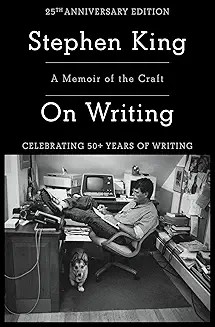
Or the reverse, as Stephen King described of his debut success, Carrie. How that novel felt awful to start, and he actually threw it away, only to have his wife rescue it from the trash can, her objectivity allowing her to see its potential. Sometimes, he tells aspirants in his book On Writing, something is sound and worth pursuing even when it doesn’t feel good to write.
So how the hell are we supposed to know? Is there really a way to tell the difference?
How do we know what’s strong and worth fully pursuing, versus what what’s actually weak and should be relegated to an e-file and nothing more?
Maybe the answer here is, time. As much time as we can allow between the completion of a working draft and a revisit, when we can look at it with the freshest eyes possible. It’s hard to find that kind of time, however, when we have deadlines.
Or, maybe, we never quite know. Even with plenty of time. Even with alpha and beta readers, critique partners, and editors giving us positive feedback within that ample time. Maybe it’s just something we can never quite perceive correctly, never quite control.
Plus, there is the subjectivity. Even if the fictional elements are sound–working scenes all connected by a through-line, a dynamic protagonist who experiences a clear arc, the submission and genre expectations met–what appeals to one publisher might not appeal to another. How are we supposed to know who will like it? How do we get a surer sense where that’s concerned?
Actually, I know the answer to this question: you read some of the work that publisher has already produced. Though I’d purchased two books from this press, I didn’t take the time to start either one. Maybe out of fear, I suppose, that I’d realize how inadequate I was. But it would have been a good idea, and that mistake is on me.
This ignorance, this blindness, terrifies me. It feels like a permanent handicap we have to figure out how to live with, or how to manage, so that our hearts don’t get broken over and over and over again. How do we manage it?
Or, maybe I am just a “sweet summer child” in the world of publishing. I’ve just begun this writer’s odyssey, after all.
Maybe, our hearts must break on the regular. Maybe, that’s the life of a writer, or at least one trying to get published. Maybe, it’s always a little painful because we have to take chances when we feel one way but know the truth might be entirely different. The fewer the chances, the less likely we are to succeed, right? Isn’t this just another form of gambling?
Ugh.
So, there you go. That’s the first reason this rejection hurt.
The other one is, I wanted validation. Having my story selected by a more established, competitive press (one with an acquisitions team!) would bring me a surer sense of legitimacy. A little more evidence that I’ve leveled up, that I have some promise. That I’m not wasting my time.
I realize, however, this is a dangerous desire. If I want the stamina it takes to make it in publishing (whatever that actually means), I have to find that validation from within.
Looking for it externally only leads to forever moving the goal post and never being able to appreciate, even enjoy, the progress I do make. And I do believe I am getting better. Blind as I ultimately am, I think I have enough clarity to see that the three short pieces I’ve written this year are better than any short piece I got published last year, even though only one of these three has been accepted so far.
Many people say, if you write, you’re a writer. I need to start believing that. Maybe, I need to write these words down and keep them nearby, and speak them out loud each time I sit down to compose. I think I have some mindset work to do.
For the sake of length, I’ll end this here. Next week, I’ll have a cheerier reflection–why rejection might actually be a great thing.
In the meantime, I acknowledge how extraordinarily privileged I am to call a story rejection a “problem,” a source of pain. So many people are suffering right now and would sell their souls to have their heart ache for this reason.
I didn’t just lose a child in a flash flood, or have my child taken by ICE. My husband didn’t just lose his job to AI. I could go on and on about all the nightmares that didn’t just happen.
Thank you for reading. If you’ve had similar experiences with rejection or want to offer any words of wisdom, whether you’re a writer or not, I’d love to read them.
Last week I alluded to some craziness in our June, but let me preface this post by saying, it hasn’t been awful.
*Cue the Halleluja chorus*
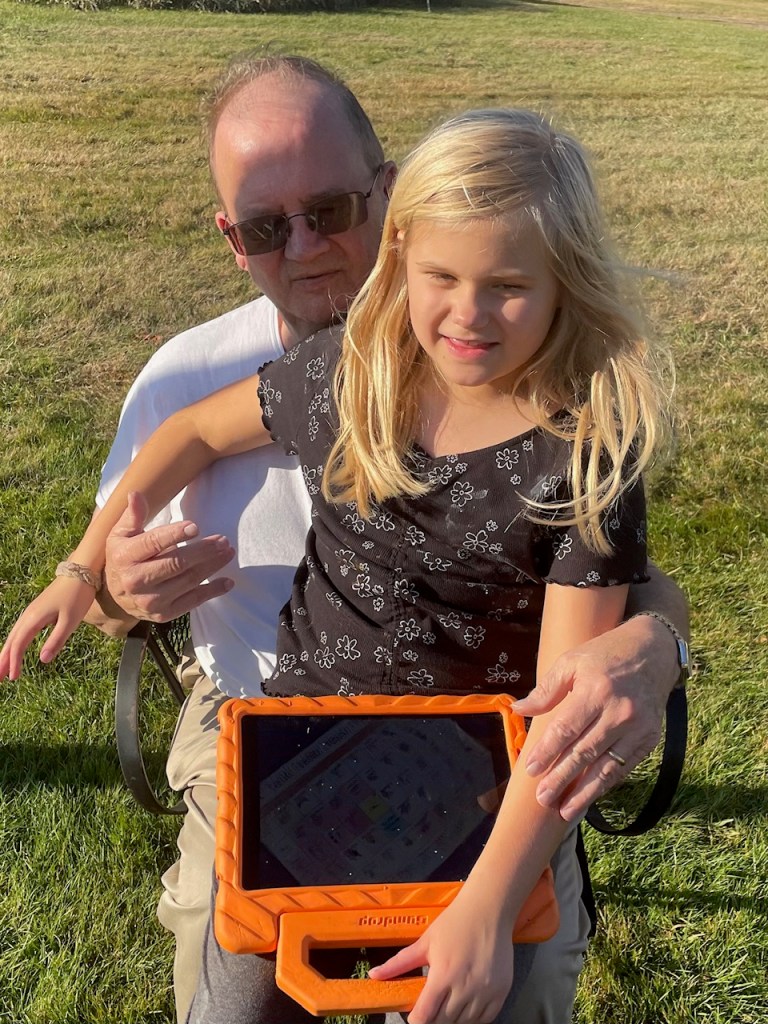
On the contrary, Daphne is doing quite well, especially compared to this time last year, when she had continence issues and regular meltdowns that often involved smashing her iPad.
This summer, she’s been generally happy… I need to find some wood right now.
*Knock, knock*
Anyway, things have been smooth for her. When that’s the case, everything else is easier, and I’m definitely more chipper.
Pleasant summer day
She’s been off for three weeks. The first two she spent at home, and I decided I wouldn’t push a strict visual schedule like I did last summer (about which I labored, continuously on this blog, to convince myself was actually helping her; it was not).
Instead, I simply aimed for general consistency: breakfast, outside time, 2-3 indoor activities, errands, then dinner and bedtime. It’s been working. She’s been compliant, cheerful, and occupied enough with sensory input and some academic and OT-style skill-building for me to feel ok with the time she does spend on YouTube Kids, while I fill Mythic Moose orders or simply catch my breath.
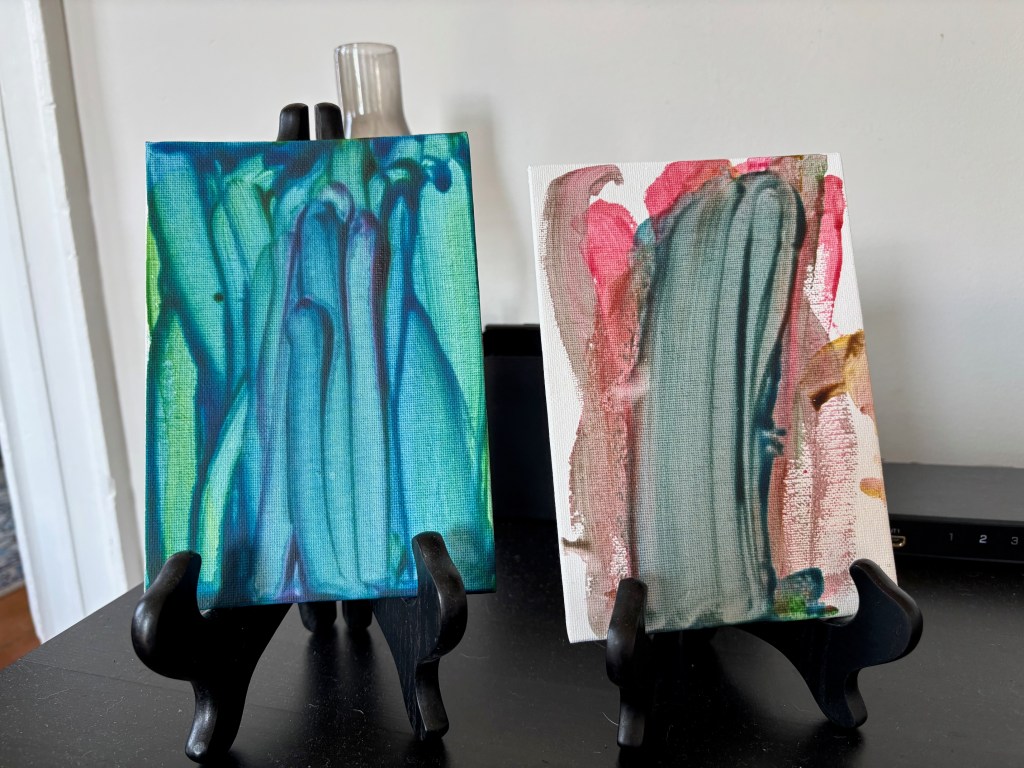
Daph’s been painting, and I love her work. The one on the left makes me think of undersea flora; the one on the right looks like a waterfall at sunset.
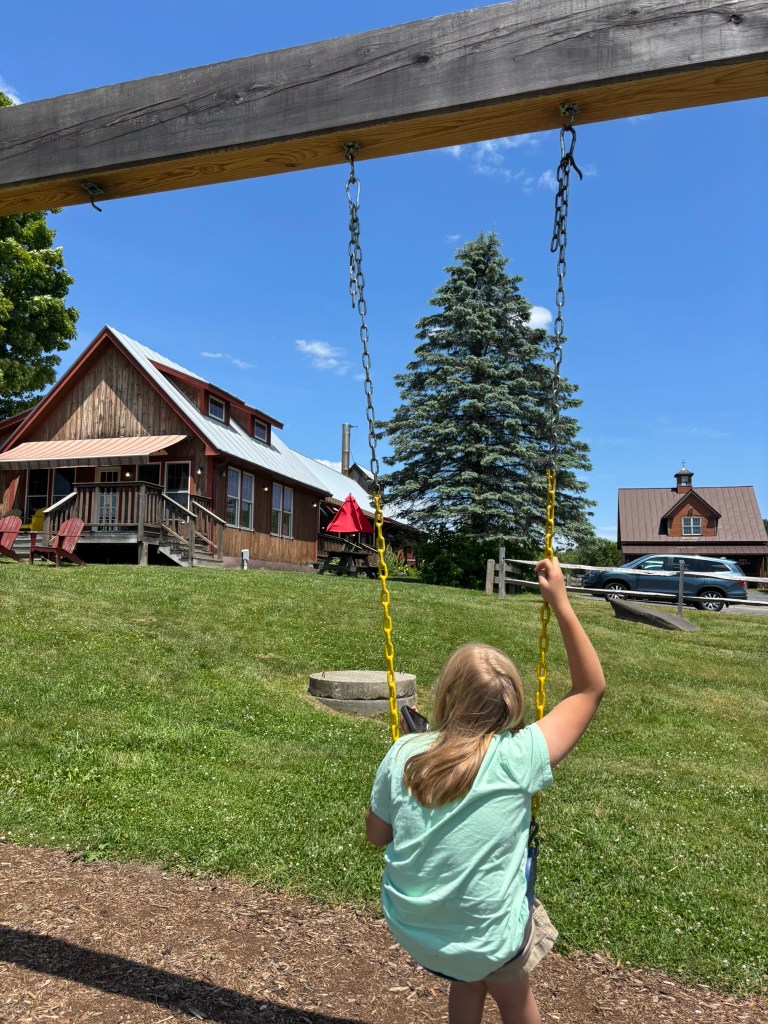
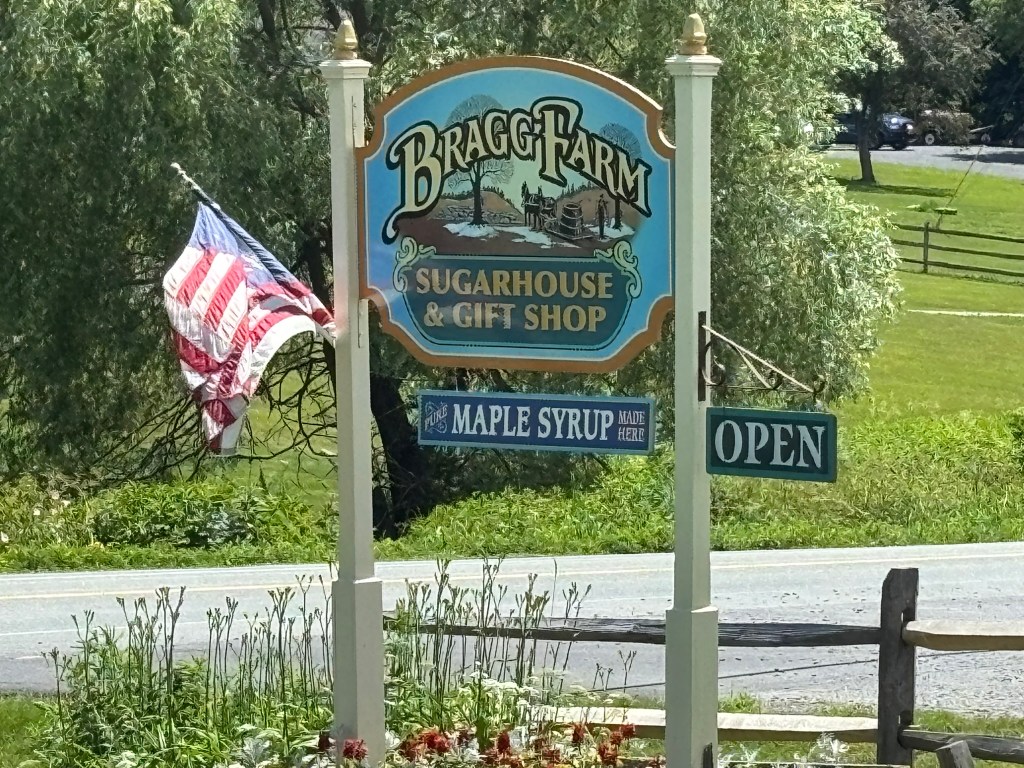
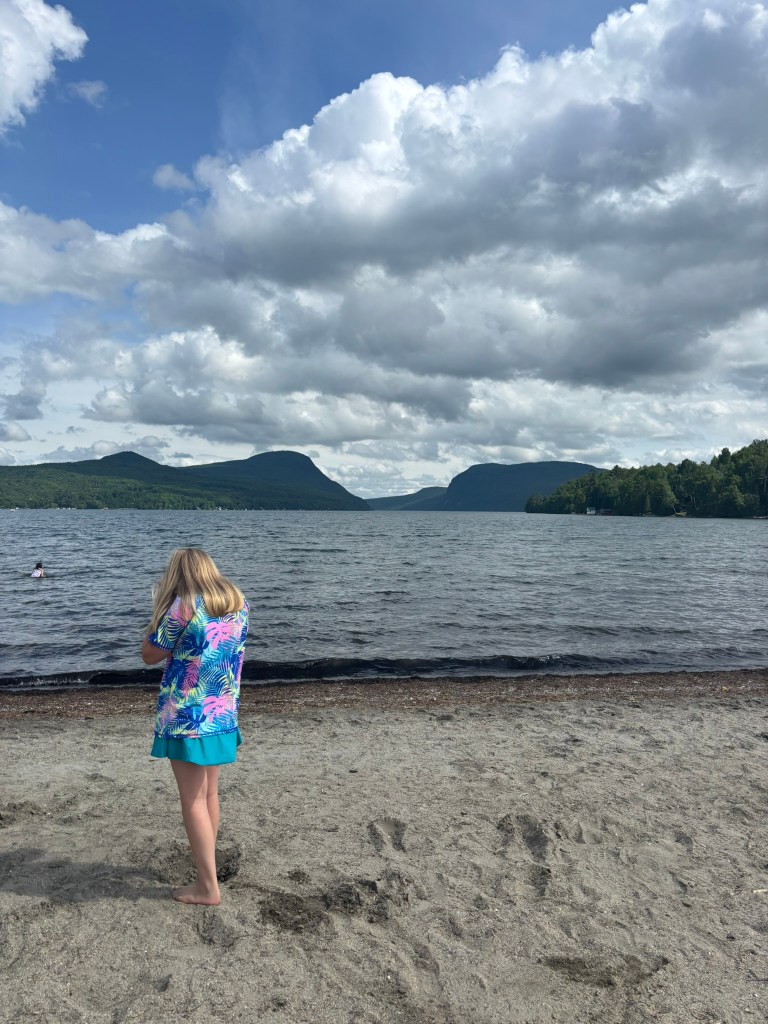
We’ve also made some treks out: to Get Air, the big trampoline park just outside Burlington, Bragg Farm to look at the animals and share a Maple Creemee (a Vermont soft serve specialty), and of course to the lakes, Willoughby and Crystal.
Bragg FarmSo cute, so Vermont
Those special days are fabulous for filling the downtime even more pleasantly.
North Beach on Lake Willoughby
Last week, she started her extended school year (ESY) services in the context of the district’s summer camp program. Now, for the month of July, she goes to half-day summer school four days a week, and Paula, the fabulous paraprofessional who worked with her in Kinder and First Grade, is her summer 1:1 aid.
*Cue the Halleluja chorus again*
I now have three and a half hours to myself every Monday through Thursday in July, and it’s perfect. I can weed the garden, do some light cleaning, write a bit, and relish my summer reading.
Baby bell pepper in our gardenBaby Roma tomatoes
When I pick her up, she’s content and regulated from the change of scenery, and I’m more refreshed. It’s even easier to have a good afternoon playing and doing her activities as usual.
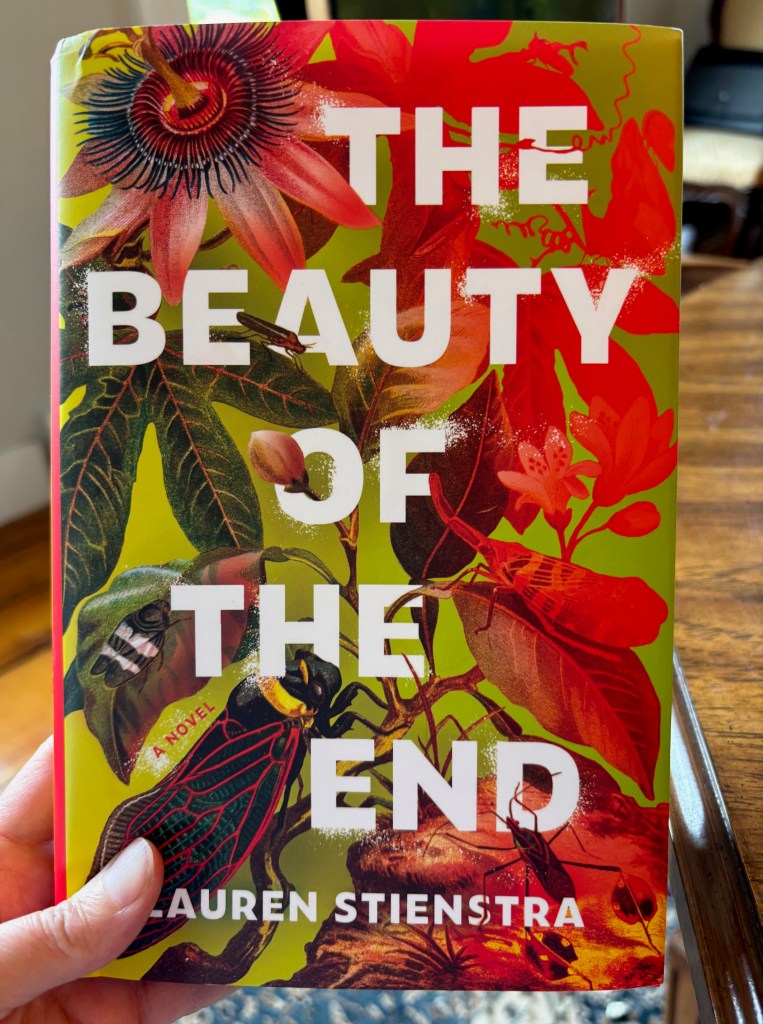
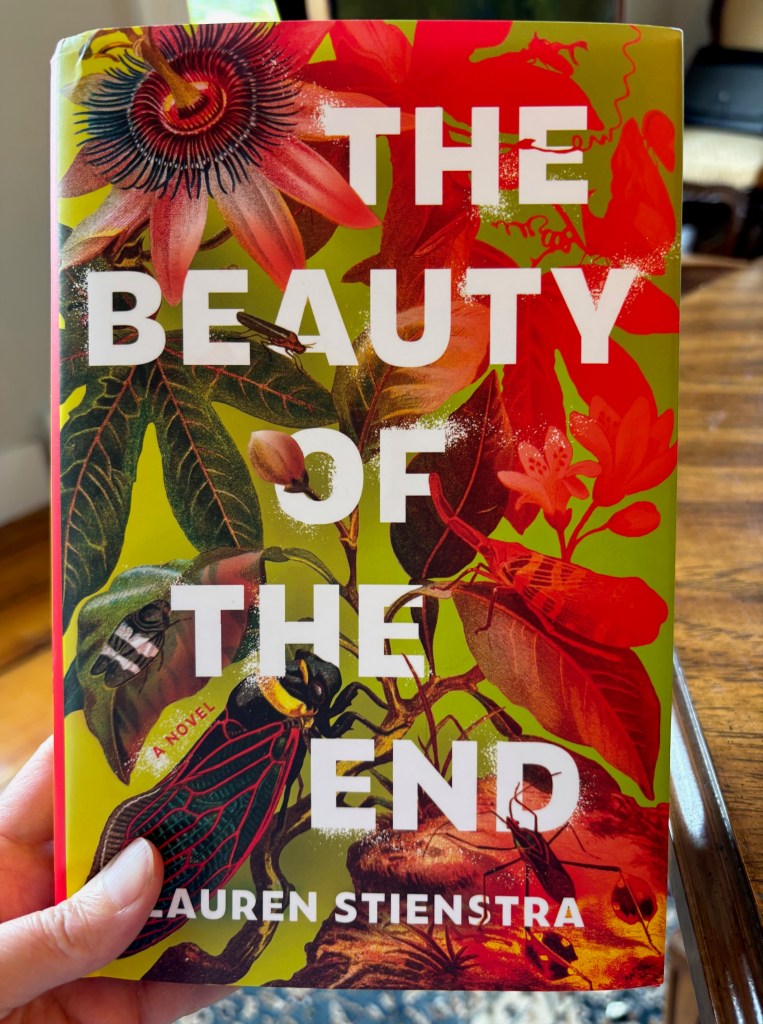
Novel I just finished; now I’m starting MEXICAN GOTHICby Silvia Moreno-Garcia
So all of that’s been positive.
My poor husband, though, has had a rough time. His upper abdominal pain flared up again in the middle of the night, despite us doing our best to follow a low-fat diet. He drove himself to the ER, where he was admitted and X-rayed. The pictures revealed a stone lodged in the opening of his gallbladder, so the attending doctor admitted him and booked surgery to remove the troublesome organ. Since it wasn’t technically an emergency, the doc didn’t wake the night surgeon, but they took his gallbladder out the next day.
It was minor surgery, done arthroscopically, and he’s healing well, but he’s been sore and unable to do as much. Then, just as he was feeling more normal, a sebaceous cyst on his back became infected, causing fresh, awful pain and a fever. Thankfully, that happened just as he was due for his surgical follow-up, so the nurse who saw him went ahead and drained the cyst. It was more brutal than I thought–she cut pretty deeply. We’ve been changing his seeping bandages regularly, and he’s on a round of antibiotics, which never make him feel great.
“I’m a walking calamity,” he said. “And I’m tired of being cut on.”
When it came time to take out the gauze the nurse had inserted after the procedure, he asked me to help.
I was expecting a half-inch wedged into the incision.
Oh, no.
It was, like, six inches packed into his flesh. I kept pulling and pulling, too slowly while he hollered. The blood and pus welled out, and I about lost my lunch.
Adding to that fun, while he was still in the hospital, a brutal heat wave descended, and Daph and I had to sleep downstairs where we have two AC window units. The upstairs becomes an oven on these rare days. We have a metal roof that’s meant to trap heat for the depths of winter, which it does beautifully, but it roasts us when temps climb into the 90s, even at night.
So, we were sleeping downstairs when early one morning, I heard what I thought was a vigorous egg song coming from inside the chicken coop. I didn’t get up, I admit, but when I did finally pad into the kitchen for coffee around seven, I glanced out and noticed the raised lid on the coop’s nest boxes.
What the hell?!
Panicked, I scanned the yard, looking for strewn feathers. Instead, I saw all four hens standing on the rocking chair up by our porch, looking spooked but fine.
Later, Jer checked the footage from the Google Nest cam over our garage. This is what he saw:
Holy crap
Thankfully, that big guy didn’t get any chickens, eggs, or trash (it was the day after garbage pick-up, and the can was empty), so he hasn’t been back.
It’s definitely predator season, though. At our barbecue on July 4th, all our neighbors and friends swapped stories of recent chicken attacks. Bears, foxes, raccoons… one friend’s poultry are so terrified, they’ve stopped going into their coop at night and are roosting instead in the trees, higher up. Another friend’s hen lost an eye, and she’s been trying to find a local veterinarian who will treat backyard chickens.
Hence, the chaos I mentioned. But, things seem to be calming down.
I also received my developmental edits for my story “Elspeth and the Fairy.”
A mock book cover for my story using Microsoft Design
I had a sick stomach opening the editorial letter, but to my relief, even delight, I read almost nothing but enthusiastic feedback, with only a few suggestions, all centered around deepening the impact of the protagonist’s emotional struggle.
“There’s very little to do developmentally,” my editor wrote.
*Cue the Halleluja chorus for a third time*
So, I’ve been working contentedly on those, and they’re just about done. When considering her suggestions, I actually divided my story into scenes and analyzed each for the requisite components: clear protagonist & antagonist, inciting incident, progressive complications, crisis, climax, resolution, and a character (protag or antag) who clearly “wins” that scene.
I’ve thought about doing this before, but I’ve never actually made myself go through with it. It took a little longer than I thought, but it revealed how I could develop more tension in my first two scenes. Not surprisingly, the weaknesses this analysis revealed aligned nicely with my editor’s notes.
That’s it; just a quick little catch-up. I hope you’re well and your summer’s going smoothly. If you’ve had any interesting adventures, I’d love to hear about them. Hopefully, they’re nothing too dire.
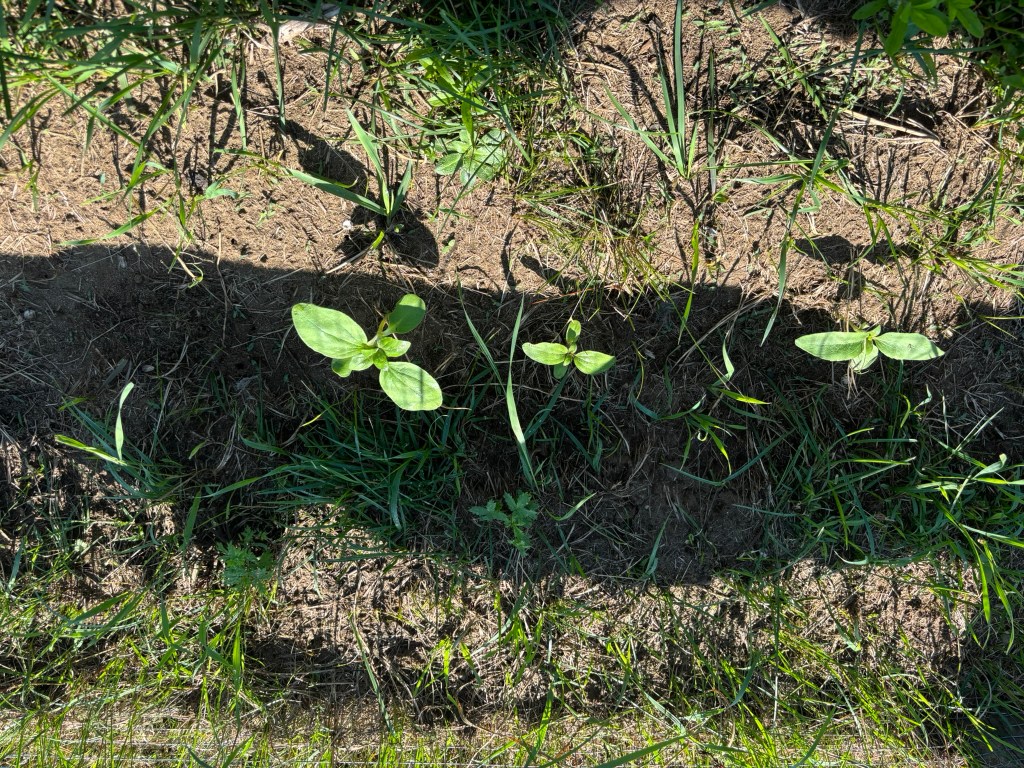
Baby sunflowers
See you next week!
XOXO,
Jenn
Postscript: I was finalizing this post just before I read about the horrific flooding in Texas. I don’t personally know anyone affected, but my father does. All the nightmares coming out about it have stopped me cold, and I’m not ready to fully acknowledge it. I might write about it next week, but for now, please know I find it devastating, and my prayers are with the families.
Do you remember the first story that made you fall in love with a different time and place?
For me, that book was The Witch of Blackbird Pond by Elizabeth George Speare. It ranks #2 in the top three childhood titles that shaped my bookish tastes and, eventually, my writerly aspirations.
Here’s a synopsis of this wonderful historical novel, published in 1958 and winner of the prestigious Newbery Medal:
Orphaned Kit Tyler knows, as she gazes for the first time at the cold, bleak shores of Connecticut Colony, that her new home will never be like the shimmering Caribbean island she left behind. In her relatives’ stern Puritan community, she feels like a tropical bird that has flown to the wrong part of the world, a bird that is now caged and lonely. The only place where Kit feels completely free is in the meadows, where she enjoys the company of the old Quaker woman known as the Witch of Blackbird Pond, and on occasion, her young sailor friend Nat. But when Kit’s friendship with the “witch” is discovered, Kit is faced with suspicion, fear, and anger. She herself is accused of witchcraft! (from Goodreads)
I first read this book on my own when I was in fifth grade. I was introduced to it when I was out with a school friend at The Galleria, Houston’s biggest, fanciest mall at the time, right off the ritzy 610 Loop.
I’d spent the night with her, and her mom dropped us and her teenaged sister off there for the day (Jeez, can you imagine a parent dropping off ten-year-olds now to be anywhere alone in public?!). We walked around, bought candy at the fancy sweets shop, ate lunch like big girls at Birraporetti’s, and spent the remainder of our time inside one of the multiple book shops, maybe the Walden Books (ah, my Houston nostalgia is panging hard right now). We both spent most of our mad money on novels, and one of the titles Kelly grabbed was Speare’s famous book.
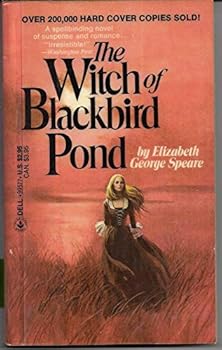
This was the cover on that particular copy:
from Amazon
Isn’t that gorgeous? I was taken by it.
Others have been, too. Last year, Briar Press NY featured this one in a brief reel of their favorite old-school gothic books covers.
I can’t remember if I bought my own copy that day, but regardless, I read the book not long after that.
And, over the years, I read it again and again. It was even our English class’s novel study in eighth grade, the same year we first had American History.
What an impression it made on me.
Katherine “Kit” Tyler was a wonderful heroine–impulsive, determined, yet kind and easily chagrined. She was also homesick, which paralleled some of my own feelings because we had moved recently to a new neighborhood in a different suburb of Houston, and I had started at a new school and was making new friends. I sympathized with Kit’s feelings of loneliness and alienation.
Kit on the dock; image from Microsoft Designer
I was also fascinated by the community described in the book. The New England Puritans, I understood, were a strict and strange religious people, and I remember thinking how awful it was for Kit to sit for hours every Sunday listening to a never-ending sermon as the pew “bit into her thigh” (that line has lingered). But the people of Weathersfield also enjoyed a strong sense of community and managed to work in some fun when it was appropriate. I learned about the village dame school, where Kit assists, Puritan courting rituals, and husking bees, for example. Later, when I studied Puritanism in more depth, memories of this story gave me a strong foundation for understanding, as children’s historical fiction ought to.
I also remember some of the imagery Speare uses to describe Kit’s first experience with the breathtaking fall foliage: “jewels” or “jewel-colored,” I believe were the words, and I thought how amazing it would be to see that for myself. (So glad I now can, every autumn!)
I liked the dynamic with her cousins, too: Judith and Mercy were quite the foils to each other as Judith was the town beauty and Mercy the quieter, kinder, more spiritually-centered model daughter. A Puritan household of three teenaged girls was an amusing situation, even if the liveliness was restrained.
Then, there was the romantic element.
The multiple romances develop quietly and naturally, well-aligned with Speare’s lovely, spare style. The central love story belongs to Kit and her sailor friend Nat, who serves as First Mate on his father’s ship that brings Kit from Barbados after her grandfather dies to Weathersfield, Connecticut, to live with her aunt and uncle.
Though Nat and his family hail from nearby Saybrook and our New Englanders themselves, they are people of the sea first. They have a worldliness and wisdom most of the other Puritans do not, so Nat understands why Kit dives into the water in the opening chapter to rescue a little girl’s dropped doll. Though irritated as he automatically jumps into the icy harbor after her, he isn’t shocked the way her fellow passengers are, once he realizes she can stay afloat. He understands that people from warmer climates often swim, that it’s not a sign of witchcraft, as the Puritans believe.
Thus, he is one of the few characters who seems to understand Kit–her habits, attitudes, and the world of tropical England from which she hails. He is her only lifeline to home; he is also a friend of Quaker Hannah’s, like Kit. It is there, in Hannah’s home on the outskirts of the village, helping out this gentle, loving elderly lady, that Kit and Nat are reacquainted and their friendship deepens.
Nat and Kit; image from Microsoft Designer
When Kit is arrested on charges of witchcraft–not long after poor old Hannah herself–guess who rescues them both?
It is when the novel resolves, however, when Kit is safely back in her aunt and uncle’s home and Nat is gone on another long voyage, that she aches deeply for him. She realizes she must love him and fears she will never see this nonchalant, happy-go-lucky, yet noble young sailor again. In the novel’s final scene, when she is visiting the docks looking for his father’s returned ship, she notices a new “trim little ketch” tied up, and a man in a bright, blue coat bent over checking cargo. It is Nat, and before she can restrain herself, she cries out for him. They run to each other, clasping hands. It is their first and only act of physical intimacy in the story, but it is hard-won and deeply satisfying. Nat tells Kit he wants to speak to her uncle and refuses to take her onboard the new ship that is now his own. When she protests, he tells her: “When I take you on board The Witch, it will be for keeps.”
Wow, did that make my little preteen heart swoon!
Another notable romance in the story happens quickly and unexpectedly between John Hale, a young minister, and Kit’s quiet, overlooked cousin Mercy (who I believe had a limp, if I recall correctly. Yay to Speare for including a character with a disability, long before inclusivity was lauded as a key value in children’s literature). John returns from an expedition fighting Indians. Having risked his life, he goes straight to Mercy, not Judith, who he’d been pressured into courting after Kit unintentionally caught the eye of the man, William, who had previously courted Judith. There, he puts his head in Mercy’s lap. That tender, honest moment, so rare for these two proper, people-pleasing characters, also made me want to leap for joy.
By the end of the novel, all three girls in Kit’s household are engaged to be married. Judith does find her way back to William, thankfully.
These are the attributes that stood out to me in my childhood. The book’s greater value, however, lies in its message of kindness and acceptance, particularly of those who are different from us, who we might not understand immediately. Old Hannah, a Quaker, has spent her life being dangerously judged and alienated by the righteous and indignant Puritan community. Yet, she remains a generous, virtuous soul, and Kit recognizes this truth, even as she faces a similar situation. Hannah is another friend and ally for Kit when she needs love and acceptance most, and together, Hannah and Nat represent a powerful found family for this novel’s heroine. New connections, friendships, and love are always possible, the novel also suggests.
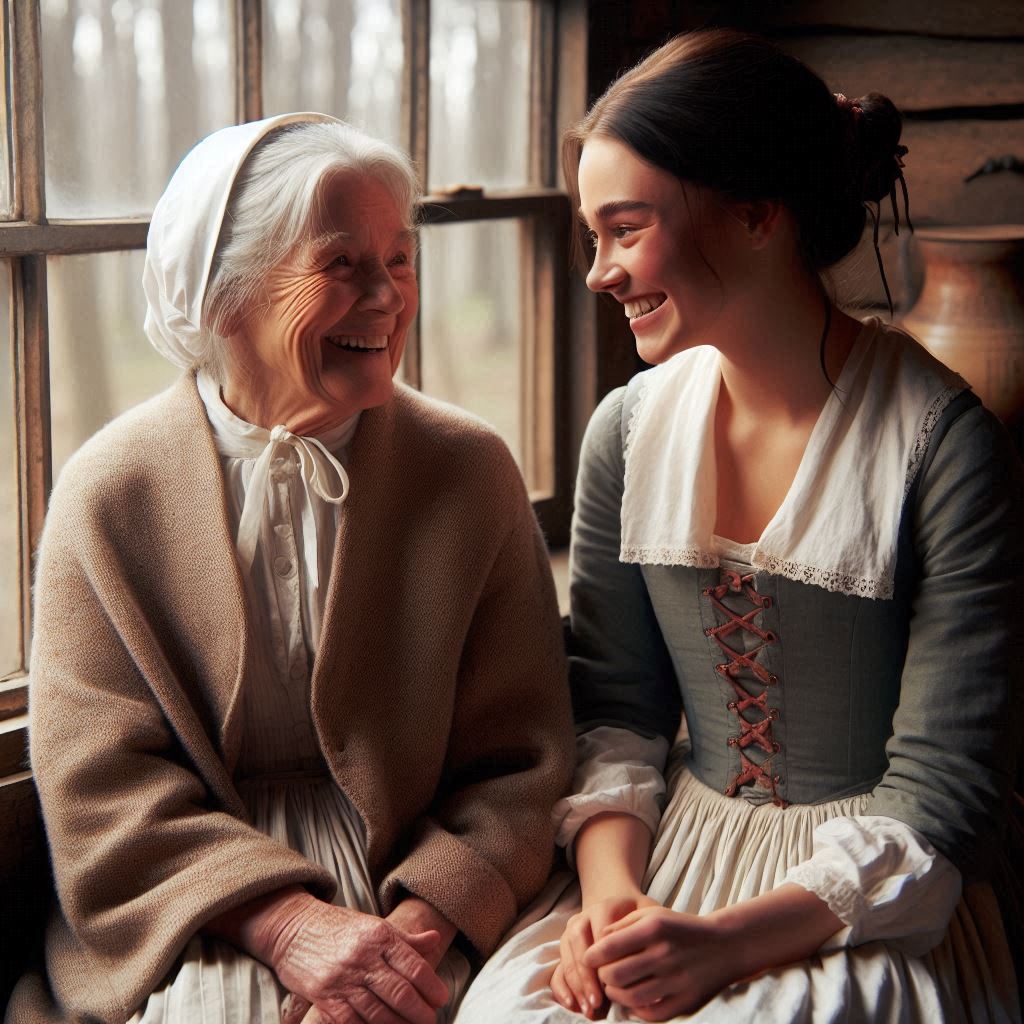
Hannah and Kit; image from Microsoft Designer
Though published long ago, this book still has so much value. I have no idea if it’s still taught in schools. I suspect not, given that it probably appeals more to girls than boys, and best literacy practices suggest that material appealing to both sexes is more effective. Plus, it does not represent people of color, so its diversity is arguably limited. It’s also potentially problematic in that Kit comes from a Barbados plantation that would have had slaves; her beloved grandfather would have been a slave owner, and that’s not a topic addressed in the story. So, I understand if this “old fashioned” book is overlooked in favor of more modern, representative titles, and there are so many of quality out there.
However, Goodreads’ statistics give me hope. According to their website, 2,431 people are currently reading The Witch of Blackbird Pond, and 85,197 people want to read it. They’re probably all adults, and that’s totally okay. These numbers are impressive for a children’s novel published 67 years ago, and they cement Elizabeth George Speare’s legacy in historical fiction.
What was a favorite historical title of yours when you were young? What did you learn from it?
See you next week, when I plan to fill you in on the craziness of our June.
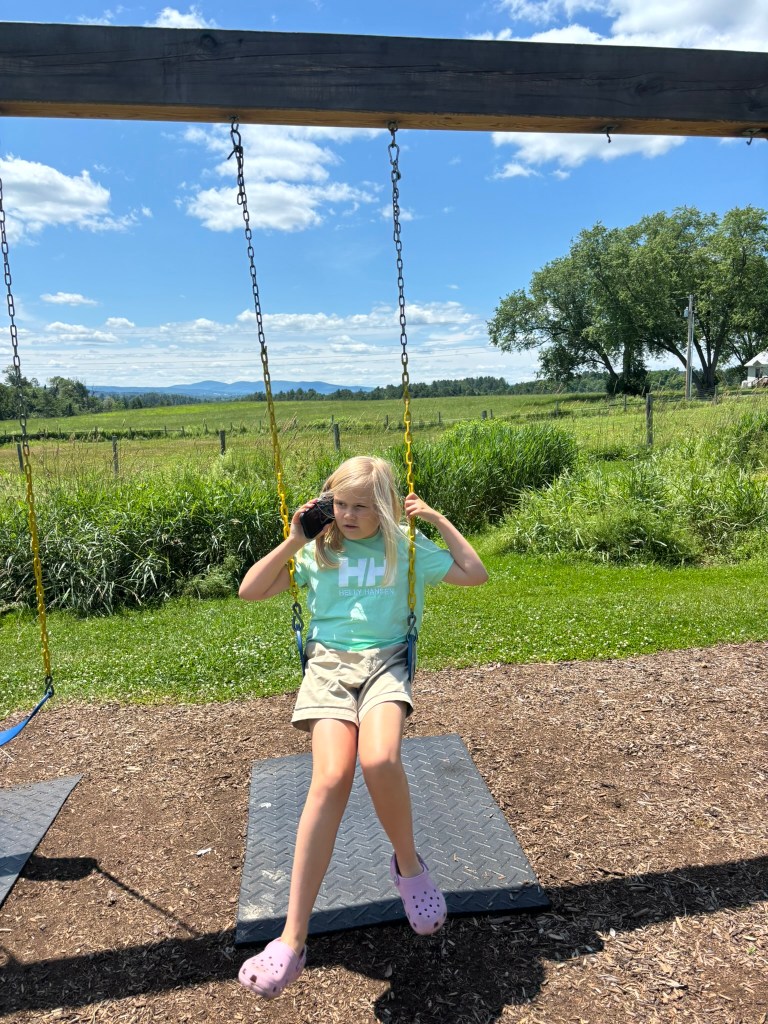
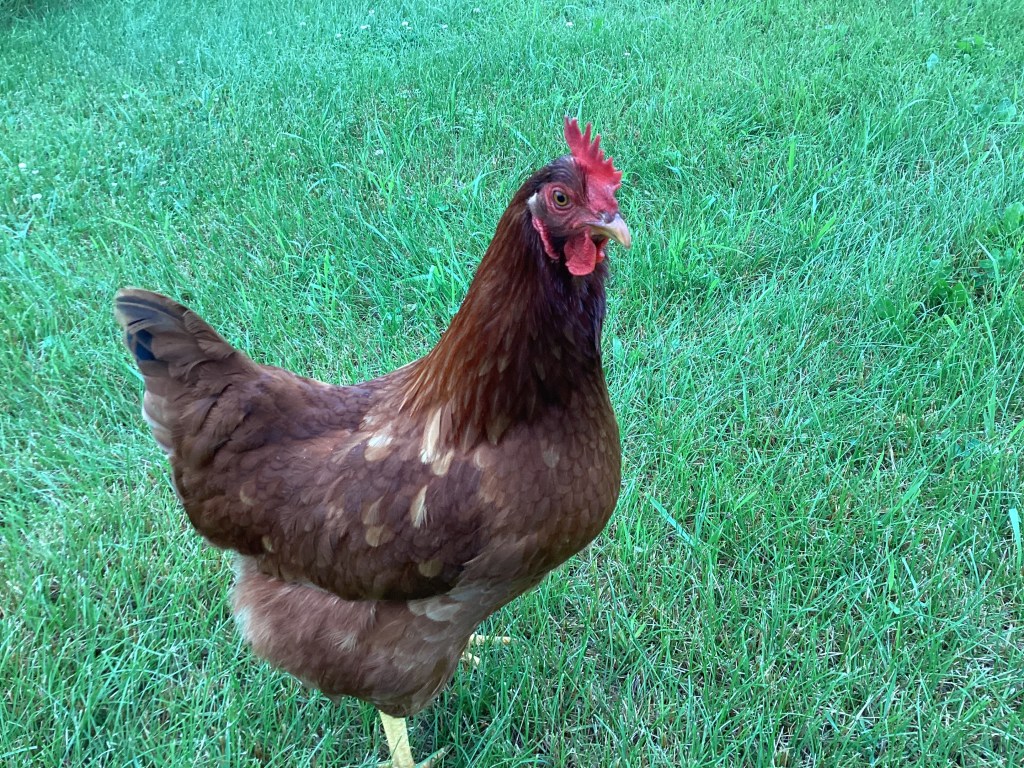
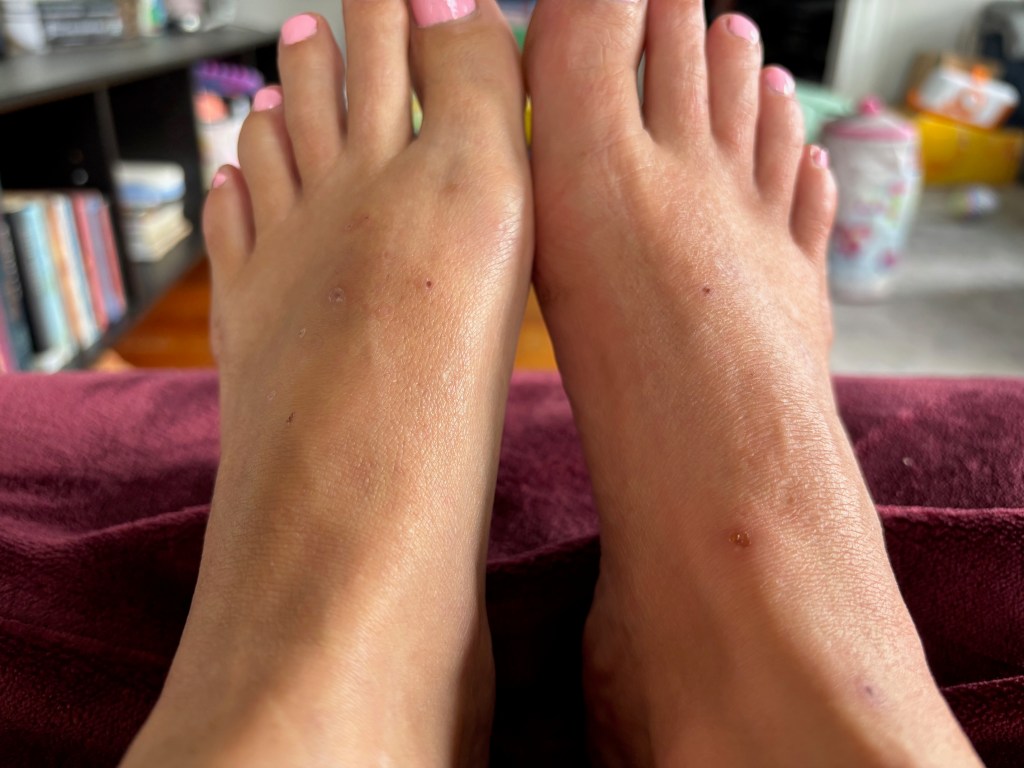
Whenever we’re doing the chicken chores, or when I take Daphne outside to swing, Susie runs up behind us and pecks our Achilles tendons. She’ll even come straight at us sometimes to peck the top of our feet, a real problem in the warm months when we’ve donned sandals or flip-flops, exposing plenty of skin.
You can see the tiny scabs healing on my feet. The freshest one is low on my right foot.
“Are you choosing violence today, Susie?” My husband likes to ask. “Are you choosing hate?”
Her attacks can actually hurt–she’ll get a pinch of flesh in her beak and pull, sometimes breaking the skin and causing us to bleed. Jer kicks her away. More often than not, I just pick her up. Sometimes I’ll put her on my lap and swing with her, which she loves. She gets drowsy and almost cuddly, a sweet response that keeps me from totally despising her.
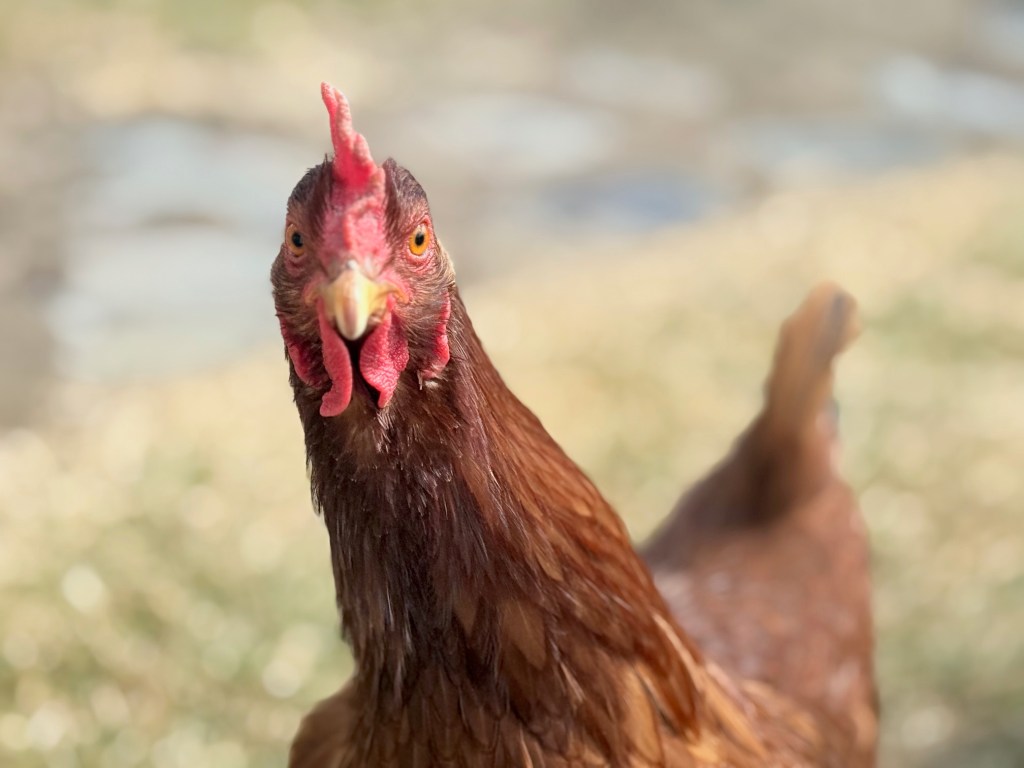
This is all quite odd, not only because she’s a hen but because she’s a Rhode Island Red, which is supposed to be an especially docile, affectionate breed. Not Susie.
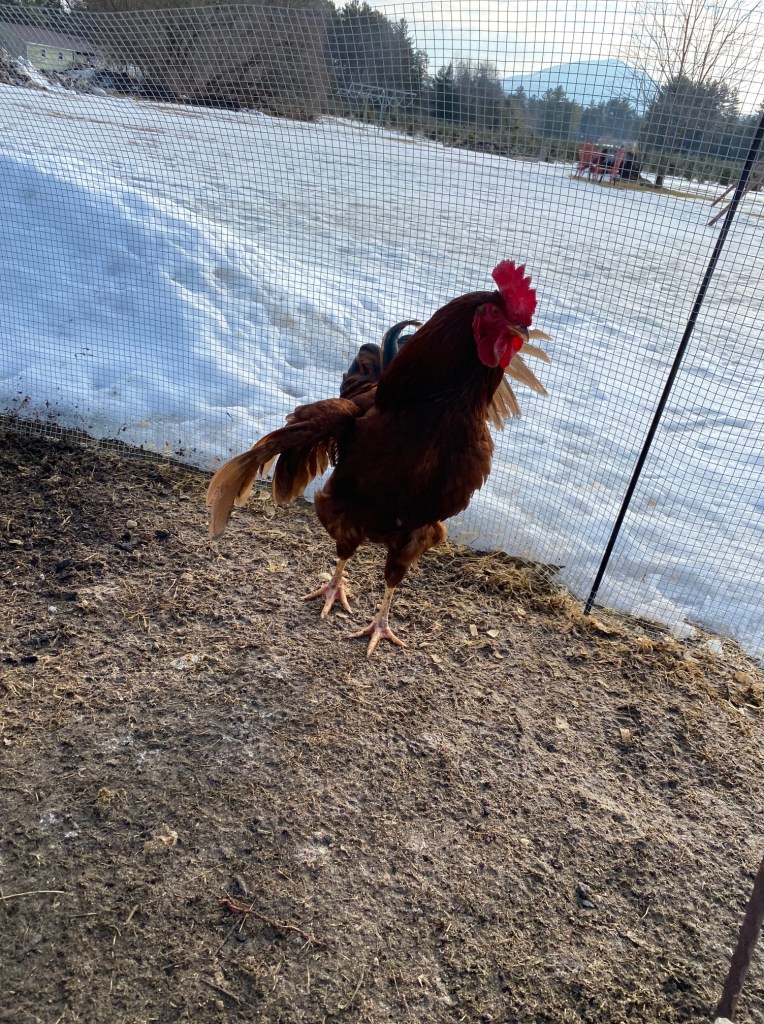
She acts, in truth, more like a Rhode Island Red rooster, which has a reputation for being quite the bastard–the truth to which I can attest because Marty, our late chanticleer from our original flock, was a prime example of a real asshole.
Marty in March 2022
Which got me thinking.
Hens sometimes get aggressive toward one another, pecking, biting, and chasing other girls away during feeding or laying in the nest boxes. But Susie doesn’t do that to her sisters. I’ve never seen her go after another hen, not even little Daisy who was clearly ill and a detriment to the flock (and who we recently lost to a predator).
In fact, Susie’s sometimes the victim of chicken-on-chicken violence. She suffers the occasional peck from Doris, our older hen and the current flock’s alpha. Susie’s only rough with humans, so I don’t think this behavior is just about trying to move up in the flock’s social hierarchy. She’s not trying to challenge Doris. Her actions seem more defensive, like she’s protecting her sisters from us and possibly other potential predators.
Susie and Doris, who doesn’t take any of Susie’s crap
I’ve also seen Susie tidbit. This is another rooster behavior in which the male scratches around in the dirt. When he unearths a tasty worm or other bit of live protein, he crows, calling his girls over to enjoy it while abstaining himself. Susie’s done this; she’s scratched and made a terrible screeching cluck, and then her sisters have charged over in that amusing waddle-run to peck frantically on the ground around her while she watches. Even when we scatter mealworms as treats, she often holds off, letting her sisters partake first.
Finally, if she’s in a particularly foul mood, she’ll puff up and do a strange side stalk as she comes toward me, about to bite. That was something I saw Marty do. Susie will even extend and then arch her neck in a way the other girls don’t, posturing like a rooster about to crow.
I started some casual research. Yes, some hens can become roosters, figuratively or literally, due to certain environmental or hormonal factors.
Apparently, a hen might take on the behaviors of a rooster when there’s no cock in the flock (lol). The absence of a rooster qualifies as an environmental stressor, since there’s no natural protector for the group. Other sources of stress include losing flock mates, which poor Susie experienced when we lost Mildred and Beverly back in December. So maybe, life on our little farm just hasn’t been that easy, and this is Susie’s reaction. From that perspective, it’s really rather noble.
This masculine behavior can also have a hormonal cause. According to Talkinghens.com, “when a hen’s left ovary becomes damaged or diseased, the right gonad can develop into an ovotestis, producing male hormones like testosterone.” This development can go so far as to create even physical changes in which the hen grows features like spurs and a larger comb. I don’t think Susie’s features are any sharper or bigger, and she hasn’t stopped laying eggs, thank goodness, but it’s possible disease has caused a hormonal change in her body and thus in her personality. We’re pretty sure her flock–probably from little Daisy–was infected with Marek’s Disease despite being supposedly vaccinated. While Susie isn’t sick, carrying the virus might have caused or contributed to a shift in her hormones.
Whatever the reason, if this behavior continues, we might have to start using a spray bottle to squirt her in the eyes.
Say what?!
It’s one humane recommendation for dealing with aggressive roosters, so it ought to work with Susie. I don’t want to kill or rehome her; she’s not inherently evil, and we need all the eggs we can get.
And look, she can identify however she wants, as Jer says. It’s 2025, after all.
She just can’t attack us.
I’ll keep you posted on her behavior management.
I never thought I’d contemplate how to handle a difficult hen. What’s the oddest pet problem you’ve had to deal with?
When I was still teaching, I was one of several district instructors trained in the AVID strategies.
AVID stands for Advancement Via Individual Determination, and it is a national organization that designs in-school support curriculum and strategies aiming to prepare all interested students in becoming “college and career” ready. (Though, what that means now in a rapidly changing world with AI, who knows?)
AVID offers electives for high schoolers, for example, that teach study methods like Cornell Note-taking, which students then apply in all their core classes. AVID also provides extensive professional development for educators in all content areas, where it stresses the importance of writing, inquiry, collaboration, organization, and reading (known as WICOR, in AVID-speak). We teachers were trained to include these WICOR elements in all our units or lessons. That was a no-brainer for me, an English teacher, but it was often a revelation for the math, science, and elective instructors.
In fact, those WICOR elements are the five key skills AVID emphasizes. They are the core of their mission, so to speak. It is AVID’s belief that these skills are what truly develop learning and success, no matter the subject area or challenge.
It’s odd, but I’ve been thinking a lot about AVID strategies lately, and even teaching and learning in general.
My curiosities and concerns about AI have provided a lot of that context.
My daughter’s own educational experience has also prompted much of that musing. Being nonspeaking, she cannot write, ask questions, discuss, or even read about things the way her peers can, at least not yet.
Daph labeling on her AAC device. It’s a start.
So much of how we learn derives from these activities. They are how we think, how we actively process the world. It worries me that she cannot yet engage this way. I often wonder how we, her family, teachers, and friends, can better help her develop an inquiring literacy. That’s her right as a person, and I’m not sure how best to achieve it, but that’s a topic for another post.
I’ve also been thinking, more specifically, about AVID’s emphasis on writing to learn, because last week was a personal milestone for me.
I hit my one-year anniversary writing this blog.
It’s not a huge deal, but I published my first post on June 4th, 2024 (rereading it now makes me cringe a little). Since then, my casual, once-a-week blogging has proven so beneficial.
It’s kept me in a solid writing routine, requiring me to compose at least a thousand coherent (hopefully!) words a week. That’s not nothing for someone who wouldn’t have to write much beyond a grocery list or a business message for Mythic Moose, if I didn’t have this WordPress.
iStock image from Unsplash
More importantly, this blog has clarified my experiences and goals for my fiction-writing life.
It’s also allowed me to reflect on both the wonderful and difficult aspects of my daughter’s journey.
It’s helped me see how much I’ve learned and changed as a person, as someone who chose to uproot her suburban professional existence and start over, as a forty-something homesteader, stay-at-home parent, and newbie creative.
By maintaining this blog, I have, indeed, written to learn.
I wasn’t sure I wanted to do this. I wasn’t sure I’d feel any benefit. I wasn’t sure I’d even have enough to say to post once a week.
It was my longtime-blogger husband’s gentle encouragement, however, plus the advice I kept seeing about the importance of starting an author platform (even before you’re really an author), that convinced me to give it a try.
I’m so glad I did.
I don’t have many subscribers. I don’t get many views. I hear mostly crickets, but it has still been a lovely, valuable endeavor. Maybe even more so because of the silence.
I didn’t intend to set the internet on fire. Rather, by sharing the things that are important to me, I’d hoped to gain clarity from these posts and perhaps make some human connections, and that’s exactly what’s happened.
While this WordPress is technically my baby author platform, it’s really more like my diary, albeit a public one, and I love that aspect of it. It’s my little cozy corner of the internet, and I would keep writing here even if I lost all my readers tomorrow.
But I do have readers, and I appreciate all of you.
Thank you for making your way here, even if it’s only occasionally. Your time means so much, and I hope you find these posts interesting, amusing, sympathetic, clarifying, or even hopeful, depending on who you are. I do my best to be honest about where my family and I are in our various journeys, and if it helps you connect, or makes you feel a little less alone, then I’m thrilled.
It’s been fun updating this site. I’m going to start a Favorites page, where I will list the authors, bloggers (including my husband’s hilarious Vermontism blog), podcasters, and artists I currently love. Some are well established; others are newer and deserve as much attention as possible.
I hope you’ll check out that new page. A link for it will appear on my home page, and I’ll get it under construction as soon as possible. Daphne’s on summer break, so now my time is more limited, but hopefully I’ll get it up over the course of this week.
On a quick, final note, I’m off to a great start increasing my seasonal reading. I dove into the Adult Summer Reading Program at our local library, the St. Johnsbury Atheneum, where I collected my bingo card and chose my free book from the second-hand bookshop affiliated with the Atheneum (a donation-to-purchase program staffed by volunteers, with all proceeds funding the library’s children’s programming).
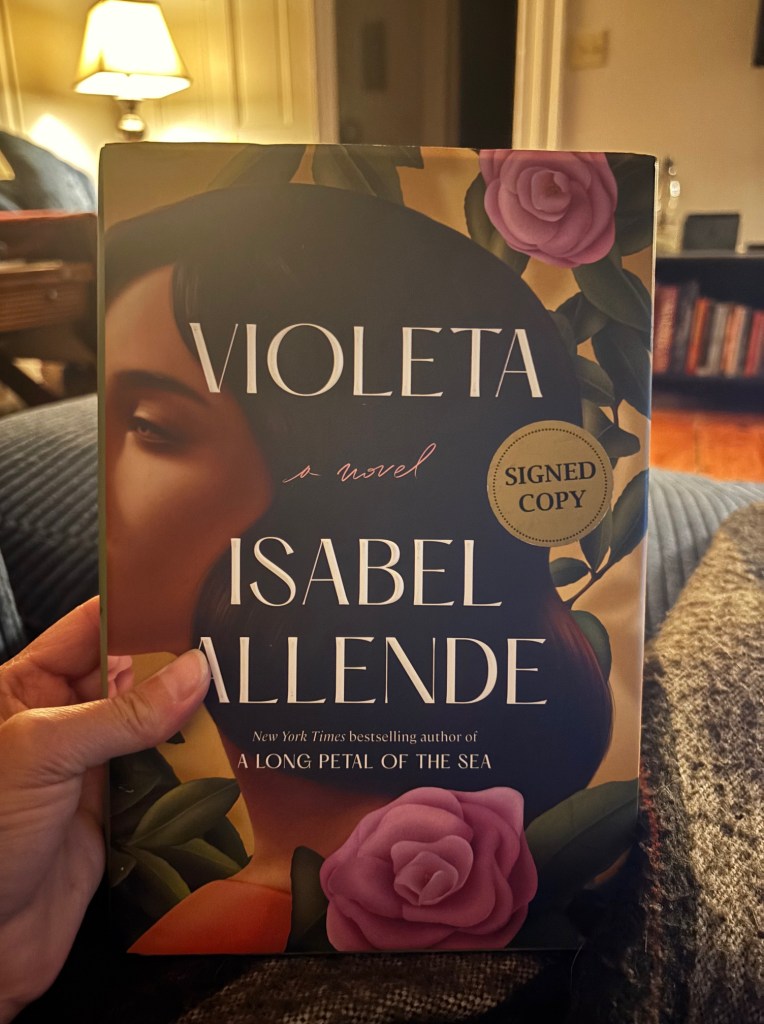
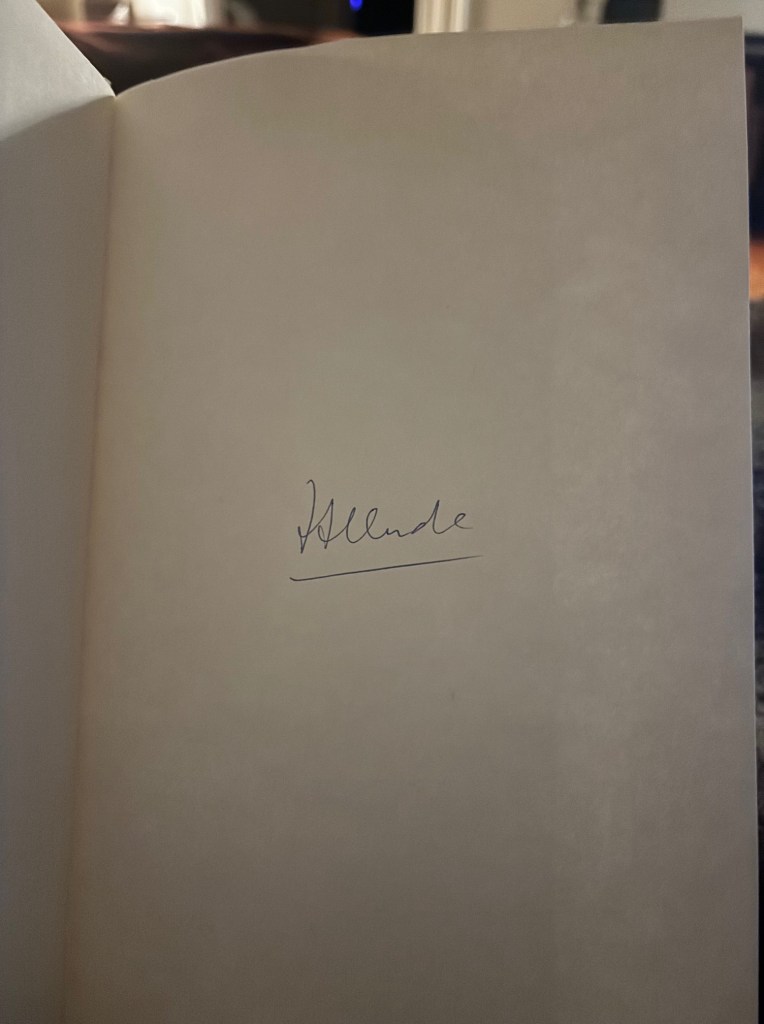
My free book! I haven’t read any Isabel Allende since Daughter of Fortune years agoSigned! Mind blown! She did, after all, receive the Presidential Medal of Freedom in 2014.
I also finished my first novel this week, Complications in Parisby Melinda Copp, which I adored.
I’m drafting this on Thursday, June 5th, and the high today in our little Northeast Kingdom village is 86 F. Yesterday, it was 88.
That might not sound terrible, but for us, it’s pretty hot. Especially because few places here have centralized AC, and all the recent rain has made the air humid. The windows in our farmhouse are open and the fans are going. That helps, but it’s clear summer’s arriving.
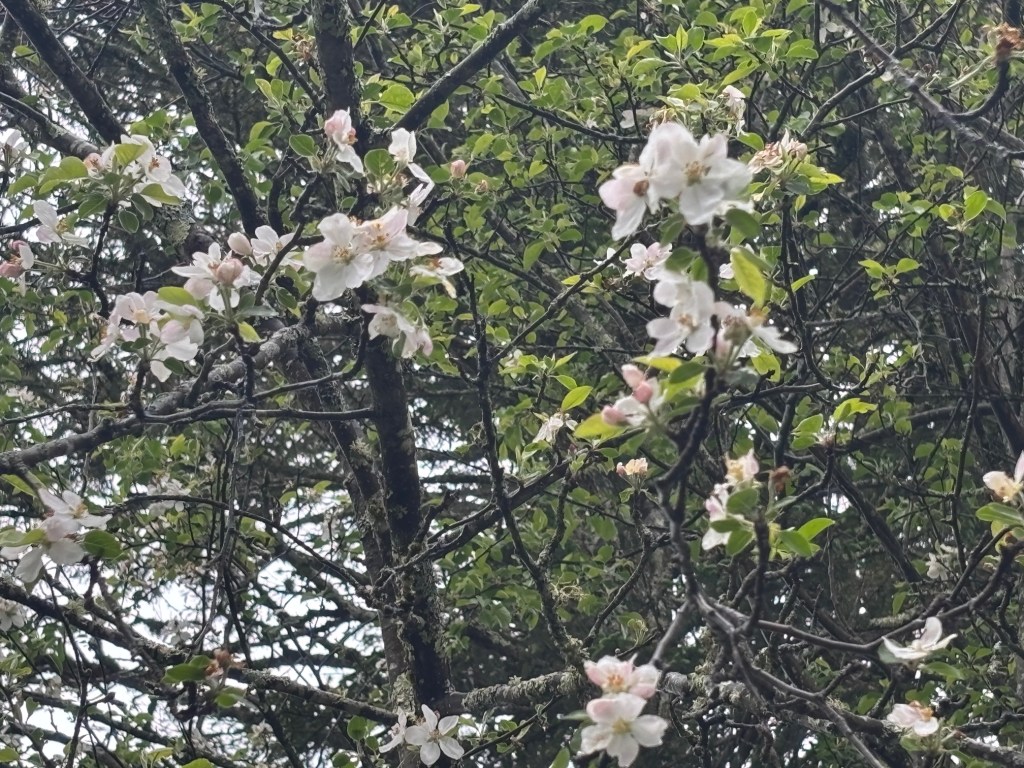
The apple blossoms are already wilting.
That’s another tough thing about our northern Vermont weather. All the way through April, we have the possibility of snow, plus temps that still dip below freezing. True spring, with its ideal days in the 60-70s, doesn’t arrive until mid-May, and by early June, we’re into our summer temperatures.
Like foliage season, true spring is gorgeous but fleeting.
There’s no use lamenting the inevitable, though, so I’ll just keep appreciating the verdant hues outside my window.
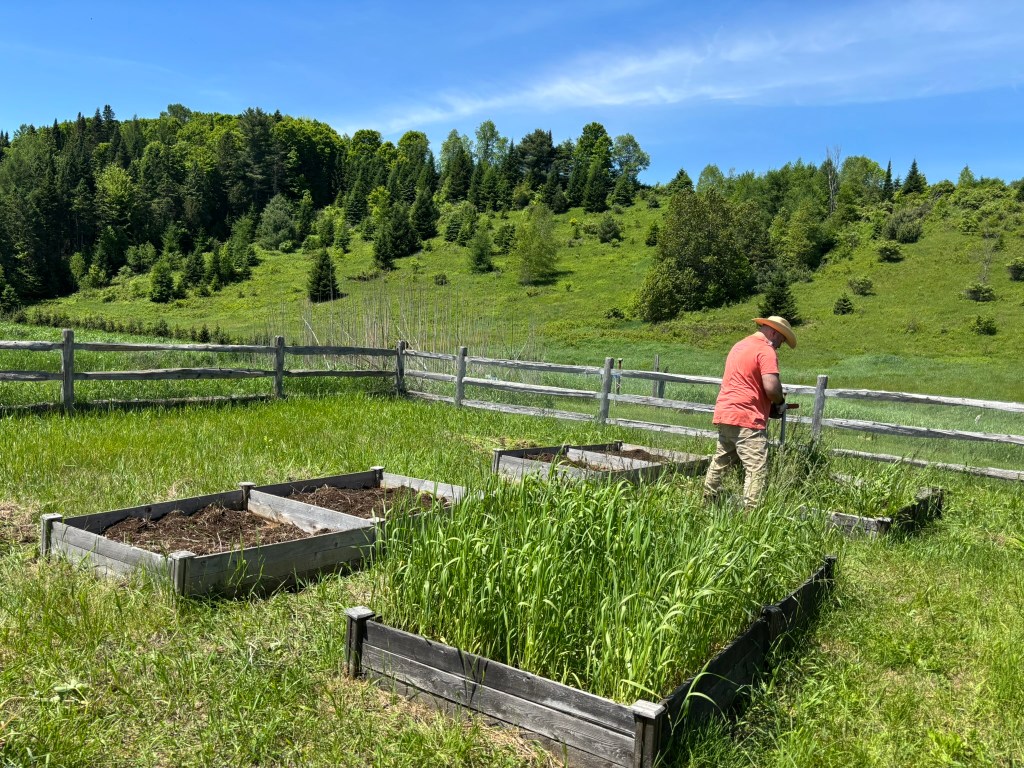
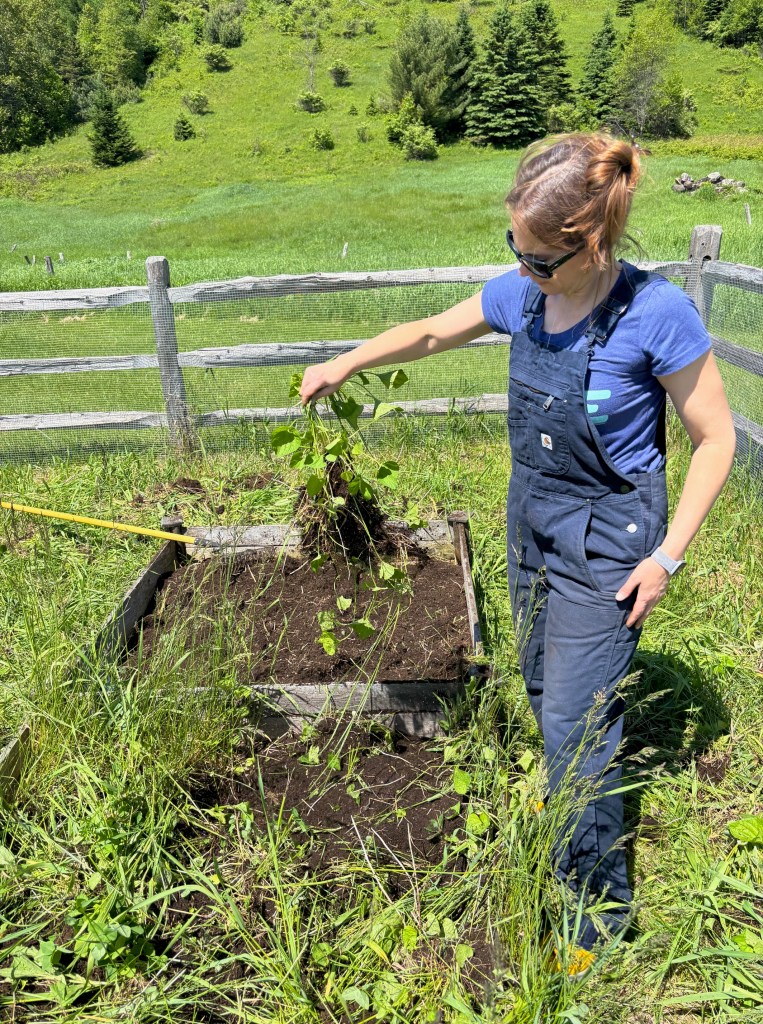
This week, hubby Jer and I got outside for some seasonal prep. On Tuesday, we took a deep breath and then proceeded to pull up all the weeds choking the garden beds.
Weedingthe beds
That always sounds like an awful chore, but once we’re in the flow, it’s always faster and more pleasant than we thought. It was cooler that day, too, and I was struck again by the beauty of our property. The work also cleared my head and gave me that satisfaction of time well-spent out of doors, laboring at something vital, under the sun.
I should wear gardening gloves.
There’s nothing more basic, in the best sense of that word, than the labor that goes into cultivating your own food. It’s what humans initially evolved to do, and it speaks to something deep inside us that’s often forgotten or neglected.
Ready for fresh soil, seeds, and sprouts
Soon, we will plant our fruit and veggie sprouts: strawberries, Roma tomatoes, lettuce, celery, peppers, squash, and more herbs (the thyme and oregano survived the winter and look good), plus the carrot and corn seeds. We’re going to make sure we till the ground around the raised beds, too, so we get pumpkins this year. I’d also like to start a little tea garden, growing chamomile, mint, and lemon balm.
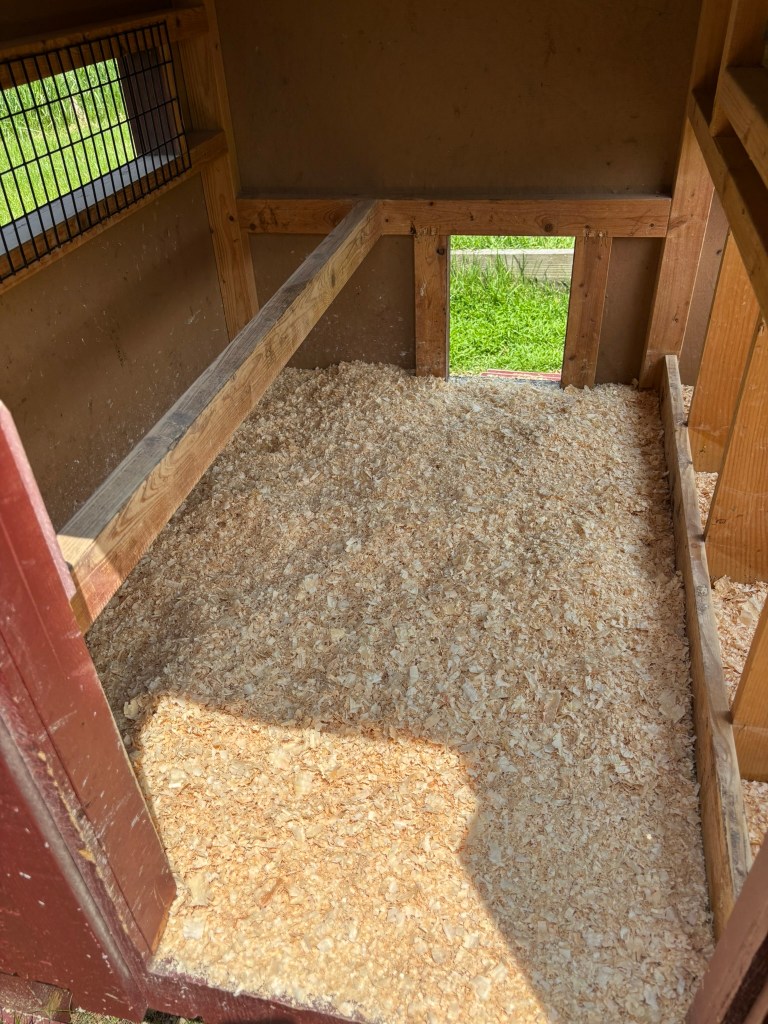
Despite being a little sore from the gardening, on Wednesday I put my Carhart overalls back on and deep cleaned our chicken coop.
Sparkling coop
Since we use the deep litter method, I only do it twice a year, once in late fall and once in late spring, and that too has gotten faster and easier. I swept out all the old shavings, dumped them in our compost bed, shop-vacuumed out any remaining bits, sanded the roost bar to remove any droppings, then gave the floor a light wash with water and a few drops of Dawn before letting it air dry. Lastly, I put a ton of fresh shavings down, and the coop was, once again, “so fresh and so clean, clean.” This ensures a happy, healthy home for our feathered girls–and, eventually, a lot of nice compost for our garden.
I’m glad we finished these big chores while Daphne’s still in school. Her summer vacation starts next week, on Friday the 13th (I will not think about how inauspicious that sounds). It can be hard to accomplish a major household task when she’s home because she still requires a lot of supervision for her safety (she sometimes tries to eat and drink things she shouldn’t), and she gets moody when she goes too long without undivided attention.
Once she’s off–very soon, eek!–it will take a couple of weeks to adjust to a summer routine that’s good for her and bearable for us, her parents. It’s hard on Jer because she can be noisy. He works remotely, and her squeals and cries can make facilitating meetings tricky, adding yet another stressor to his daily grind.
I struggle a bit because I lose all my reading and writing time during the day. Initially, I go through a kind of withdrawal. Caring for her can be tedious on the best days and frustrating or exhausting on the hardest, and I crave the stimulation and escape my work gives me. The solution for that, however, is to get my butt up earlier than usual. If I can wake up first and enjoy my coffee with a book or article while the house is quiet, I’m centered and more energized for the day. I’m already a morning person, and if I’ve had a dose of reading and reflection, then I’m usually ready to enjoy my kiddo (at least while she’s in a good mood).
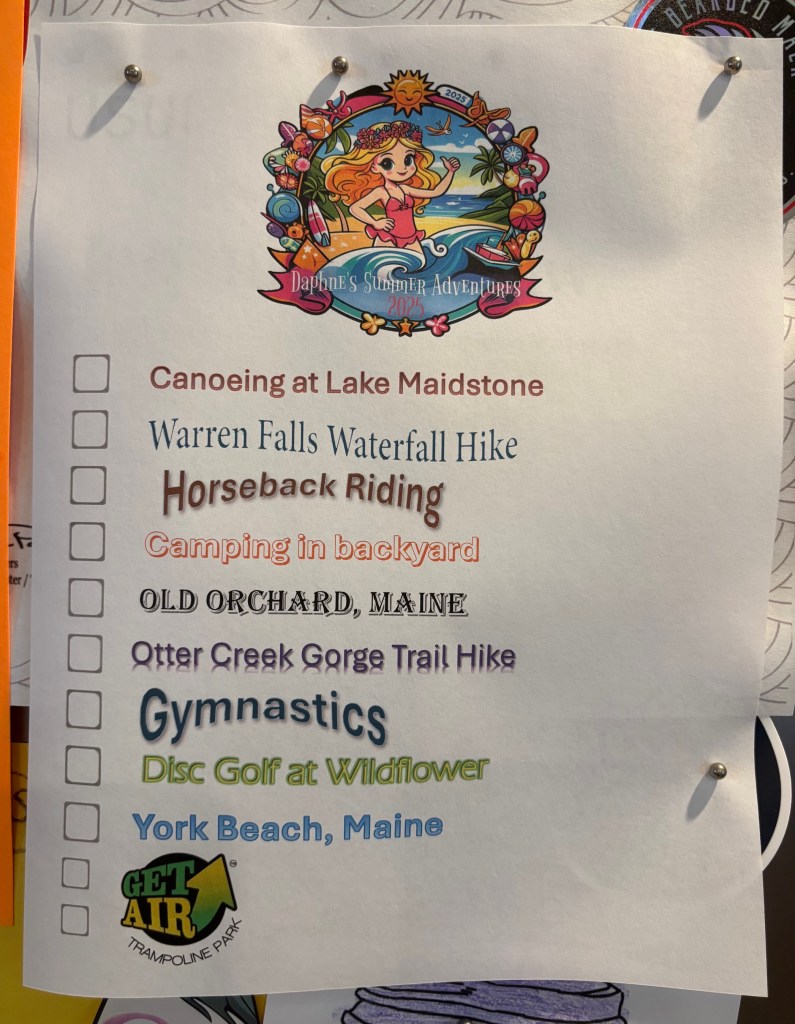
Jer is great about helping me entertain Daph. He plays with her when he can on the weekdays, and he’s already made this year’s summer adventures checklist, coming up with enough special activities so there’s about one a week.
Summer activity checklist
Now that I’ve been writing seriously for a couple years, I have a better idea how to space out my projects to account for Daph’s summer time at home. That’s actually a good segue way for sharing my 2025 writing goals.
In January, I wrote them down: Finish the zero draft of my first novel, submit three short pieces for publication, then write another zero draft of another novel. That first zero draft is done, and I have two pieces submitted plus edits basically done on the third, so all I’ll need to do for that one is start submitting it places.
That just leaves the second novel, but I don’t have a lot of specific ideas for it yet. That makes this summer, however, perfect for planning. I’m going to take a break from composing to focus on prewriting for that second novel; I should be able to do that in the mornings, evenings, and in pockets of downtime on the weekends. Then, when Daph goes back to school in September, I will begin that final project, and I should be able to have a roughly 80k zero draft done by the end of December. That feels doable, given my time and writing habits.
That draft will probably be garbage, but that’s not the point. The point is to practice longform fiction so that one day, I can write a novel that isn’t garbage. That’s my ultimate goal.
I also want to squeeze in more reading this summer.
A title on my summer TBR. I’ve actually been chatting with this author on Bluesky.
Shifting the emphasis from writing to reading is an essential way to give my brain a break and let it soak up the crafts of much more experienced and better writers. That will help me continue to grow.
My writing group’s June newsletter had a great idea for staying on track with goals during the summer, since it’s a busier season for many of us. They suggested designing your own at-home writing retreat, which I thought was fabulous. Here are their tips:
Set your intention: what do you want to accomplish? Getting words on the page? Editing? Planning? A combo of everything? What do you want the energy to be? Serious or more easy-going?
Design your schedule: In their words, “a one-day deep dive? A weekend retreat? One writing-focused day per week?”
Create your space: Set up a “corner” (or your office) in a way that “feels intentional.” This might mean lighting a candle, setting up near a sunny window or somewhere outside, or closing a door and adding a “Do Not Disturb” sign.
Plan your writing sessions: block your time with goals or an agenda, and include little inspirational breaks/activities.
Add a little magic: Allow yourself “to do something you never let yourself do.” For example, a slow breakfast in bed with your journal, or a celebratory cock/mocktail to toast your day. I always have a weekend drink, but if I plan a mini-retreat during the week, I’ll definitely end it with a crisp glass of white wine or a nice, hoppy craft beer.
Maybe, when our folks visit in August for my husband’s 50th birthday and can help with Daphne, I’ll plan my own one day deep-dive retreat, with an emphasis on novel-planning and reflections from The Story Grid: What Good Editors Knowby Shawn Coyne, which I plan to read this month. I keep hearing what an amazing, obligatory craft book it is.
That’s basically it–our summer plans, in development. Hopefully, things go as expected.
On that note, please send good thoughts our way for Jer. He’s struggling with acute upper abdominal pain and will need an ultrasound soon. The doctors think it’s gallstones, and he’ll probably need to have his gallbladder out. Hopefully, that goes smoothly and we’ll be able to proceed with a pleasant, healthy summer.
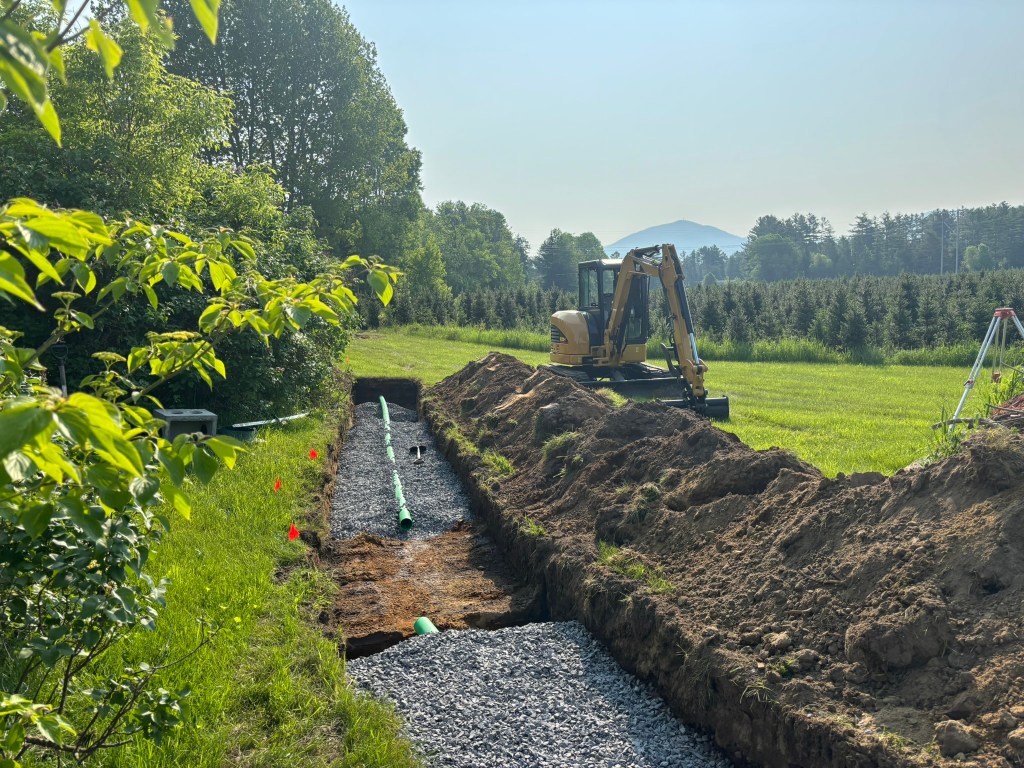
The big, and unexpected, home improvement project we thought would take months–getting a new leach field–is actually all done. Yay!
New pipes! Bye bye clogged septic system
We got a good deal from a local engineer and his retired father, who is up from Florida for the summer and was happy to construct the field for us. We shouldn’t–knock on wood–have any more plumbing issues for a while.
Ugh. Old house problems.
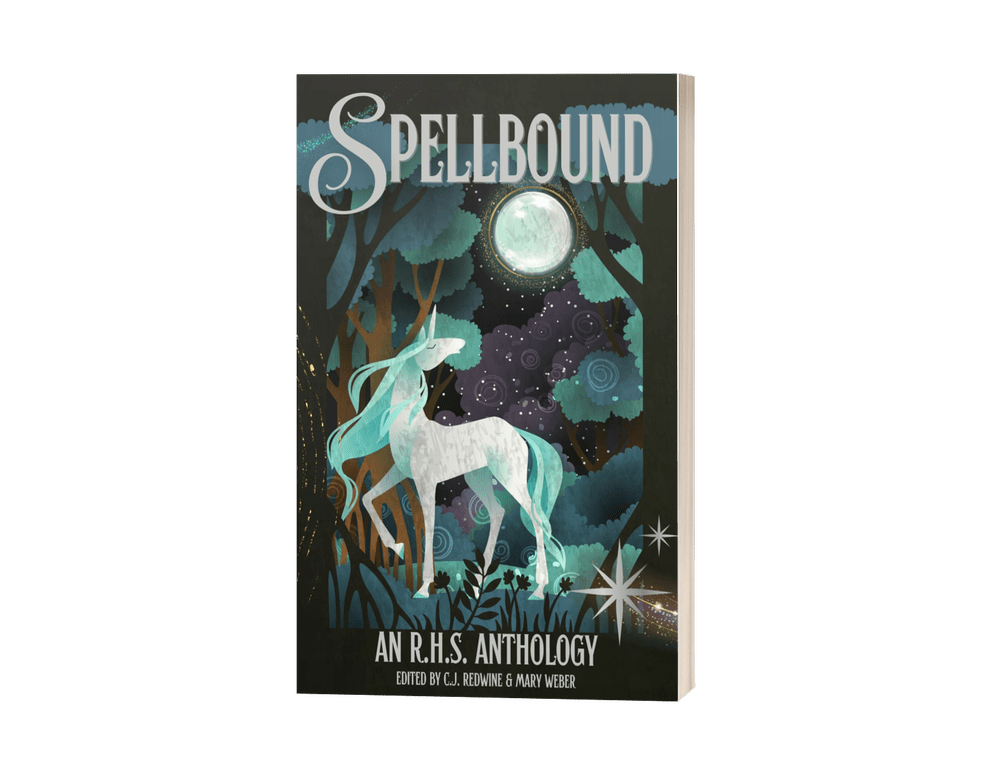
On a final, happier note: the submission gods did indeed look kindly on my latest piece, “Elspeth and the Fairy.” It was accepted for The Red Herrings Society’s fantasy-themed anthology, Spellbound, which will be published in September.
Sweet cover
I’m thrilled because this year, reading committees made up of authors, agents, and editors are scoring each submission for each anthology (there are three total), and the top-scoring submissions are being accepted for limited spots. I’m quite proud mine scored high enough to be included, and I’m looking forward to improving it via developmental and line edits from Mary and CJ, who are professional editors and book coaches. Edits are truly the best way to learn, and “Elspeth” was a wonderfully impromptu, inspired labor of love, so I’m delighted it will receive this treatment.
How are things in your neck of the woods? Not too hot, I hope. I’d love to hear about your summer plans, bookish or otherwise.
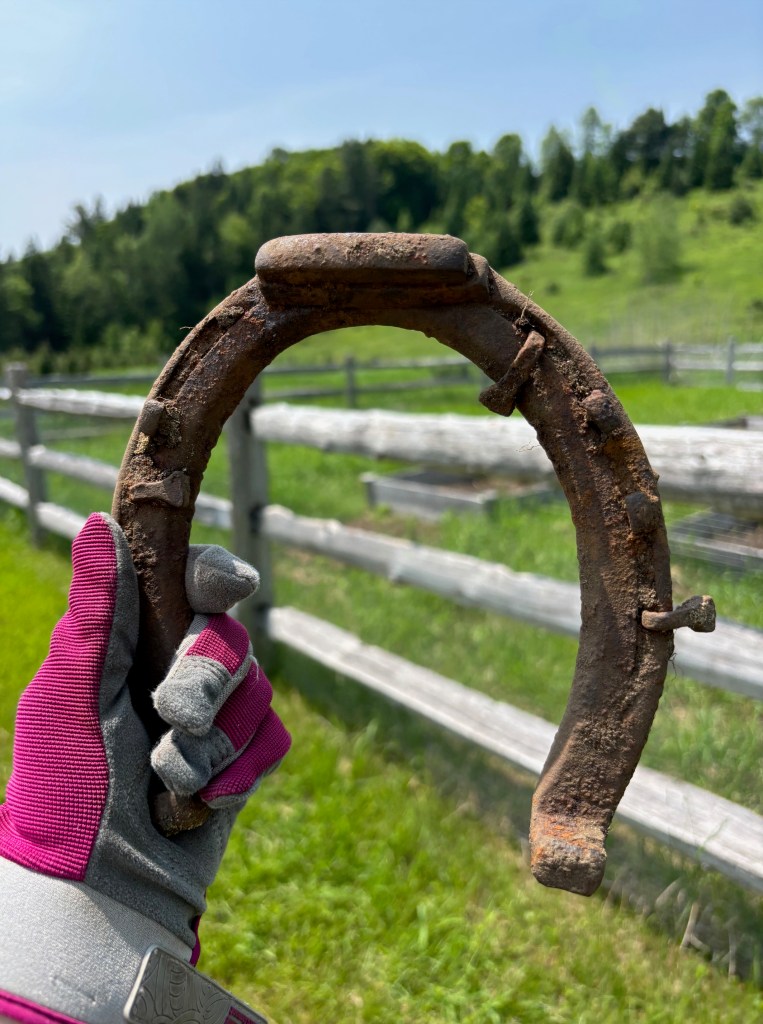
Old horseshoe the contractor dug up while building the leach field. Hopefully, it will bring us all a bit of luck.
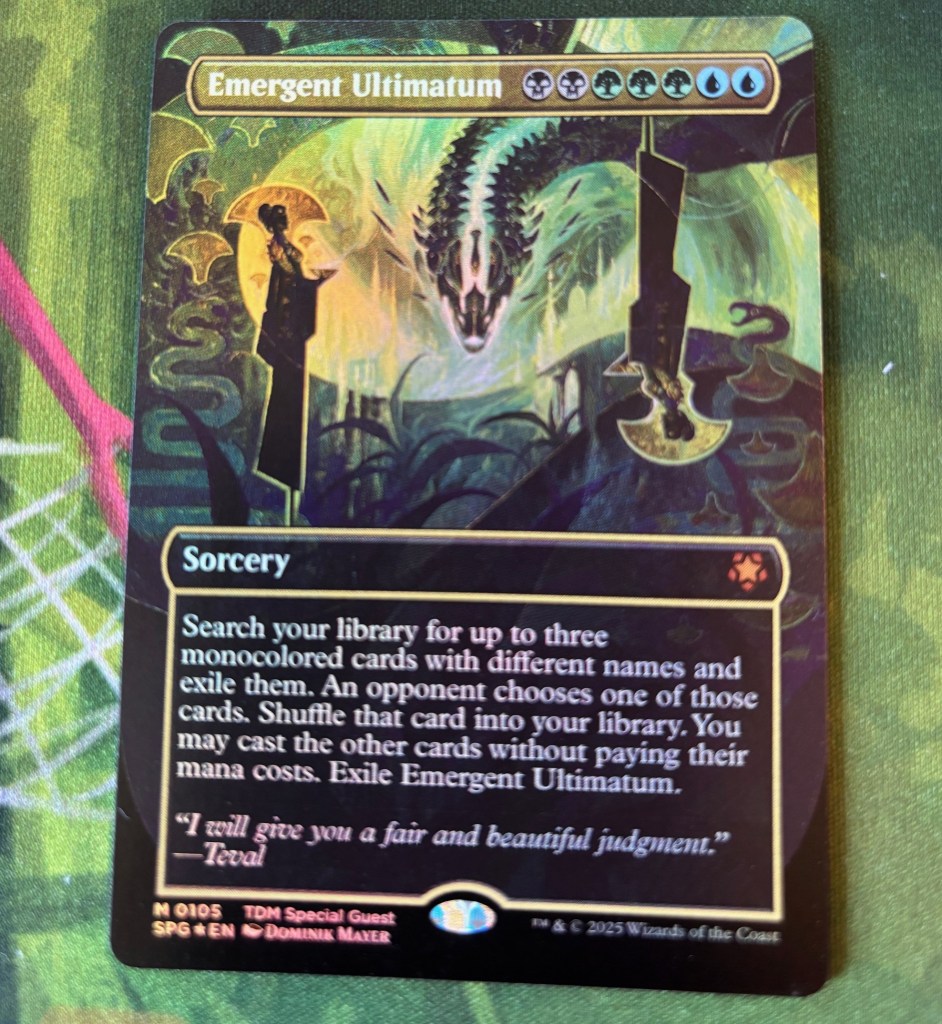
If you’re like me, you really don’t know what the hell these are.
So no, they aren’t characters or titles from some fantasy series I’m brewing up in the back of my imagination. That’s not my kind of writing, anyway.
They’re actually cards from two recent sets of the iconic Magic: The Gathering game. And I wouldn’t know a damn thing about them except, now I’m helping my husband sell them… among many other cards from these and other sets.
Yes, we’ve started a modest little side hustle. An online game shop, Mythic Moose Games, which right now features playing cards from Magic and even Pokemon.
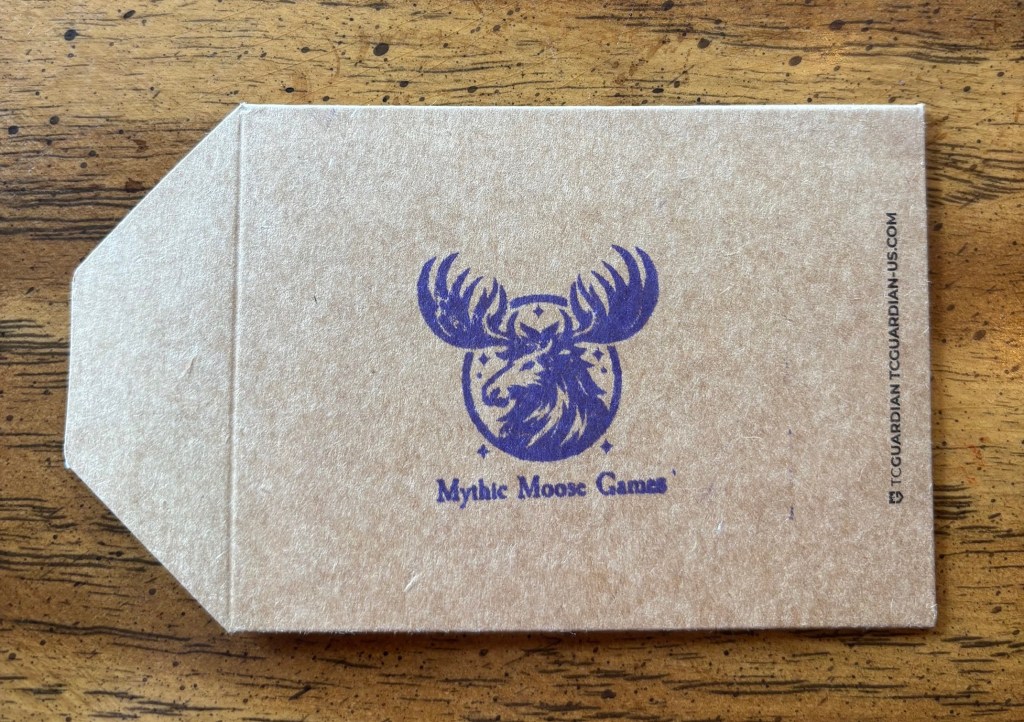
One of two logos
(And oh, jeez, this Pokemon… crazy designs, multiple iterations of the same cards, and tiny numbers we have to squint to read… clearly meant for kiddos and their young, sharp eyes.)
Let me back up a bit.
My brilliant, strategic, game-loving husband has always dreamed of having his own small business (a result, I believe, of watching his brilliant mother run her own for many years). Often what comes up is a game shop because I think Jer could create an amazing one. He knows so many games, the gamer culture, has top-notch aesthetic tastes, a solid brain for business, and wonderful people skills. He could create a magical, safe “clubhouse” style atmosphere for gamer nerds the NEK over.
He’s also turning fifty in August, and I’d love to see him have something a little more tangible and creative that he could really make his own. Something beyond the abstract IT PMO work he does to earn our living.
This crazy guy would run a wonderful game shop.
We started discussing a game shop a couple months ago. At first, we just considered an online business, but then we learned we could get bulk discount on merchandise from Alliance if we had a brick and mortar, so we started looking at commercial spaces.
Three weeks ago, we came close to signing a lease on a huge, beautiful space here in downtown Lyndonville, on the second floor of an old building, right next to the town’s book shop.
Lois’s space, though the pic doesn’t do it justice.
The building’s owner, an elegant, kind lady named Lois, was ready to give us a smokin’ hot deal on a one-year lease, but we decided we just didn’t have the funds to invest effectively in such a large space, what with needing a ton of stock to fill all that square footage, plus shelving and lock-casing, tables and chairs for game nights, point of sale equipment, etc.
So, while it was wonderful to meet this lady from one of the town’s prestigious families (her grandfather bought the space from a Darling himself), signing the lease didn’t feel wise, ultimately, so we abstained. And I’m so glad we did, because it turns out we need a whole new leach field for our septic system, plus potential private school for Daphne. More about all that later.
Lois’s building was super-gorg, though. She shared how it used to be a dancehall for the youngsters, and all the boys would sit on one side, all the girls on the other. At one point, they had car shows in it and even a bowling alley in the basement. In the 20s, there was a lower-floor speakeasy, too (a lot of rum running happened here, given the proximity to Canada).
The last tenant (the wife of the local electrician) told Jer on the phone about all the ghosts she’d seen in there.
Hopefully, the right person will come along to employ such a special space. It won’t be us, though.
We pivoted back to the original plan of retailing solely online, at least to start.
Isn’t that a gorgeous card?
It made the most sense to set up an online shop via TCG Player, and make use of their systems, shipping policies, and insurance.
So, we named our shop Mythic Moose Games–my suggestion, actually–and Jer invested in some Magic and Pokemon boxes. When they arrived, he insisted I help him open at least some of the packs so he could educate me in common, uncommon, rare, and mythic cards in the Magic world, among other things (I also now know a bit about foils, full art, showcase art, and showcase foils). We even practiced making pack-opening videos potentially for YouTube, with the appeal that I could do the opening while wearing special rings to match the sets’ themes on my manicured hands.
Then, we put our first selection of merch up for sale about two weeks ago, as just a Level One baby shop.
I’m happy to report that now, we’ve completed about 55 orders, and we’re close to cracking our first $1K (though we’re still very much in the red). We’re also now a Level Three shop. Once we hit Level Four–soon, I think– we’ll be able to add way more merch and offer free shipping. That should really crank up sales.
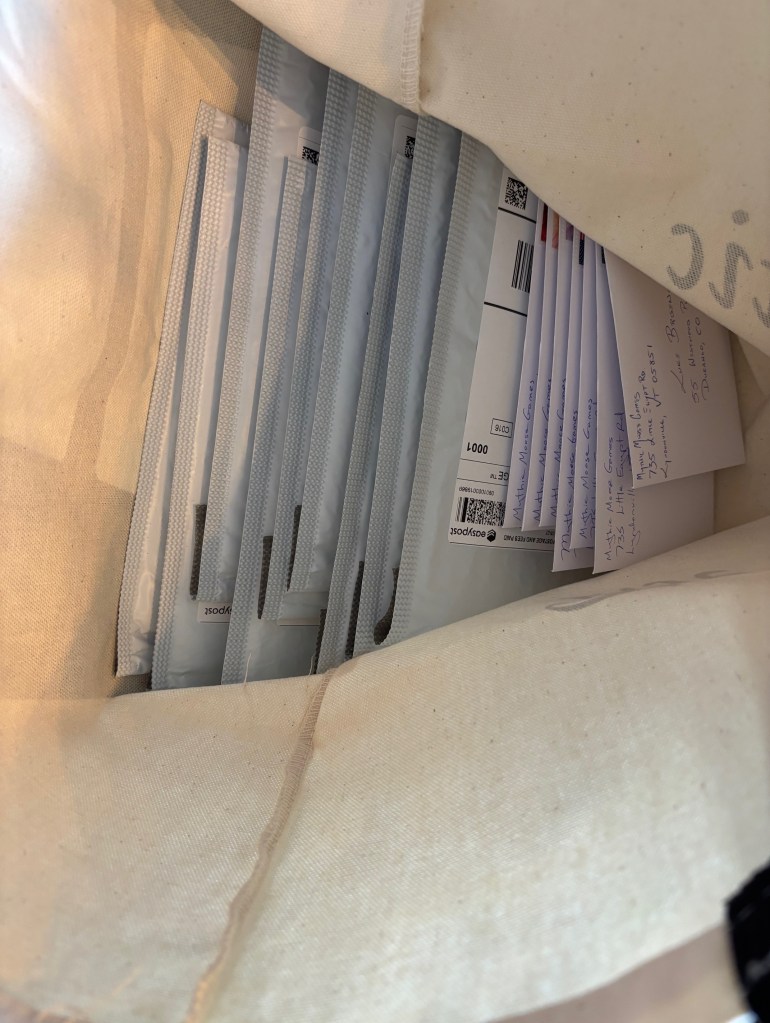
It’s been fun so far, and we definitely have a routine. After I get Daphne to school, I come home, do the chicken chores, and then Jer and I open up the orders. Often, he pulls the cards from the binders because he can find them much faster, while I write the thank you notes, package up the merch, address the envelopes, and print the labels for the more expensive orders to which we add tracking (we now own a label printer and postal scale).
A day’s order ready for the mail
Usually, it takes us about 60-90 minutes, and it’s quality time we spend together working on our special little passion project.
That’s the best thing about all this. We’ve added a whole new dimension to our partnership.
Custom card envelopes
I’m beginning to soak up a little of the business strategy, too. Like, how we should price our cards to both gain attention in the vast array of TCG shops and account a bit for shipping costs. Jer seems to have found a sweet spot, undercutting prices just a little. It’s gotten us a lot of initial sales as gamers hunt for the best deals on particular cards. Like anything online nowadays, it’s part of a (probably temporary) strategy to get noticed. To fight for some visibility in a saturated market.
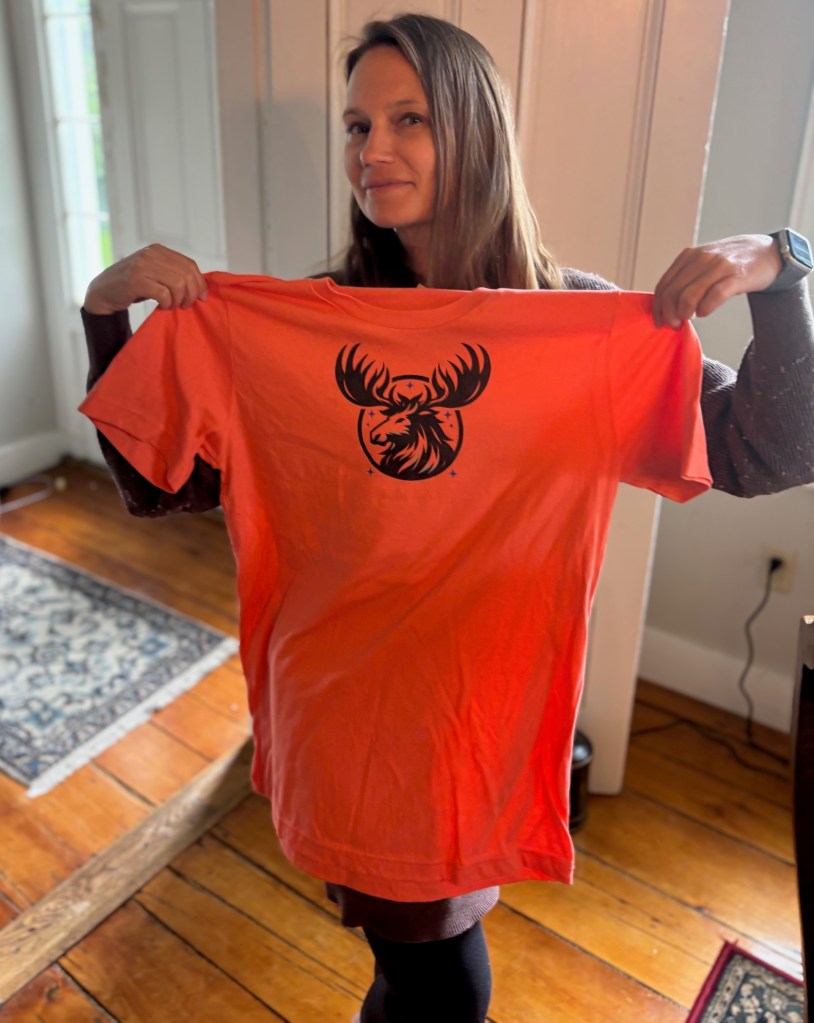
We just got our Mythic Moose t-shirts in–so fun! They’re really just for us but, hey. We figured, why not?
The orange alludes to the orange symbol on the valuable mythic Magic cards.
If you know a Magic or Pokemon player, or are one yourself, please check out our shop!
Do you have any passion projects going on right now? I’d love to hear about them!
See you next week, when I hope I’ll have some positive writing news.
Now that everything is blooming, I have fairies on my mind.
And I did, indeed, compose my own little fairy tale last week. I thought it would be fun to share it here, but I ended up far happier with my story than I expected, so I pivoted and now I’m doing something different with it.
Fae Lady Rowan in her gown of leaves. Image from Microsoft Design.
Sadly, that means I can’t post it here, at least not right now. But, if these new plans fall through, I will absolutely publish “Elspeth and the Fairy” here on WordPress as soon as possible.
What I can share is a little synopsis:
The younger daughter of a Celtic Scottish lord, Lady Elspeth has a brave and sympathetic nature. When her kingdom loses their monarch, King Ian, and the heir presumptive, Lord Alistair, falls victim to a wicked enchantment, Elspeth takes it upon herself to enter the realm of the fairies.
There, she encounters Lady Rowan, a fae guardian of early spring. Despite the antagonism between their species, Rowan agrees to help Elspeth by healing the afflicted Alistair, with whom Elspeth has fallen in love.
But, the fairy’s aid comes at a price.
What Elspeth doesn’t realize–that price might ultimately include her own virtuous soul.
Unlike my spicy monster short (which I hope to write more about soon), I produced this fairy tale quickly. I began drafting on Monday of last week and finished on Friday. On Saturday, I cut 600 words and made a few minor adjustments, with motifs and theme in mind. Then, I shared it with my go-to alpha reader, who responded enthusiastically. Finally, I made a few additional line edits, and that was it.
It’s rare for me to “finish” something so quickly. I write that in quotes because it’s not really finished, of course. Hopefully, it will go through a round of developmental edits followed by line edits. But, I was “finished” as far as producing what I could effectively by myself. The story felt structurally, thematically, and stylistically sound, so it was time to give it to the submission gods.
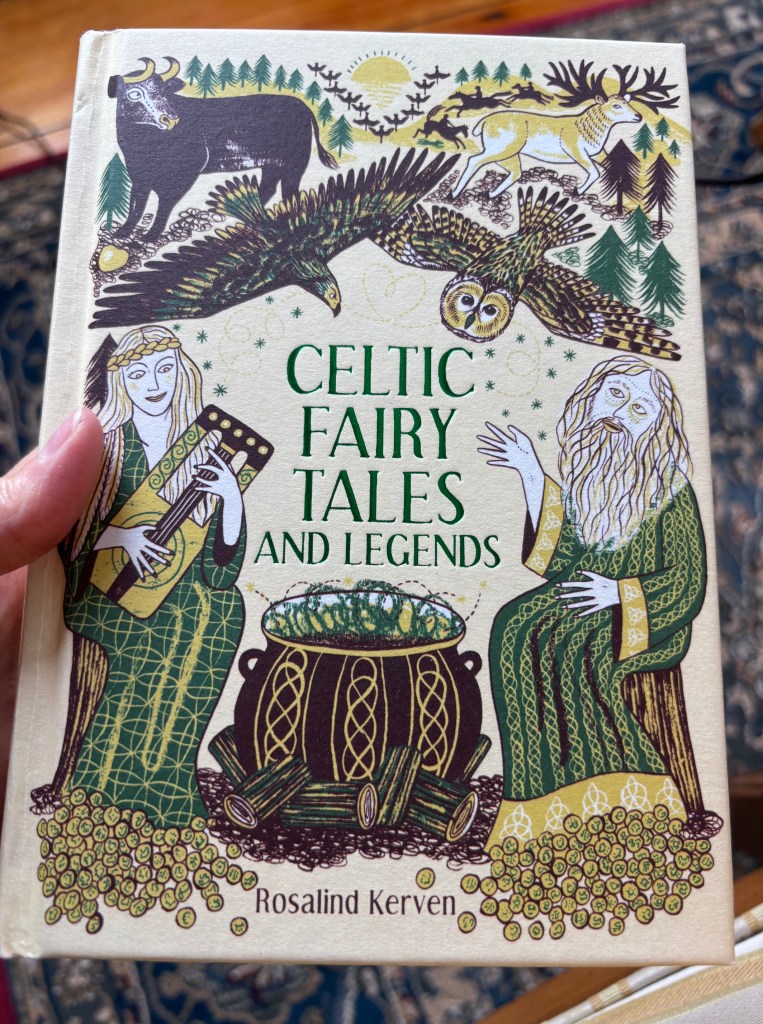
I’m attributing this speed to the fact that I’d just consumed a collection of old Celtic stories, so the genre and messages–already familiar–were fresh in my mind.
Source material
Fairy tales employ third person POV with a fair amount of psychic distance. They involve magic, of course, often wielded by witches, wizards, and fairies. Humans are the main characters. Wicked men and women are punished but, if they learn their lessons, forgiven and even rewarded too. Virtuous humans who stick to their moral guns are almost always rewarded, their sacrifices honored with the granting of their hearts’ desires. All of this provided my story’s framework.
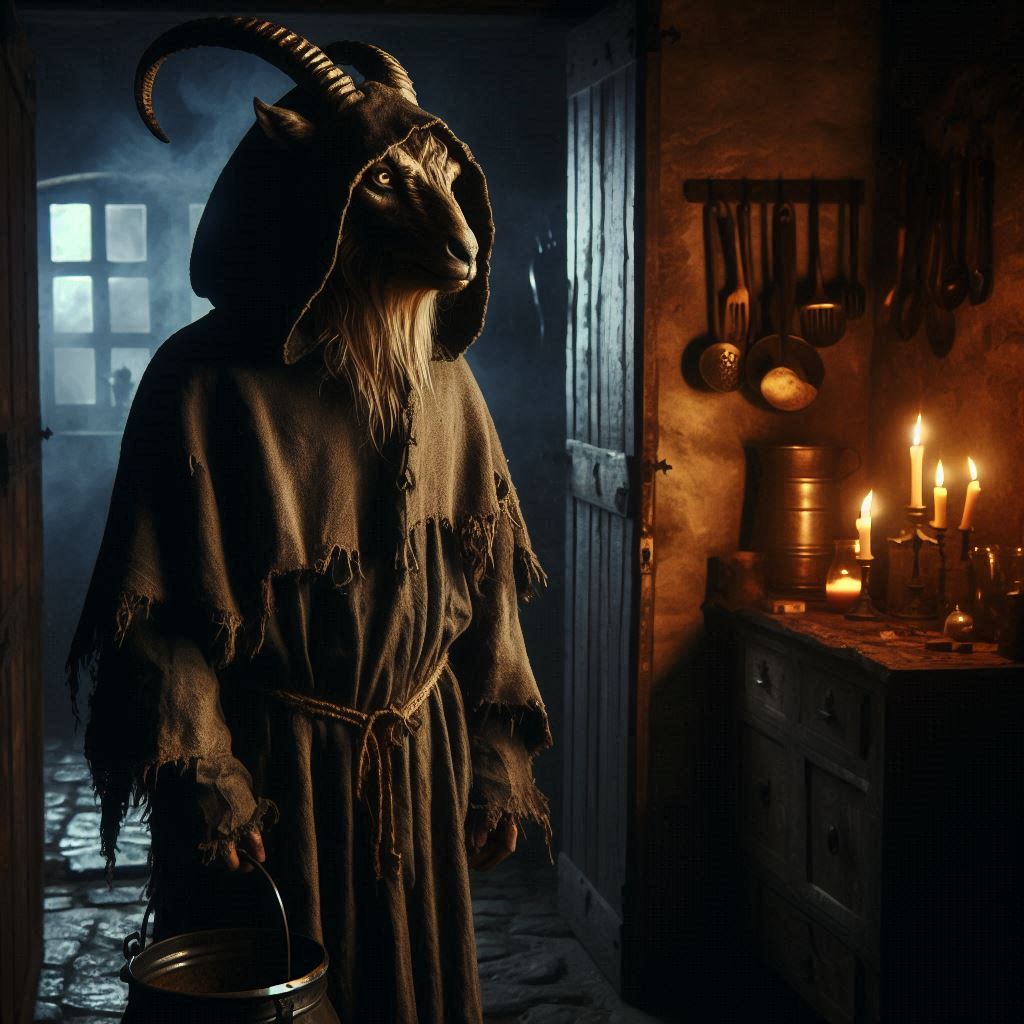
What made writing this tale so fun was weaving together little inspirations taken from my favorite selections in Rosalind Kerven’s collection. I didn’t even realize I was doing it, but when I leafed back through those stories, I realized I’d borrowed some of my favorite features from “Kate Crackernuts” (human with a goat’s head), “The Bogle of the Murky Well” (fairy abduction), “The Black Bull of Norroway” (frightening beast that’s actually gentle), and “The Daughter of King Under-Wave” (a difficult bargain). I made them my own and synthesized them into a fresh, surprisingly cohesive story that began to write itself halfway through (always a good sign).
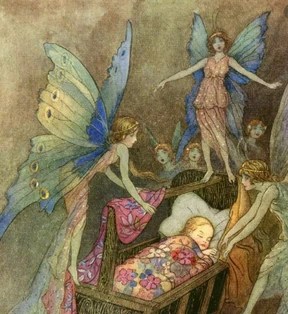
Interestingly, these inspiring old tales all come from Scotland as opposed to Ireland or Wales, which Kerven’s book also includes. In her notes for these Highland pieces, Kerven writes that Scotland’s stories often feature “strong, determined female heroes” and fairy folk with “bizarre, malicious nature[s]” (unlike the kinder fairies who show grace in the Welsh stories). In the Scottish tales especially, fairies “who abduct both adult and infant mortals are common.” This information factored into my plot and characters too, and I finally recognized all the Scottish influences. Hence, my story’s subtitle: “A new tale inspired by old Scottish stories.”
Finally, I included both Christian and pagan elements, just like the oldest stories from the British canon, such as Beowulf, often do.
In “Elspeth and the Fairy,” for example, the king is a pious man who’s left on a religious quest–a crusade, really– to bring more souls into the fold of his righteous kingdom. The pagan elements are heavier, however. Elspeth’s sister, Fiona, cries out to the goddess Morrigan at one point, and the sun god Lugh is mentioned. Of course, the fae folk–about as pagan as things come– play an integral role.
When the first draft was done, I realized I didn’t have a title for it. I considered “True Spring” or “To Disturb a Daffodil,” but neither were in the titular spirit of the old legends, which often include the protagonist’s name plus another character/element from the tale: “King Cormac and the Golden Apples,” for instance, or “The Sorceress and the Poet” or “Molly Whuppy and the Giant” or even “Sir Gawain and the Green Knight.” So, I settled on “Elspeth and the Fairy,” and that felt right.
But I think writing this story was ultimately so satisfying because, fairy tales are about how the world should be. Good conquers evil; right always wins; night always gives way to day. More specific to mine, spring (rebirth) always follows winter (death). Fairy stories are comforting and simple in that they reaffirm our traditional values and are premised on hope. Happily ever after is a requirement of the genre.
Right now, I want things to feel simple, and I want to be optimistic. I think a lot of us do.
On a lighter note, while drafting, I indulged in a little fun AI imagery. Some of it was great–the best I can’t share because it would give away the story’s end. Sigh. Maybe one day.
I like this image of Muir, a beggar creature to whom Elspeth provides kindness and shelter. From Microsoft Designer.
Some of it was laughably awful, though, so I’ll share those below, in the spirit of anti-AI fun.
The heroine, Elspeth, aiding a terrified, afflicted Lord Alistair, c/o Microsoft Designer. I love her dress but she looks like she’s posing for a camera. He, apparently, has nothing on under his coat. This is like a bad engagement shoot or something.The beautiful Fiona, Elspeth’s sister, c/o Microsoft Designer. That’s a fantastic hat and dress but the cleavage! Really, AI?! Always with the boobs. Plus, her right thumb is in the wrong place. Why are hands such a struggle?!I don’t hate this additional image of Lady Rowan, the fairy, though she looks friendlier here than she actually is in the story. C/o Microsoft Designer.
Please keep your fingers crossed for this sweet, clean little piece. Hopefully, it will find a publication home. I should know one way or another by mid June.
Do you have a favorite fairy tale? Or, what do you enjoy most about this genre?
Thank you for reading, as always. And thank you for tolerating my treatment of this space like a public diary.


























 Jennifer Shaw