On the first Wednesday of December, I cut down my own Christmas tree.
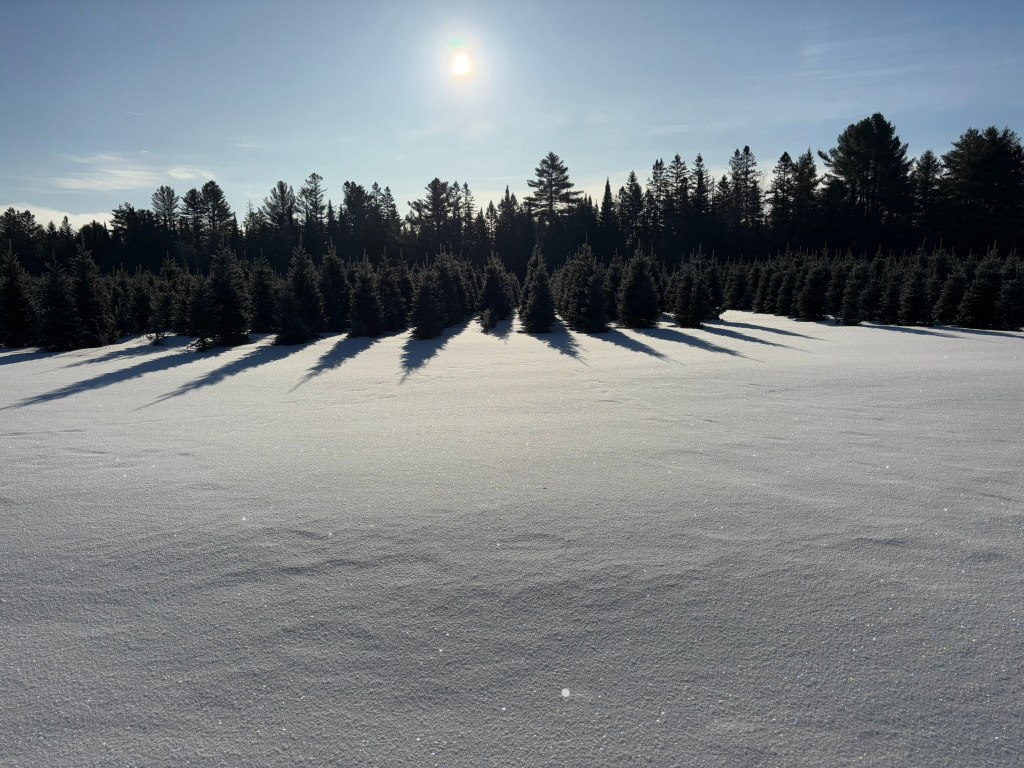
Bluebird morningon our property
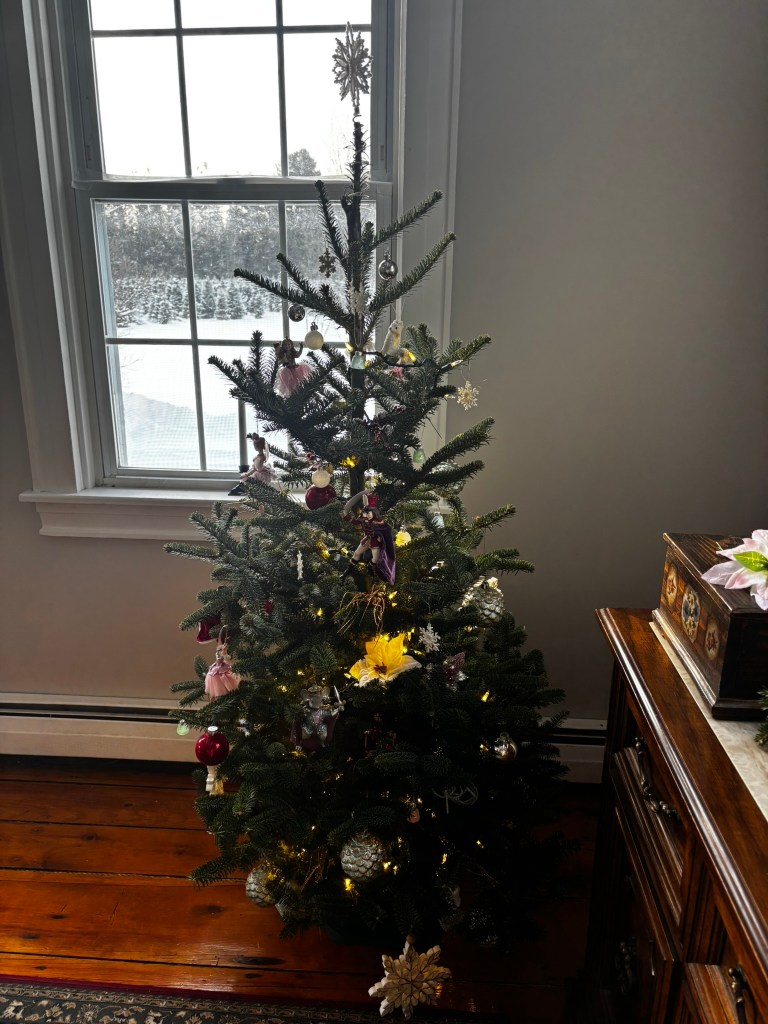
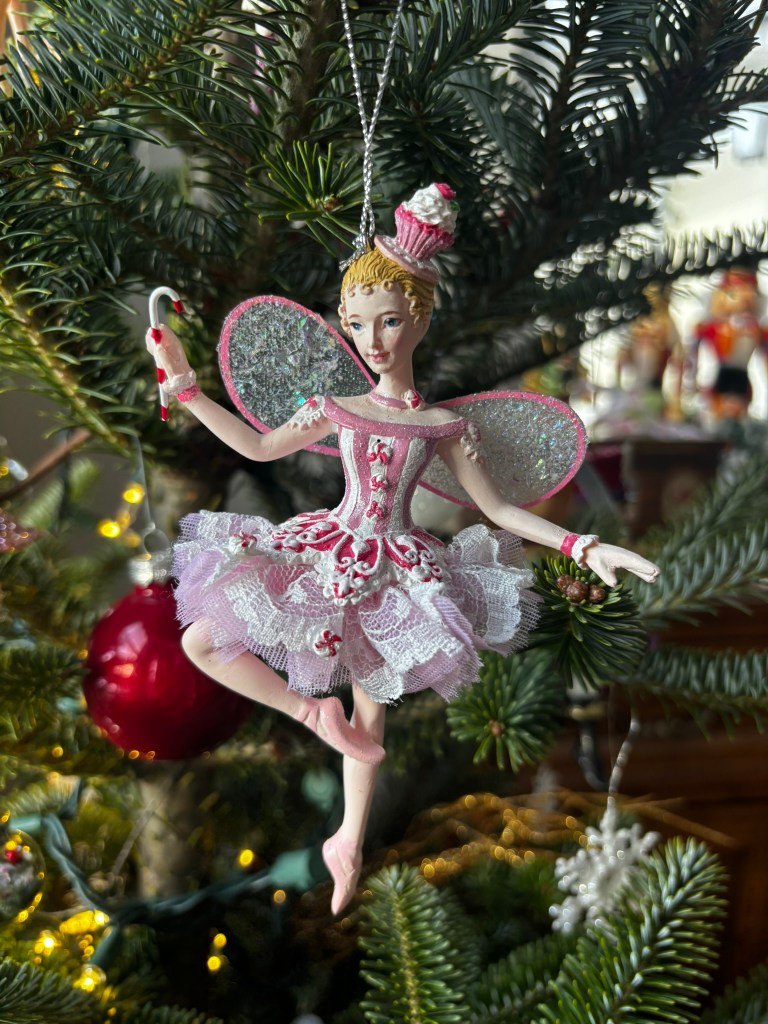
We live on a Christmas tree farm in northeastern Vermont, so choosing and hauling our own trees back to the house is a wonderful and relatively easy privilege. In the last couple of years, I’ve put up my own little Yuletide arbor in our farmhouse dining room, where I trim it with Nutcracker-themed ornaments and all kinds of sparkly feminine baubles. It’s become my own little tradition, one that’s separate from decorating our larger family tree in the living room with my husband and daughter.
This year, we’d done all our holiday decorating before we left for Thanksgiving in Newport, except for getting my mini tree. No biggie, I thought. We’ll just get that little guy and put him up the weekend we’re back. Unfortunately, along with some new clothes and other fun stuff, we carried home our first seasonal illness, and my husband hadn’t felt well for days. No fever, just a nasty cough, low energy, and a lack of appetite, but he certainly didn’t feel up to cutting down and carrying in another fir tree.
I was feeling the pressure—less than a month until Christmas, and I wanted to enjoy all my decorations for as long as possible, including my little tree. Impatience and frustration were squeezing out any sympathy for my poor husband. (Yes, I realize how spoiled I sound.)
It occurred to me, though, while driving home from school drop-off, marveling at the crystalline majesty of a sunny, post-snowstorm morning, that I should just cut down my tree myself.
It couldn’t be that difficult, right?
Even if I didn’t have the strength to saw all the way through the trunk, trying was better than sitting inside irritable and helpless about it. I’d done enough of that lately about other things, and I was sick of feeling that way.
So, I resolved to have one more cup of coffee, then don my snow pants, sturdiest gloves, and Bean boots, and venture out with the handsaw.
I’ve always been petite, and I’ve tended to think of myself as rather delicate and helpless. I’m not sure where that attitude came from, but I suspect it’s something I absorbed growing up as an early Millennial at the very edge of the Deep South, where I danced on the drill team and joined a sorority. In these more socially conservative groups, there lingered the idea that ladies ought never to do the manual labor a male will happily do for them. It’s the classic princess attitude, or the idea that you ought to be a “show pony” as opposed to a “work horse,” as my stylist once said. So, I usually defaulted to letting my boyfriends and, later, even my husband do most of the literal heavy lifting.
But I wasn’t going to act helpless that morning, dammit. I wanted my Christmas tree, and I would make that happen.
I found the saw in the garage and trudged into the lines of Fraser firs, already invigorated by the sunlight on my face and the endorphins activated by the outdoor exertion, and I was toasty despite the 19 degrees F. I picked a younger tree not far from the house, brushing off most of the snow first to ensure it had a nice shape. Then I kneeled, grasped the trunk in my left hand, and began sawing with my right.
Chosen tree
It felt like the saw’s teeth hardly made a slice, and my shoulder ached right away. I’m almost forty-four and I’ve been sedentary this year, so I’m not in the best shape. I stopped for a minute, leaned my palms into my thighs, and watched my own apparent weakness materialize in the steam from my breath.
Crap, I thought. I probably couldn’t do this. I’d have to wait. Or, I’d have to march back in, announce to my husband I failed, and see how gallant he was feeling. It was likely he’d drag on his own coat and snowpants between virtual meetings and come finish the job for me. He’s a sweet, solicitous soul like that.
I hated the idea.
Try again, I thought. A little higher up. Don’t give up so easily.
I started sawing once more, not quite so close to the ground. I realized I needed two hands, and I let go of the trunk and used both—my entire body, really—to saw away, allowing my gaze to wander, just concentrating on the rhythm of the movement and keeping my core muscles strong. Doing my best not to strain my middle-aged back.
I just kept sawing and breathing. Panting, more like it, but I kept going. It wasn’t pretty or dainty.
It took a while but suddenly, that little tree tumbled over. It startled me because, not feeling much through my gloves, I didn’t think I was making any progress.
But wouldn’t you know it, down it went.
Success
I hadn’t felt like such a badass since giving birth to my child ten years ago. Well, maybe not quite that fierce, but close.
I lifted my handsome little tree, now entirely mine, onto my daughter’s snow tube and pulled him back toward the house.
Bringing it on home
“See what I did?” I asked Susie, Jeanie, Mimi, and Doris, my hens. The tree and tube just scared them, and they ran under their coop to hide.
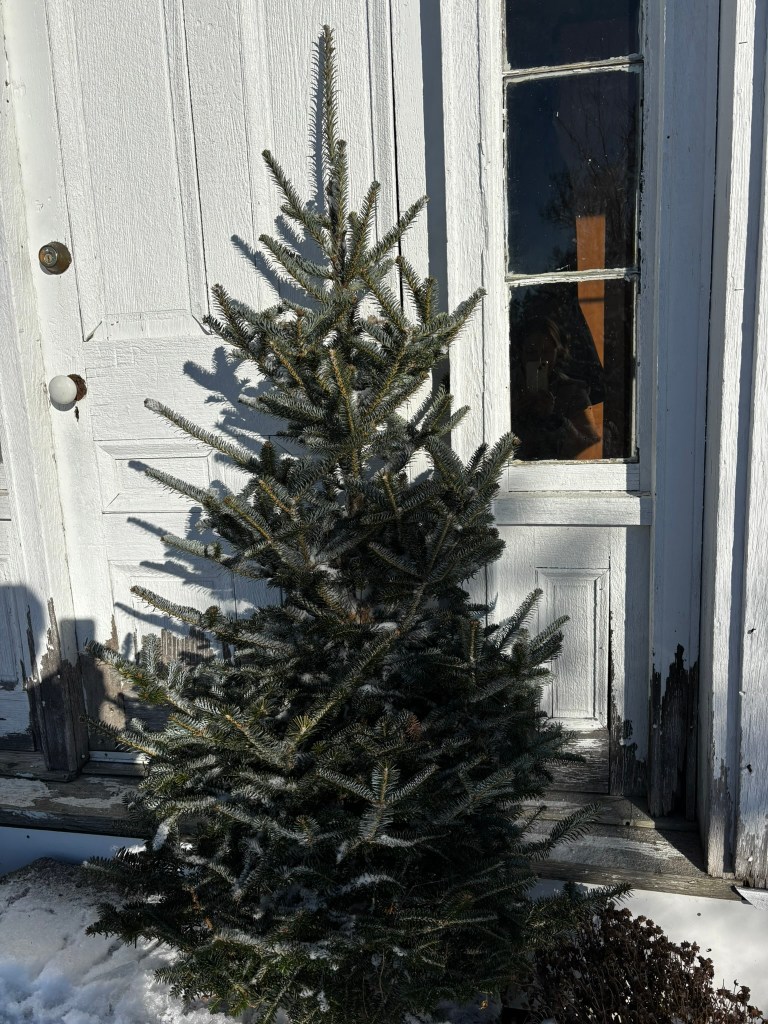
But I was still proud of myself. I propped the little Fraser up against our ancient front door, where the sun could melt the remaining snow before I brought it inside to decorate. Prior to that morning, I would have said the tree-trimming was the best part, but now I wasn’t so sure.
Drying out
Years ago, when I had a side-gig as a Pure Barre instructor, we had a saying: “You are stronger than you think.”
I used to consider that phrase little more than branding. A trite, obligatory statement we instructors were trained to weave into our cues in every class, especially when we could see our clients’ trembles and sweat, that point when many of them came out of their positions to rest because they just couldn’t take the shake and burn. The phrase was meant to keep them going a little longer.
Those painful segments were, after all, when their bodies were actually changing. When their strength was truly developing, though in the moment it felt like weakness and failure. That burn was the breakdown of their muscles, what made our clients ultimately leaner and stronger, and the next class a little easier, once they were rested and their muscles repaired.
As the years go on, in many episodes both major and minor, like my little tree-cutting adventure, I’ve recognized the truth of those words. We are all, in fact, stronger than we believe, physically, mentally, and emotionally, and when we persevere through our doubts and discomforts, we often achieve the most growth.
“Of course you cut down your own tree,” my husband said when, puffy with pride, I reported what I’d done. He sounded almost blasé about it, and for a minute I was miffed, but then I realized I should be flattered.
“You’re a tough, capable person, Jen,” he added. “I wouldn’t have married you otherwise.”
My tree finally all decorated
As this year draws to a close and we face yet another one—probably just as chaotic and uncertain as this one, if not more so—that is my December wish for us all. I hope we all remember our own strength. I hope we all persevere through those difficult moments, big and small, with greater confidence.
I want all of us to take more chances, even little ones. I want us all to make even the little things happen for ourselves because there is growth in those moments too. They are, in truth, rehearsals in grit and determination, and we need them to fortify ourselves for when those bigger, more daunting trials come along, as they inevitably will.
I write this as a metaphor of course, but I hope we can all go out and cut down our own Christmas trees.
Sugar Plum wishes
Happy holidays! I wish you the best, and I’ll see you in the new year.
Happy December! I thought I was done posting for the year, but it turns out I have more to share.
My friend Robyn Baker at The Ink Grove on Substack publishes monthly writing prompts, and it occurred to me these would be great ways to practice scene structure. I’d use each one to compose a single working scene with all the requisite elements, as a little composition separate from any longer, more serious WIP and meant simply to develop my skills. It seemed like a constructive endeavor and another way to have some fun.
So, on Thanksgiving night, I drafted a scene for Robyn’s November prompt: to write anything in a genre of choice that included a photograph, an unexpected guest, and Thanksgiving dinner.
It was a blast, and I kept gravitating back to this little piece, developing and editing it for a couple days afterward.
I decided to share it here for a few reasons. First, to hold myself accountable in this new practice. Second, to get more comfortable with vulnerability and imperfection. Finally, to share what Robyn’s doing with a few more people.
So, here is my scene for her November prompt. I should have shared it much sooner, but I started it late, we were traveling home from Newport, and then we all got sick. Oh, well. The world’s an imperfect place.
I hope you enjoy this little narrative of contemporary fiction, about a woman whose carefully curated solitude is challenged when an unexpected knock offers the possibility of connection, if she has the courage to hope again.
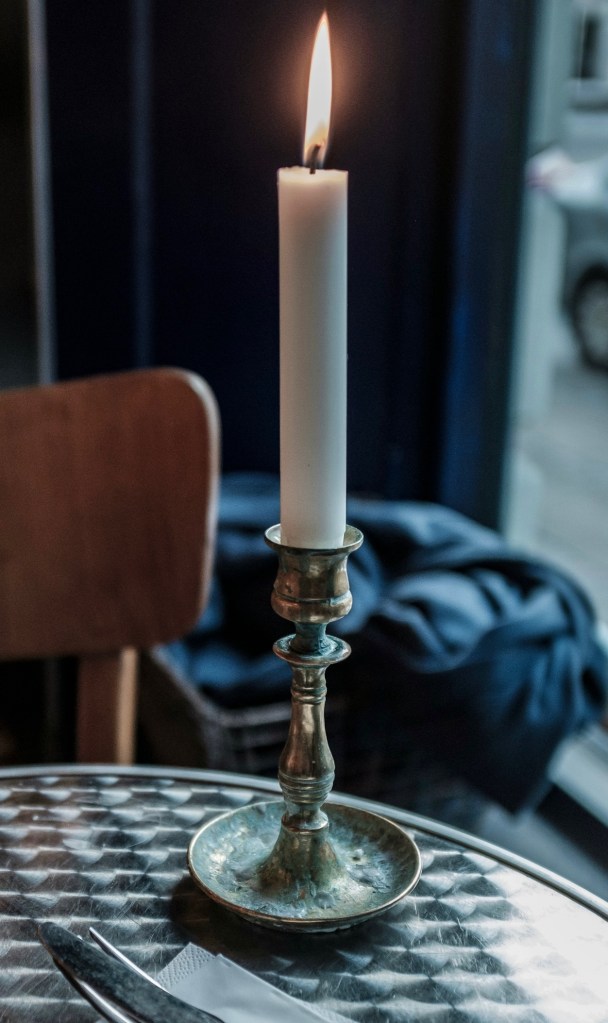
Image by Lasse Moller on Unsplash
A CANDLE and a KNOCK
In her tiny living room, Tess sat down at the little round table made of particle board. She’d covered its cheapness with an ivory damask tablecloth, its sheen reflecting the warm lamplight, and she’d placed on it her grandmother’s sterling silver candlestick and crystal vase, filled with burgundy, mauve, and gold-colored mums. Beyond the table, a downhill view of Main Street ending at Lake Champlain, long and gray and still, filled the bottom half of her third-floor window.
Tess had already poured herself a generous amount of Gallo pinot grigio and served food on only her china plate: rolled slices of Boar’s Head smoked turkey, plus servings of green bean casserole and mashed potatoes made from scratch because, why not? And though she was alone, the table would have looked lopsided with only a place set for herself, so she’d laid out matching dinner, roll, and salad plates—the sage Wedgewood a steal from a Waterbury antique shop—plus cutlery, wine glass, and linen napkin on the other side too, for the sake of symmetry. She planned to take a couple pictures on her phone, for posterity. To prove she was, in fact, using what little she had to curate a new, lovely life entirely on her own terms.
Maybe she would post the best pic on her new Insta, if it didn’t feel too weird or pathetic.
But instead of reaching for her phone, perched on a thick library book within arm’s reach, she picked up an old photograph next to her dinner knife. It was an image captured on real film a decade ago, and it had spent years pressed between a page and a plastic sheet in her parents’ album before Tess discovered it.
In the photo, she stood in graduation robes between her linen-suited mother and her robed father, his ceremonial attire matching her own. The university had awarded them both their bachelor’s degrees that day, and in the picture, his gray and her blonde head were tilted toward each other, touching.
That short span of years when her mother was still healthy, her father sober, and everyone beamed.
The picture would be a perfect relic if her then-boyfriend Brad, now her ex-husband, hadn’t taken it.
Well, she couldn’t change that. And really, it didn’t sully all the joy she remembered from that day. Not really. She could still recall the pockets of air beneath her heels, that strange sense of power and possibility. That feeling that if she and Dad just bent their knees deeply enough and leapt, they could touch the sun.
A phantom hand squeezed her heart. It ached almost as much as any cramp, and she slid the photo between the candlestick and silver pepper shaker, the image disappearing in the angle of the wafer-thin photo.
Swiping her cheek, she reached for her phone. Dwelling on any of that was stupid; it wouldn’t bring any of them back.
Instead, she’d snap a quick picture of her table, then disappear for a while as she ate and read her book. She wanted the peace and quiet of a solitary evening, in truth. It was restful. She was just fine on her own.
Happy Thanksgiving.
“Crap.” She hadn’t lit the beeswax taper in the candlestick. She couldn’t take a proper picture without the wick lit.
Tess stood up to hunt for a book of matches, and someone knocked twice at the front door. Quick and staccato.
She paused, then crossed the room quietly. Rising onto the balls of her bare feet, she saw through the peephole a magnified length of blue and a smaller head of brown.
The hell?
Why was he here?
She was a little dizzy.
The thought of making even short, polite conversation with her landlord’s electrician drained what serenity she’d mustered.
But, Josh was a nice guy, despite his couple of crooked teeth. The last thing she wanted to do was be rude to him on a holiday. He’d probably just forgotten something. A thing from his toolbox, a drill attachment or something. This old Queen Anne Victorian, converted into multiple residences, was undergoing a fresh round of renovations. Josh didn’t strike her as the careless type, so of course he’d come back for something he’d forgotten when he’d worked on her apartment earlier that week.
She could pretend to be out.
If she was quiet long enough, he’d go away.
That would be easier. She could get back to her food and the bloated escapism that was ABreath of Snow and Ashes.
She glanced over at the table. The empty chair. Empty plates and glasses opposite her own, gleaming and cold. Beyond the window, the massive stillness and silence of the lake. No boats on the water today. Not even a train pulling in or out of the station down at the lake’s edge.
She considered the hours of silence to come. The long night.
She might go the entire weekend without speaking to anyone. Such a thing was entirely possible, these days.
Gingerly, she turned the top lock. Her stomach clenched at the scrape and click. Now he knew she was there. She turned the cold knob and opened the door, just enough to lean out, her chest tight.
“Hey, Josh.”
“Hi, Tess. I hope I’m not bothering you.” He flashed her a tentative, close-mouthed smile.
“No.”
She opened the door a little wider, still leaning out. It felt wrong to let him see her bare toes. It’d been ages since she painted them. And she was wearing nothing but loose yoga pants and an old V-neck top, no bra. She tucked a strand of hair behind her ear, locks slipping from the clip, and kept her chest hidden lest he see the shape of her nipples against the shirt’s fabric.
“Did you forget something?” she asked.
“I—” He pulled his chin back and laughed. A brief, sharp sound. “Well…” He clasped his hands together. “This is embarrassing. I was around, and I thought I might actually take you up on your offer. Though please, no pressure if you’re busy.”
“My offer?”
Her mind scanned back over their exchanges that week, remembering mostly his words, though nothing beyond the usual Good morning, I’ll be working on the wiring today, I’ll keep this door propped, will the drilling bother you?
Her responses: Would you like a bottled water? I’ll be out for a while… See you tomorrow…
“The potatoes?” he ventured. “The ones you were going to make from scratch?”
“Oh!” A wave of heat engulfed her. That’s right. She’d made an off-hand comment about mashing potatoes by hand, and all the heavy cream and garlic she needed. The recipe would make a ton, she’d said, and she’d be happy to share them with him.
She’d meant as leftovers in Tupperware of course, to give him the day he came back for work, but she hadn’t said that part out loud. And really, it had just been chatter to fill the space between them while he’d been on a break from updating the third-floor wiring. He’d sipped from a water bottle, lingering in her doorway, his eyes never leaving her.
And he’d recently switched from “Ms. Thetford” to her first name. After she’d made him coffee one morning, and they’d chatted a little on his break about embossed tin paneling and the ceiling rose around the old chandelier in the building’s foyer. He seemed to know a lot about old houses. He’d also begun to tease her, lightly, occasionally, after she’d called him her “Go-to House Prof.”
Usually, during the day, she looked better. Hair brushed, some powder, mascara, and lip gloss on, wearing fresh jeans and a turtleneck and vest, maybe. Stud earrings or tiny hoops. With him around, she’d started to make some effort. Today he’d caught her barefaced, her chest floppy in this dull old shirt.
A coat was draped over his arm, and his clothes, usually well-worn, earnest Carhart, were now anything but, though his button-down was a shade too bright, and his jeans, though clean and ironed, looked unfashionably faded, and she’d hardly call his scuffed boots nice. He smelled a little too strongly, too, of… Acqua di Gio?
Holy hell.
She squeezed the doorknob.
He looked like he was dressed for a date.
With her?
Was that what he thought this was?!
Holy fucking hell. Her armpits were hot.
He’d been scanning what he could see of her with his eyes, trying, it seemed, to read her thoughts in her own appearance.
“My apologies.” He stepped back, crimson coloring his cheeks. “I didn’t mean to interrupt you. I’ll head out.” He smiled again, weakly, and hitched his thumb toward the staircase. “I planned to go see my kid, anyway.”
“Give me just a sec!” She held up a finger and closed the door, though she didn’t click it all the way shut. She grabbed a cardigan off the hat stand and slipped into it. She let down her hair, fluffed it, then re-twisted it tightly, refastening the clip.
Okay. So he thought this was a date of some kind. She could do this. She could let him in, even just fix him a container of potatoes to go, if things were too crazy awkward. She would not come across like some thoughtless, disinterested bitch.
That scent.
Fresh, citrusy.
His square shoulders. Veins running visibly under the freckled skin of his well-shaped forearms. The sensual spiral of a dark tattoo. The softness of his tone.
He also had a suspicious gauntness in his pale face, and not for the first time, she wondered about his private life. Did he use any drugs? Was he a recovered addict? From fentanyl, or something else? Around his eyes and cheekbones, he bore creases and shadows he seemed too young for, and he was a tad on the skinny side. Was she being horribly prejudiced?
But, he wasn’t bad looking.
She’d already admitted that to herself.
No ring on his finger, though Jeez, he had a child; that was a lot.
But he seemed to have his life together.
He was kind.
She dragged in a breath, a hand on her chest, willing everything behind her sternum to soften.
Don’t overthink this. Don’t automatically turn this into something it’s not, or not yet…
He wasn’t holding flowers or a bottle of wine, like a man should if he were coming over for a dinner date. Damn, maybe she was misreading all of it. He might be on his way somewhere else and really just want some food on the run. Maybe he didn’t want to sit down to eat with her, after all. Maybe he’d try to pawn the potatoes she gave him off as his own contribution to someone else’s meal. Maybe this was some elaborate strategy to get away with as little holiday cooking as possible. Wouldn’t that be just like a man?
“Tess?” He called quietly from the other side of the door.
Outside, beneath her window, something shattered on the concrete. Muted voices argued.
Maybe he would just use her.
Was she okay with that possibility?
But maybe he won’t.
She opened the door wider, reappearing before him. “You don’t need to go yet, not if you’re not in a hurry.” She gestured, continuing, “Please, come in. I do definitely have a lot of potatoes. Way more than I can eat.”
Her voice was too shrill, her gesture too big.
“Thank you,” he said softly, moving past her.
Closing the door, she tried to crack a joke. “You’re not actually a sun-tolerant vampire, right? Because if you are, be careful. There’s an eff ton of garlic in these potatoes.”
He was already in the room, looking at the elegant table. He looked back at her. “Too late, you’ve let me in.” His smile was easier now. A little more confident, but still warm and sweet. “I think I can probably handle the garlic.”
The issue of a post-garlic kiss materialized suddenly in the air between them. But, of course, Tess wouldn’t go there.
Josh didn’t, either.
“Oh,” he said instead, digging into the pocket of his coat. “Before I forget, this is for you.”
He handed her a small cellophane bag with a familiar deer logo, tied with a little orange ribbon.
“Nonpareils! I love these!”
“I noticed you eating them the other day.”
She giggled. “I shouldn’t, but they’re irresistible.” She held the little bag to her chest. “My dad used to buy these for me. ‘Chocolate snowcaps,’ he called them. We’d eat them together.”
“Dads are kind of awesome like that.” Now, his smile had a quiet, knowing look.
She nodded. “They are.” Her throat threatened to close.
He tilted his head, regarding her. “You look pretty, Tess.”
The way he said her name, this time. Like it was full on his tongue.
“Your hair is nice,” he continued, “twisted up like that.”
It took every bit of control she had to look him directly in the eyes without her own welling up. “Thank you, Josh. This is so… well, thoughtful.”
She wasn’t sure if she meant the compliment, or the candy, or simply his presence.
A fresh warmth had suffused the room. Tess felt it tingling the tips of her ears and the back of her neck. Even the skin on her arms, beneath her sweater.
Josh waved his hand in casual dismissal, but his bright eyes were larger, more pleased.
“I’m gonna go stash these with my other sweets.” She turned quickly away, stepping into her galley kitchen where he couldn’t see her, taking yet another moment to collect herself. She also rifled quickly through all the drawers.
Maybe she was foolish. But, suddenly, she was so damn grateful she’d set that second spot. It was cringey, sure. It probably looked odd or pathetic or still, somehow, overeager, even though he’d figured out she hadn’t expected him.
But at least now it’s not all so sad.
She had a spot for him, possibly. If he wanted to stay.
“Do you happen to have a lighter?” she asked, returning to the living room.
“I think so.” He dug into his other coat pocket and pulled out a black Bic. “I smoke a cigarette every now and then. Just cigarettes, and I’m trying to quit completely.”
“It’s ok.”
She took the lighter, flicked it, and lit the candle.
“Let me get you some food.” She set the Bic down and picked up his empty dinner plate, adding, “Please, sit down.”
Her feet were buoyant on the wooden floor, and over her shoulder, she flashed Josh what she hoped was a dazzling, flirty smile. The high tug at the corners of her mouth felt tight, but she’d perfected this look a long time ago, and she could get it back again.
It’s been a tough year for many of us, for a lot of reasons.
So, to end on a positive note, I’m offering my own list of favorite bookish things among all the others shared on blogs and social media this time of year. I’ve always found these lists a great way to discover amazing new people and things and to celebrate what we’ve loved.
So, without further ado, here are my favorites:
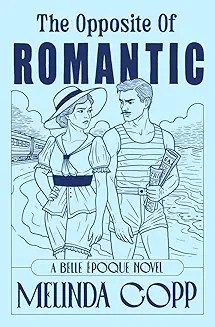
FAVORITE INDIE AUTHOR: Melinda Copp
Copp writes historical romances set in Belle Epoque France, and among other aspects of her work, I find her choice of setting refreshing. I adored Love and the Downfall of Society and Complications in Paris, where we meet the circle of modern, admirable women on whom the books center.
This novel is a swoony, well-paced, and surprisingly sweet story considering how thorny Vanessa, the main character, is. The novel’s singular, first-person point of view (a departure from Copp’s dual third-person POVs) works well in this one, giving Vanessa, a rising female journalist, a fresh and honest interiority. It allows readers a deeper insight into her feisty personality, and for this reason, I couldn’t dislike her, even though she’s initially selfish and does some cruel things.
She’s an orphan, having lost her entire family when only a teenager, so we understand that her apparent callousness and cold ambition—now also threatened when her newspaper is bought by a rival publication—are a shield behind which she tries to protect herself. So often, she acts out of fear—some of it valid, some of it inflated in her own mind—and it takes a truly good man like Benoit Levin, plus some lovely female friends, to help her open her heart to new vulnerability, wisdom, and deep, surprising love.
Her first kiss with Benoit is magnificent! I love it when the first kiss is done well in a romance (a mediocre one is tough to rebound from), and I find this one an absolute delight! Of course, the book’s title is ironic—it is highly romantic.
The setting is also an especially lush escape. The descriptions of the sea and sky at Cabourg on La Manche (the English Channel) are beautiful, and I particularly enjoyed them as we are resigning ourselves to a cold, early winter here in northern New England.
Benoit might be arguably too perfect, but you know what? Nearly perfect men do exist; I’m married to one. Benoit is a good foil to Vanessa, and he does make the mistake of keeping something important from her, so he’s not totally infallible.
Finally, I appreciate how Copp makes Benoit’s domestic life messy—it forces Vanessa to take an even further step beyond herself when considering a future with this man, and I found that realistic. So many of us have challenging home situations ourselves, and for me, this detail made the book especially relatable.
Copp is finding her stride with these characters and their world, and I can’t wait for her next Belle Epoque title! I hope it’s Catherine’s story; I need to know what precisely is up between her and her almost-stepbrother, Henry. Talk about messy!
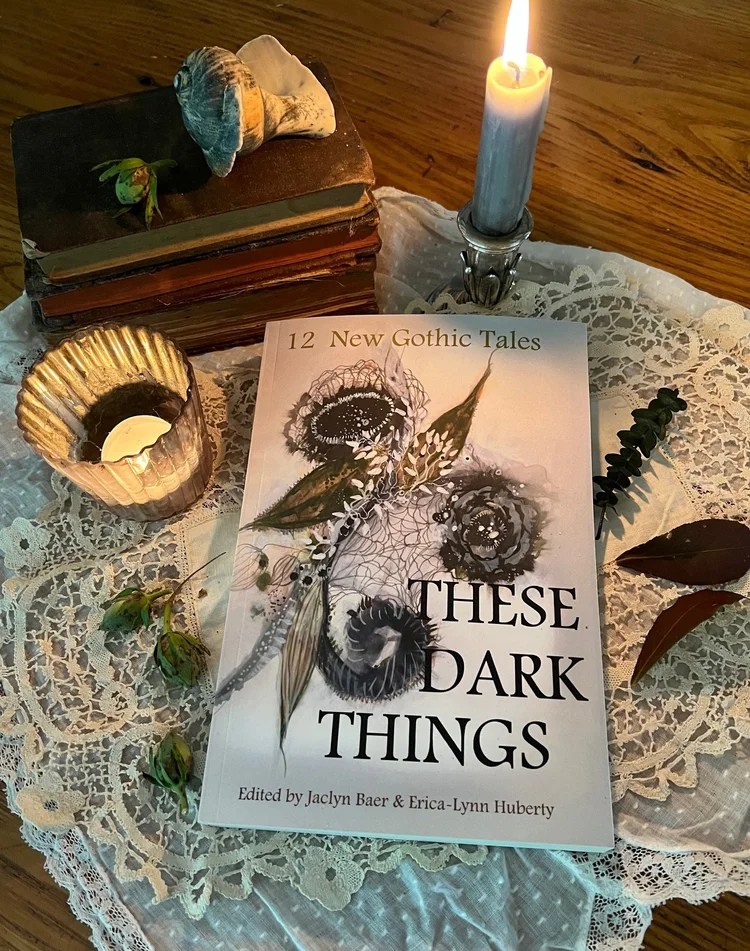
FAVORITE BOOK FROM A SMALL PRESS: THESE DARK THINGS
I was so impressed with this anthology of modern gothic short fiction, edited by Jaclyn Baer and Erica-Lynn Huberty and published by Briar Press New York. It’s a strong collection of well-crafted psychological horror, often quiet in tone and approach but bold in themes and effects. For a more thorough look, see my blog review from January.
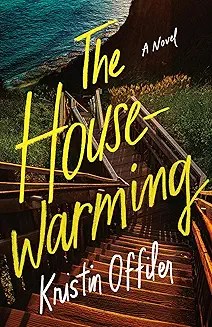
FAVORITE DEBUT NOVEL: THE HOUSEWARMING by Kristin Offiler
The Housewarming is a strong debut that combines elements of women’s fiction with psychological thriller. Offiler writes well about early motherhood and female friendships, but I especially appreciated her treatment of true crime fandom. It’s a relevant ethical issue, and it made me think twice about my own love for true crime podcasts.
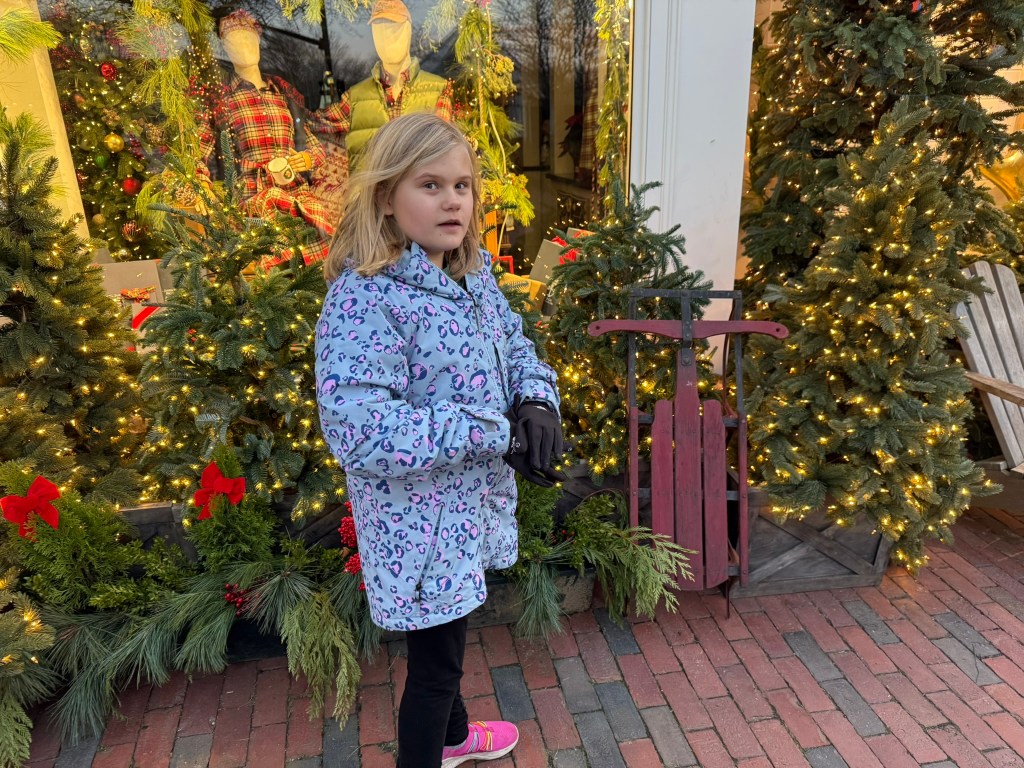
This beachy, summery book is set on Block Island and in Newport, RI, which I have a personal connection to through my husband’s family. In fact, we just spent Thanksgiving in Newport, and as we window shopped, I found myself thinking a lot about the story, which has lingered with me longer than I anticipated.
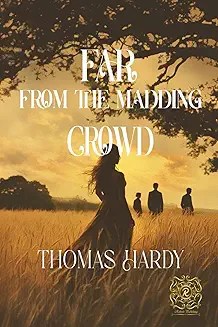
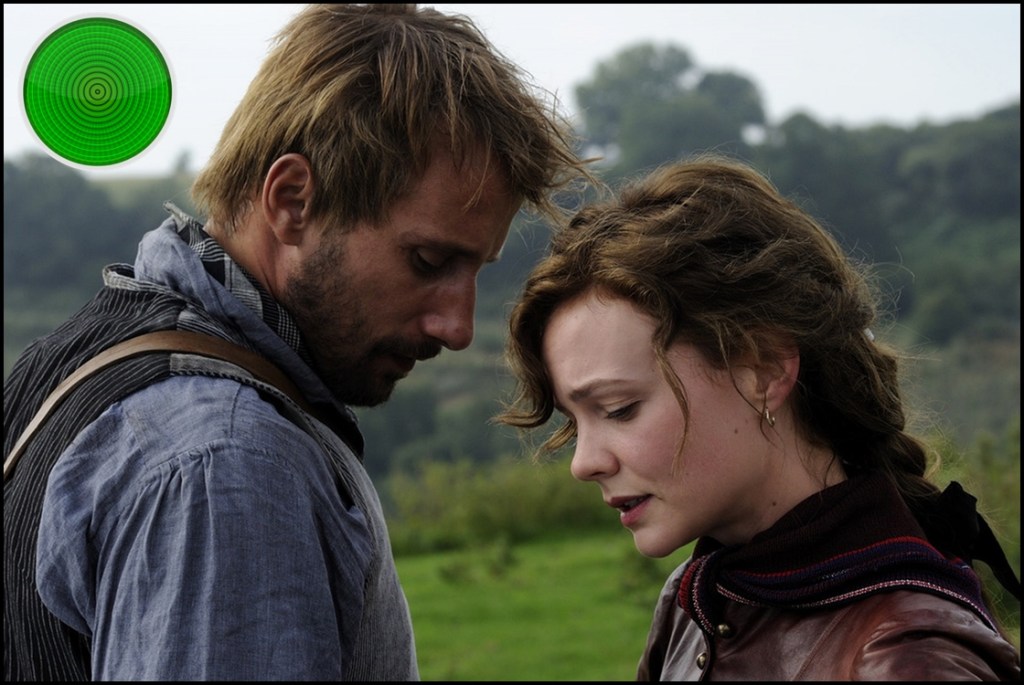
I try to read at least one classic every year. I love Hardy and hadn’t read anything by him in years, and I gravitated to this title because I now live in the countryside so I thought I’d find his work even more engaging. Plus, I’d seen clips from a movie adaptation staring Cary Mulligan floating around on Instagram, and the story looked beautiful. When I started the novel, though, I was bracing myself for tragedy–Hardy can break your heart like no one else, considering his masterpieces Tess of the D’Urbervilles and Jude the Obscure.
I was surprised and delighted, then, with the joyful, deeply satisfying ending of Madding Crowd. It is a perfect testament to what mature romantic love and marriage is–selfless respect and steadfast partnership, through and through.
Despite being initially rejected, the humble, grounded shepherd Gabriel Oak stands by his former sweetheart and current employer Bathsheba Everdene through hardship and heartbreak. When she is finally free to recognize how much she needs him–how much she loves him, in fact–he is there to return her love openly, and the emotional triumph is well earned for both characters. I found myself in tears, floating on a cloud of elation, as I finished this book, marveling at the universal truth of certain human experiences, no different despite a hundred-plus gap in years.
Then I went and gave my husband a big hug.
Hubby and I at The Nutcracker at Rosecliff in Newport, RI, 11/26
OVERALL FAVORITE NOVEL: MEXICAN GOTHIC by Silvia Moreno-Garcia
Back in July, when I closed Mexican Gothic for good, I felt an immediate pang. Though the story disturbed me, I already missed it. It had wormed its way so gorgeously and insidiously into my imagination that it hurt to think there wasn’t another chapter to devour, another act to get gorgeously, frightfully tangled up in. That there was nothing new to contemplate.
If you are a fan of gothic fiction and haven’t yet read this contemporary masterpiece of the genre, please do so right away. Author Silvia Moreno-Garcia does absolutely “get it right,” as the Telegraph claims in the opening testimonials in my print copy.
Everything is there—the driving arch plot of a single, modern, stubborn heroine out to defeat a seductive, all-consuming, patriarchal evil, even as she proves to herself her own depth and mettle. The enormous, isolated old house is perfectly neglected and rotting from within yet very much alive and grasping. The Doyle family is everything you can ask for in an antagonistic gothic clan—insular, incestuous, despairing in some cases, and depraved in others.
The style and plot develop beautifully in the author’s pacing, beginning with a creepy setting and that odd, creepy family shackled to the past. It develops in small, deceptively simple details here and there to suggest all is not right, despite the protagonist Noemi’s rational worldview. It builds in the surreal, fragmented, nightmarish dreams she begins to suffer, and finally drives the reader relentlessly through crises and a climax of literal events harrowing and developed enough to reveal that terrible potential fate worse than death. The ending, thus, if not entirely surprising, is fully cathartic, especially as love and perseverance win the day.
Yet, brilliantly, Moreno-Garcia does not end this tale with unqualified optimism. There are fears planted in the main characters, foreboding seeds of doubt which suggest the thematic question, can one ever truly recover from trauma? Can one ever escape their nature, whether that nature is real and inherent or a misperception of the victim’s, ripe enough for a self-fulfilling prophecy? It is a resolution left open just enough to leave room for some doubt, providing readers with a final, meditative shiver. It is also a resolution that pays respect to the depth and complexity of traumatic experience and how it might ultimately impact victims.
Essentially, that’s what this novel is about, in my opinion—trauma. Specifically, the trauma of domestic captivity, for both women and men. For the female characters, that suffering manifests especially as sexual abuse by a sadistic patriarch (without being too difficult and graphic to read), supported by the terrible compliance of the matriarch. That is the essential horror—a real life one, tragically—that firmly roots this fantastic, speculative tale into our everyday world and makes it so terribly compelling and real.
So there you have it–my favorites. Thanks for reading! I’m planning to take a break from all writing, basically, but I’ll be back here on WordPress in January.
Thank you, too, to anyone who visits this site regularly. I’ve enjoyed sharing my thoughts, hopes, joys, and struggles with you, and I hope you’ll come back for more, even if it’s just the occasional scan.
Happy holidays! Have a wonderful, restful break doing all the things you love with friends and family. All my best wishes to you.
Daphne wishes you a happy holidays, too!
I hope we can end this year with a measure of peace and joy as we brace for another, which will no doubt include its share of political chaos and general uncertainty. I plan, however, to continue leaning into all the people and things I love and being grateful for what I have. Thank you for being part of that.
When the second, and final, transformation occurred, Muir’s arms were smeared in blood past his elbows.
Toiling in Lord Aitken’s scullery, he gripped the buck’s hindquarter with his feeble left hand and sawed the flattened blade of the skinning knife down the inside of its leg toward the gutting incision with his equally afflicted right, careful to keep the blade between the skin and muscle. Releasing the animal, he began to pull its skin away with his free hand, using the knife to carefully separate the connective tissue where it clung. The tawny fur did not give way easily.
Muir’s stringy muscles strained at the effort. His breath grew ragged, and sweat slicked the fleshed parts of him, for he was still mostly a wretched man. Of this exertion, he was not conscious; his body labored in motor memory. He felt, however, the fullness of his throat—inside, still very human despite his goat’s brow—though he’d done such butchery a hundred times.
Already gutted, the deer’s fur remained even and unblemished; it bore on its head only four points. It had been a young animal, and the destruction made Muir ache, an internal throb that matched the rhythm of his efforts. The dressing and skinning always felt like a sin, so he had laid the deer out on a worktable rather than hang it from a hook, though that made the awful chore more difficult. He did not care.
As he skinned the creature, he grunted a quiet prayer in Latin.
“Gratias tibi ago, Domine, pro hac largitate. Non vastare.”
Thank you, Lord, for this bounty. It will not go to waste.
Though a priest would have condemned it as heresy, he added in Gaelic, “Tapadh leibh, Cernunnos; tapadh leat, Danu, airson an tiodhlac seo dhut fhèin. Bidh mi ag ath-aithris, cha tèid e gu sgudal.”
I repeat, it will not go to waste.
When the hide finally came free, he laid it aside; the fur would line some new garment to keep someone warm. Sill gripping the knife, he paused to stroke the animal’s cold head and plush ear, its glassy eye unresponsive. Meat now. Carnes. Only empty meat.
No, not empty. From it, other tangible things would come.
Indeed, nothing would go to waste. He thought it again for the thousandth time, and it was as precious and necessary as a prayer bead.
He’d said it first when, ten years ago, he’d suffered the initial curse, that great crucible of his life. That vow had kept him moving forward, enabling him to assist Elspeth.
Elspeth.
She was his redemption here on earth.
He must remain in her house. With her, near her.
He could not bear their parting. That would be the true damnation.
While Alistair had chosen another—blind fool that he still was—Muir was not so confident another man wouldn’t eventually recognize Elspeth’s beauty and great worth, beyond jewels indeed. She would likely marry this man and leave her father’s house.
Leave him.
Or, perhaps, she would take Muir with her. As a devoted servant. And he’d have to witness another man put his arms around her, watch her belly swell with children not his own…
He set the knife down and leaned his palms flat on the worktable. He tried to breathe through his nausea as he gazed at a hand. Muir’s hands, seared in boils and crimson as the deer’s blood, red as a blood moon. Though Elspeth never once shrank from them, they were hands that could not hold her.
He closed his eyes.
A sensation washed through him, like warm seawater. Soothing but ancient and rife with power…
***
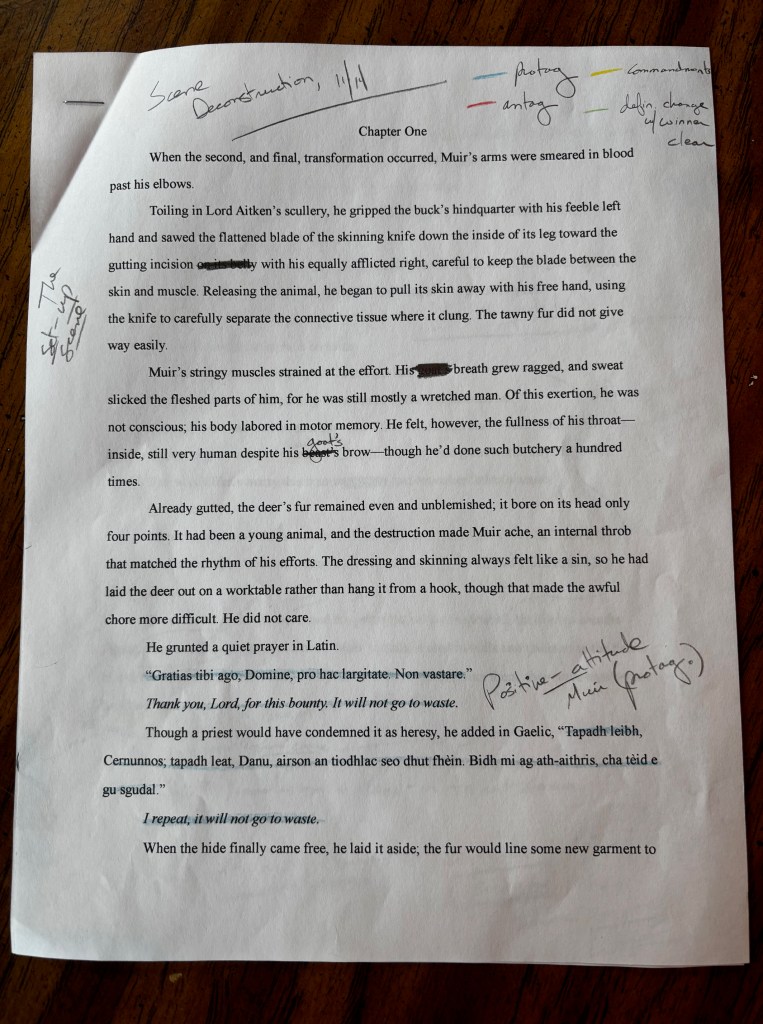
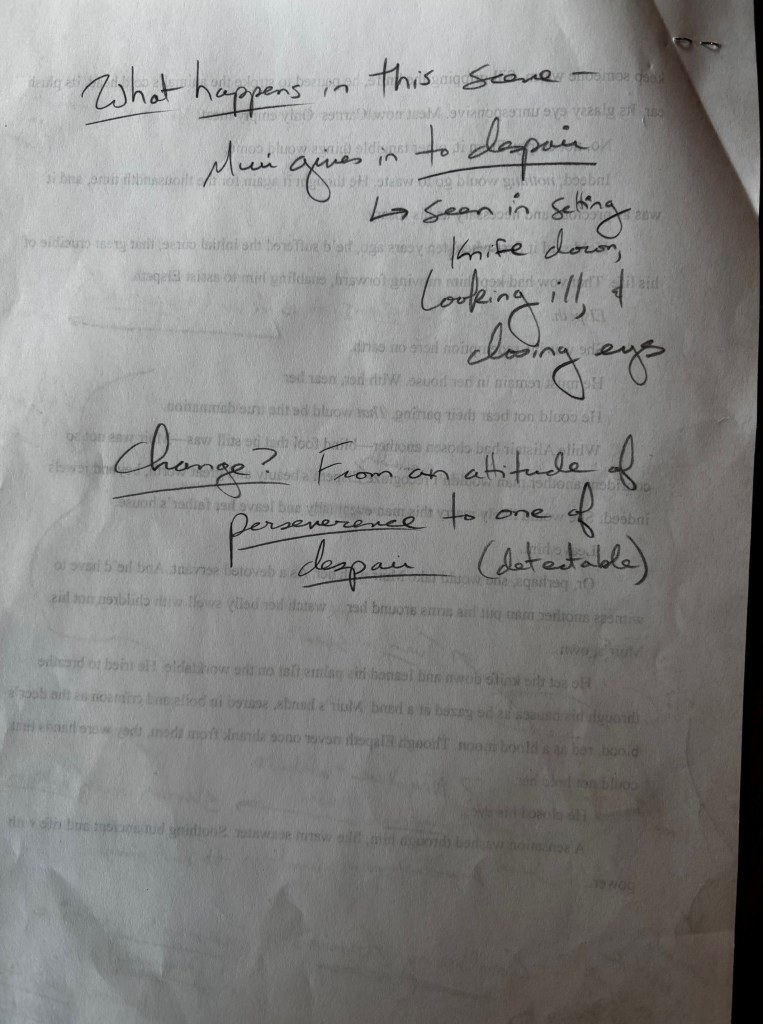
This year, I’ve concentrated on developing effective scene structure, and the following photos show the self-edits/reflections and highlights for structure I’ve already completed on these two pages.
Basically, I analyzed what I had to ensure everything required for a complete scene was there:
a clear protagonist & antagonist with conflicting desires (more subtle in this case because it is the persevering Muir vs. his despairing self)
the five commandments of storytelling (inciting incident of scene, progressive complications, crisis, climax, & resolution)
a definitive change where someone “wins” the scene (in this case, despairing Muir wins)
(The above criteria comes from Tim Grahl and is a condensed version of what Shawn Coyne teaches in his craft book The Story Grid).
This scene, which sets up the entire novelette, is very much a working draft. I find it interesting that a visual scan reveals over half of it is spent grounding readers in character, setting, and tone before the inciting incident occurs. This might suggest there’s too much grounding, given the proportions between that and the storytelling commandments.
I need to step away from the entire work, for now, and eventually have a reliable critique partner or editor look at all of it for me, especially if I want to do anything with it.
And, oh god, I’ll have to find people to edit the Latin and Gaelic. Why did I do that to myself?!
But, I hope the scene’s on its way to hooking, orienting, and intriguing you.
Thank you for letting me share it with you. Have a wonderful weekend!
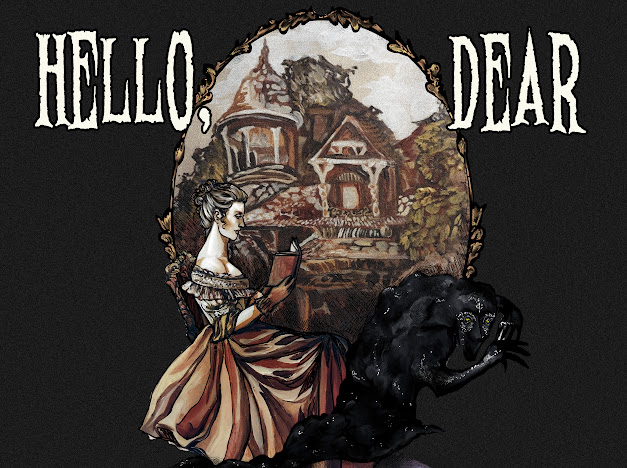
Last year, I discovered how awesome it felt to have an artist illustrate a picture for my work.
Artist and writer Sybil Wainwright created the above for my feminist ghost story “Hello, Dear,” published by Amaranth in September of last year. I love how she chose sepia tones to mimic the look of an old photograph.
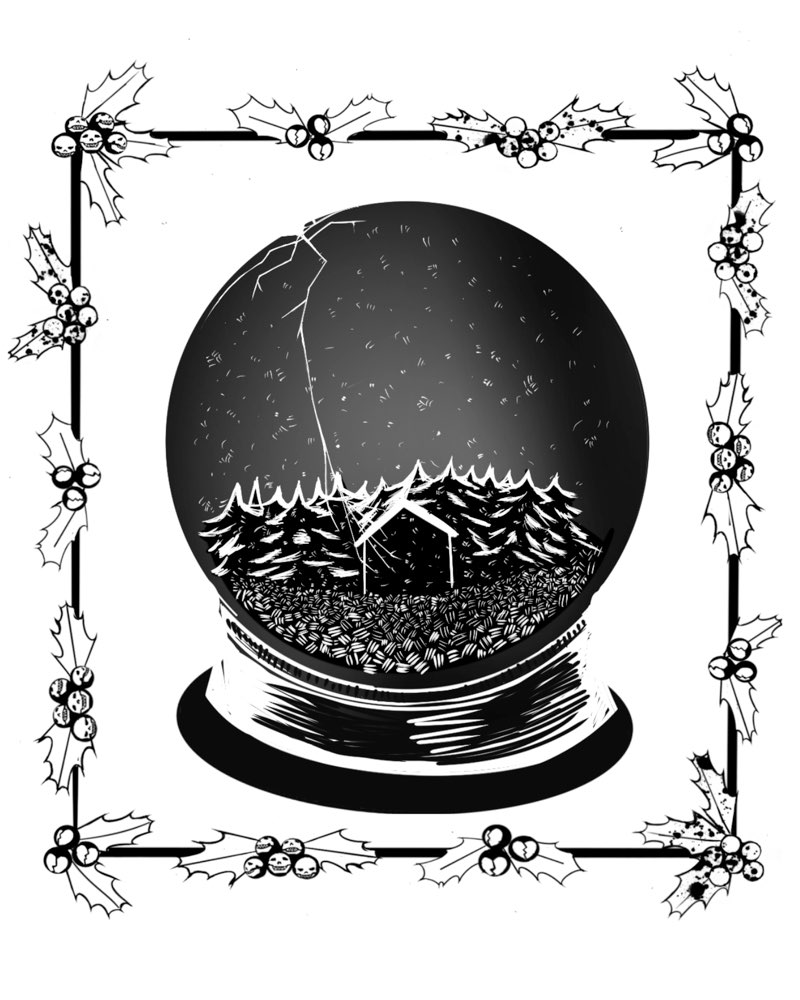
Artist Khareese Orr created this one for “So Many Fragile Things,” a Christmas horror story with dark fantasy elements, published by Amaranth in December. The crack in the glass suggesting a hand seizing the house is perfect. I also appreciate the little images inside the holly berries.
This year, no one is commissioning work for any of my pieces. It’s looking like I’ll end 2025 with only one story published, though I believe I’ve improved in my craft. That’s how it goes sometimes, I suppose.
I decided, however, on whims of rebellion and self-love, that I would commission something for myself. Why not?
I was also curious about how that process worked. How does the writer communicate their vision to the artist? What are the details of a contract? What does the creative process look like? Commissioning book art, especially cover work, is a key piece of self-publishing, which is something I’d like to learn more about.
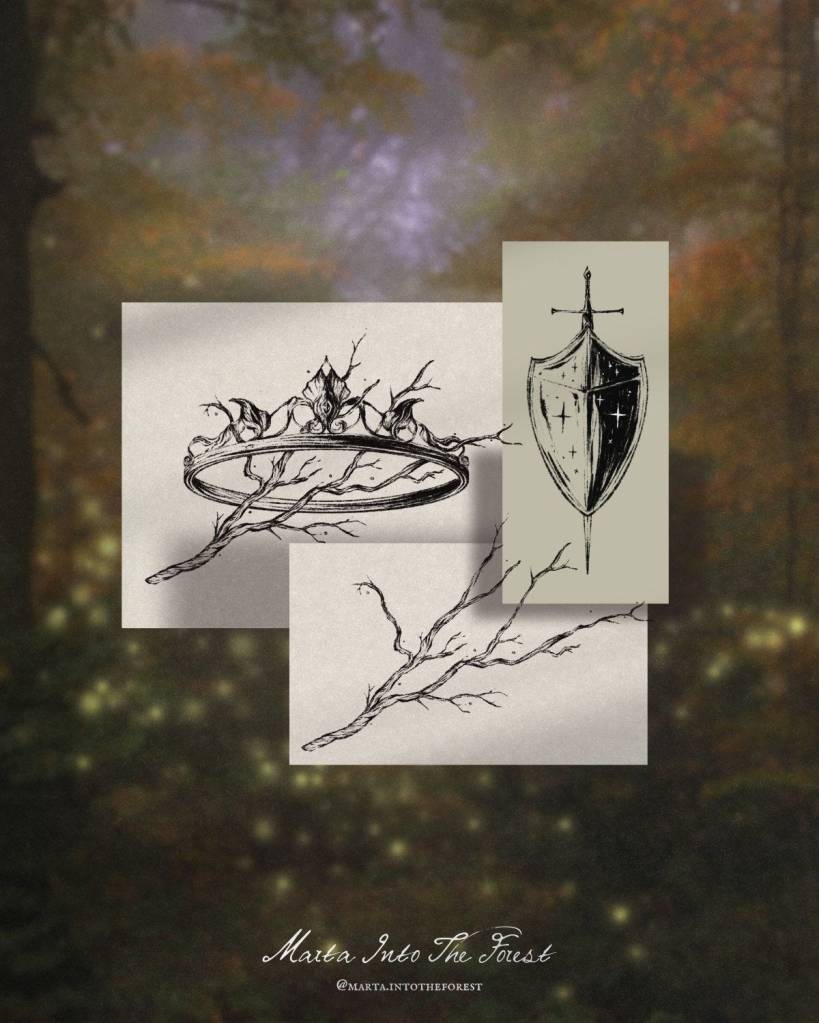
So, after being taken by the beauty of Marta Into the Forest’s gorgeous, gothic-y medieval creations, I reached out to her via Substack.
Here’s a small sample of the work she’s shared there:
Samples of internal book art
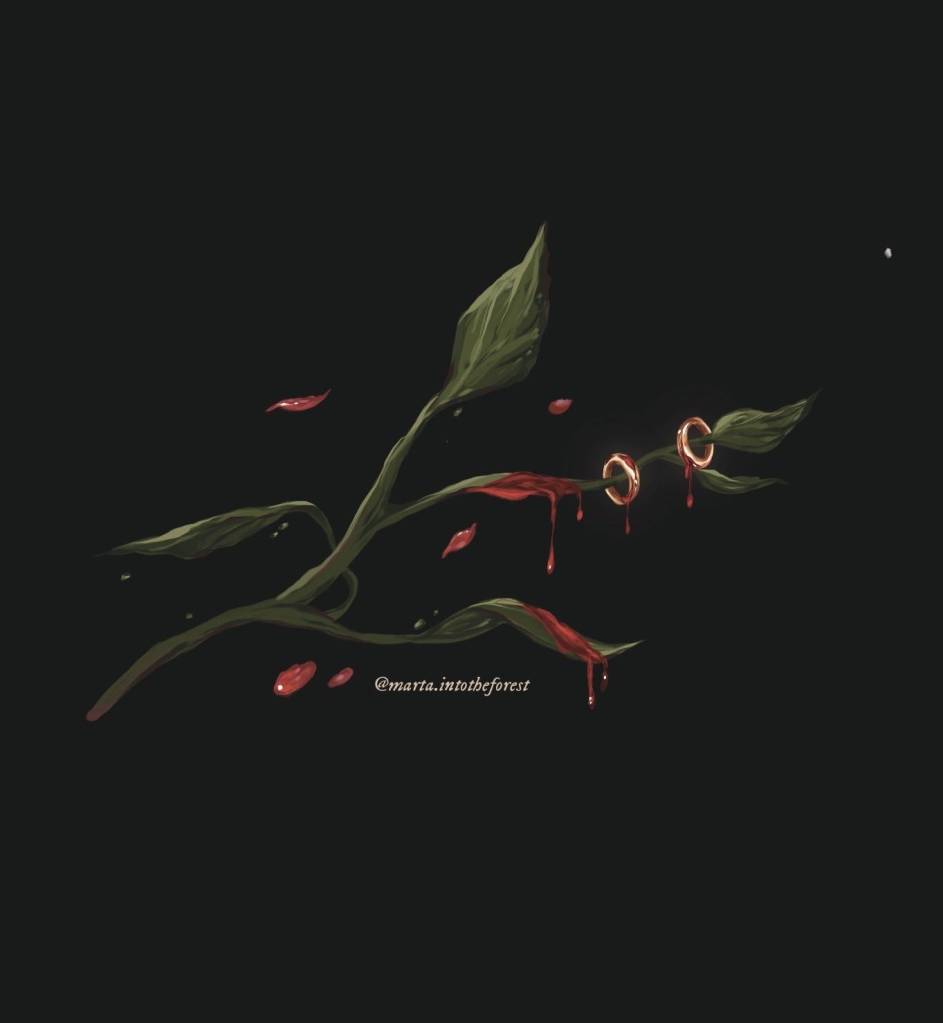
Titled “The Blood Rings,” ominously beautiful. There’s a definite narrative here, probably a commission from a writer.
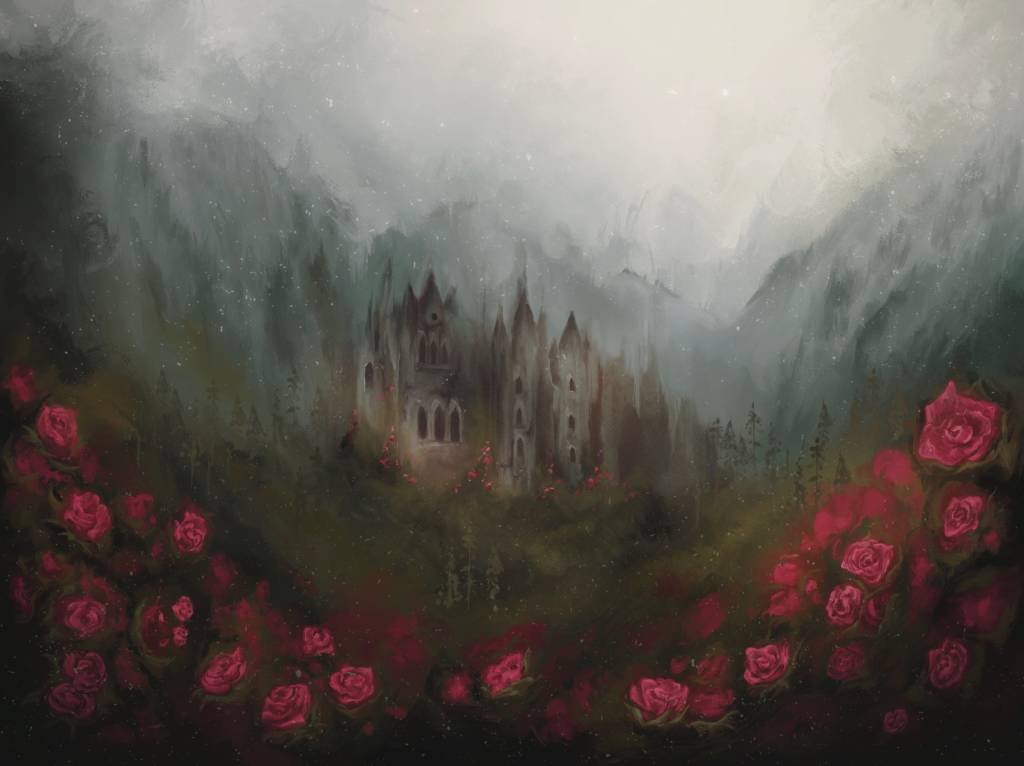
Holy hell, look at this gorgeous end paper… hauntingly impressionistic. Done for author K.M. Davidson’s book “Sundered Heavens”
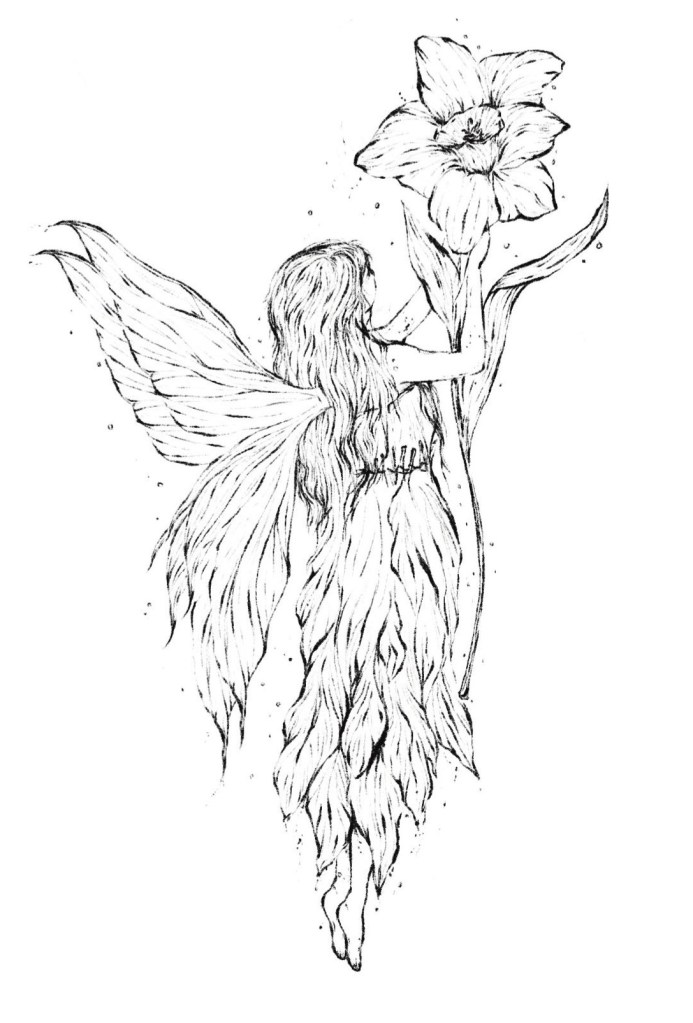
Marta was warm and quick in her response. She had openings starting in October, so on the first of the spooky month, I sent her a short description of my vision for an internal art design inspired by “Elspeth and the Fairy.” I relayed how the character was a fairy with pointy ears and long dark hair, but her ears didn’t have to show. I visualized her holding a daffodil (significant to the story) and wearing a gown of woven leaves, as she’s described in the tale. I explained she is beautiful but haughty and antagonistic. I also said I would defer to Marta as the artist–whatever she thought would look best, I was game to see.
I paid the fee–a very reasonable one–upfront and signed the contract with Marta. I agreed to limited rights, allowing Marta to retain the image for her own portfolio and marketing purposes, basically, and she got started. She sent me samples of her work-in-progress for feedback along the way (as outlined in the contract), and they were like little pop-up treats for my in-box.
If you’re not familiar with the term, an internal art design is a small sketch or symbol found inside the pages of a novel or story collection/anthology, often at the top of a chapter or above a section break within a chapter or story. It adds a little flair to the book’s format, an additional little aesthetic appeal.
Marta worked fast, finishing my commission in about two weeks. So, without further ado, here it is…
Cue drumroll…
Image by @marta.intotheforest
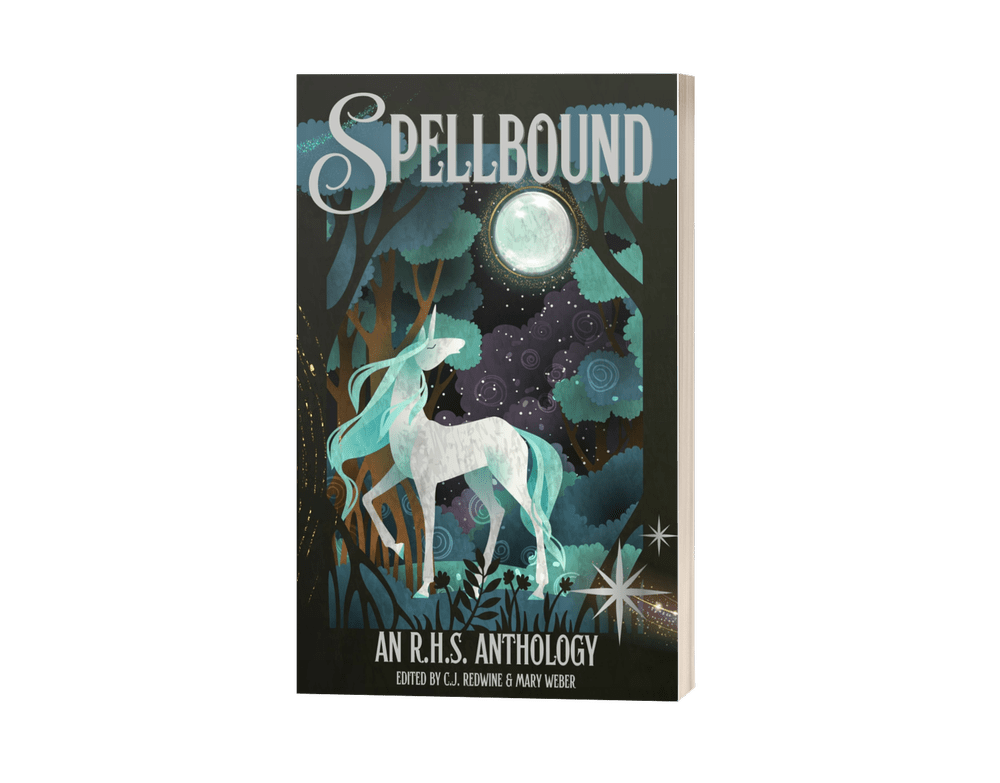
Isn’t she gorgeous?! She is Lady Rowan, a fairy guardian of early spring and antagonist to Elspeth in my fairy tale, published in Spellbound in September of this year.
I left a fair amount up to Marta, and I love how she chose not to show Rowan’s face. This is common in book and especially cover art, as I understand it, the idea being that readers get to envision the exact look or beauty of the character in their own minds. It’s arguably more universally appealing, and I can understand that notion.
Happily, this image works well not only for “Elspeth and the Fairy” but even better for the fictional piece I just completed, a novelette and sequel to “Elspeth” in which Rowan makes a brief appearance at the very end.
Again, if you’re not familiar with the term, a novelette is a fictional work longer than a typical short story but shorter than a novella. It ranges in word count from 7,500 to 17,500 words.
I wrote my 12.5 k sequel, quite simply, because I just wasn’t ready to be done with the story’s world. In fact, I started it the day after Spellbound was released.
I was intrigued by the idea of writing another version of the same ending, from a different character’s perspective. How could I flesh him out? What were things like through his eyes? How precisely did he feel? What exactly did he grapple with, and how did he change? How could I develop the love story itself, unfettered by word count and completely free for me to write exactly what I wanted to?
I call this piece (more a historical fantasy romance than a fairy tale) a sequel because it does extend the story a little way beyond the first tale’s end, but really it might just be a companion piece.
And you know what? Writing it was deeply satisfying.
In fact, it turned into my unexpected passion project for the year.
I did not write it with an eye toward publication (though now I’m considering what I could do with it on my own terms), and that proved meaningful because it reminded me why I devote most of my free time to this fiction thing in the first place.
I do it because I love challenging my imagination through the medium of language. I love the act of writing itself, regardless of the outcome.
It is, first and foremost, my ultimate act of self-care.
I’m no longer a working professional strategizing and problem-solving on a daily basis. So, writing keeps my mind sharp and my creativity nourished. It allows me a healthy escape and even a way to manage difficult emotions. It gives me a purpose beyond my domestic life and even something toward which to aspire (as long as I remain firmly rooted in its primary purpose). When I’m in that delicious flow state, it gives me a way to transcend myself, even when I’m writing utter dog crap.
It’s magic, in short. And not just magic in the metaphorical sense but in the literal, if we define magic as “the practice of moving natural energies to effect needed change… a tool to improve ourselves and the world in which we live” (Scott Cunningham, from Wicca: A Guide for the Solitary Practitioner).
My new novelette does have a working title, but I don’t want to include it here in case anyone reading this post hasn’t read “Elspeth and the Fairy;” I don’t want to give too much away.
I will share a blurb for it, however:
A curse breaks.
A second chance reigns.
A first chance aspires to love.
For ten years following a witch’s spell, the mysterious Muir has labored as a wretched half-man, half-goat in the scullery of a minor lord, his true identity unknown. Only a maiden of the household, the brave and sympathetic Lady Elspeth, has shown him protection and care. In return, he has done his best to guide her on her quest to save the man she adores, the afflicted Lord Alistair, heir presumptive, from the fairies wreaking havoc in a kingdom without a monarch.
Now, having proven victorious in her trial, Elspeth has not only saved Alistair but someone else… And Muir, restored to his former glory, is now free to pursue all that’s his, including his beloved Beth.
But first, he must find her while wrestling deep, new shadows in the dark heart of the forest. Can he reach his maiden in time, even as he confronts his greatest failures? And if he finds her, will she even want him?
Can he prove himself worthy of her?
This blurb is definitely a draft and little cringey, but hey, it’s early. Thanks for letting me share it with you! If I can work up the courage, I might share the very first scene of Chapter One in a new post tomorrow.
I hope you’ve enjoyed this one full of beautiful images. And I hope your November is going well. Thank goodness the government has reopened…
To wrap up, here are the latest additions to my list of things I’m thankful for, each one inspired by the goings on of that particular day. This list covers Nov 8 through today, Nov 13:
8. A sweet daughter who still loves spending her Saturday with Mom and Dad
9. Morning cuddles in bed with coffee while the first snow falls outside our witch’s window
10. Doing housework leisurely while T Swift sings through my earbuds (I’m currently obsessed with the acoustic version of her new song “The Fate of Ophelia”)
11. Wonderful mother-in-laws who spoil our kiddo with things like hot air balloon windsocks just because Daphne took a fancy to these particular aerial vehicles. Happy birthday, Julie! Cary, we love you too!
12. A long To-Be-Read (TBR) list and being able to swap book recs with my own amazing mama. I just got her to read Mexican Gothic.
13. A husband who knows how to buy me THE. PERFECT. XMAS. GIFT: A Nov 26th performance of The Nutcracker by the Newport Contemporary Ballet, done in one of the Gilded Age Newport RI Mansions, Rosecliff (where parts of the Robert Redford Great Gatsby were shot). Apparently, the audience will walk room-to-room for the first act and then enjoy the second act in the grand ballroom. I *cannot wait* for the Sugar Plum’s grand pas de deux under those chandeliers!!!
Thank you for reading. Do you have any news? Anything you’re particularly grateful for? Or any insight into commissioning artwork, if you’re an author?
Feel free to pop anything in the comments.
See you tomorrow, maybe. Next week, for sure.
XOXO,
Jenn
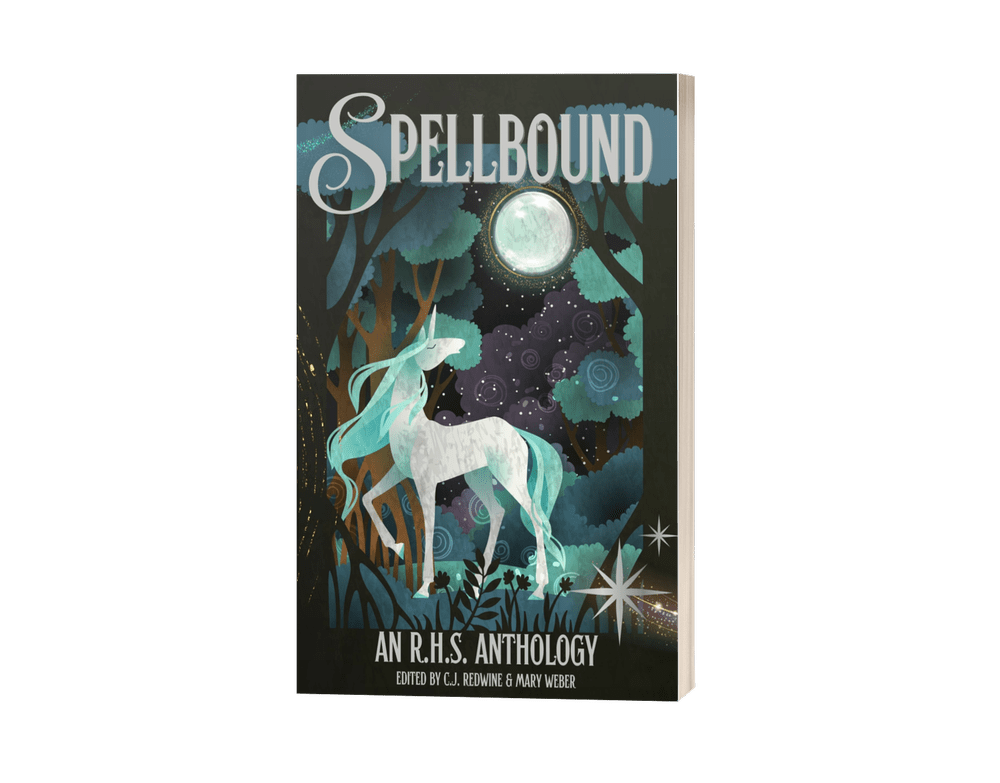
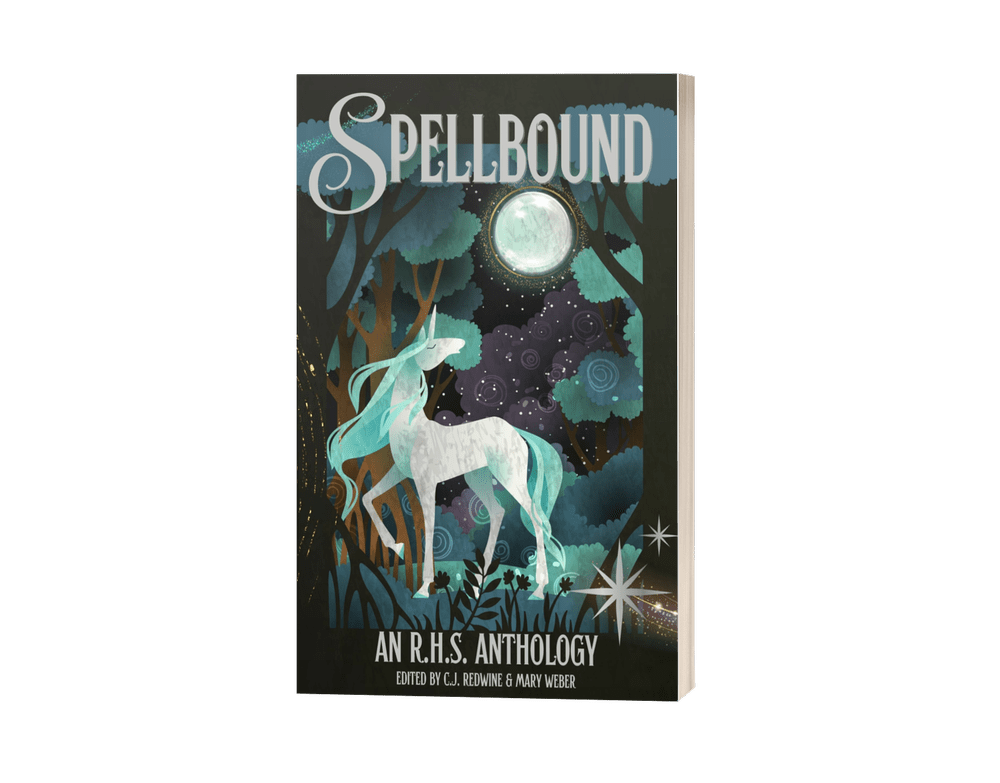
Download a free e-version of Spellbound to read “Elspeth and the Fairy,” which has the privilege of opening this collection of fantasy/magic stories.
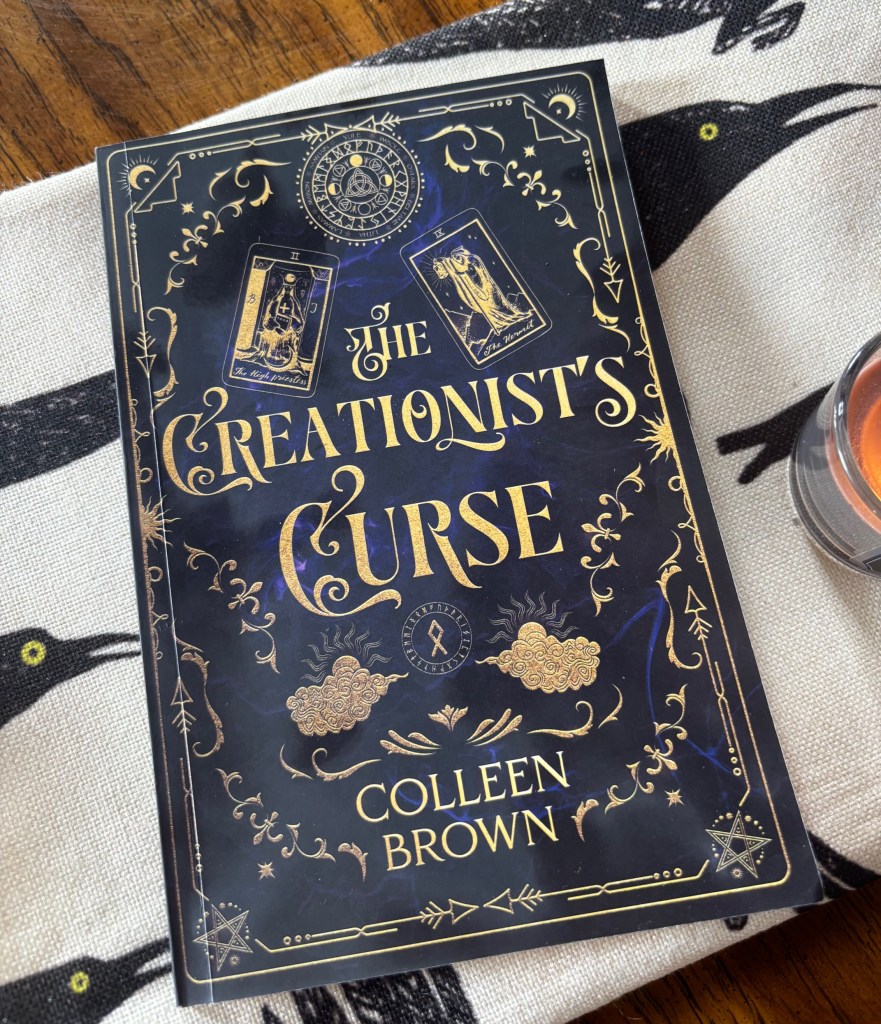
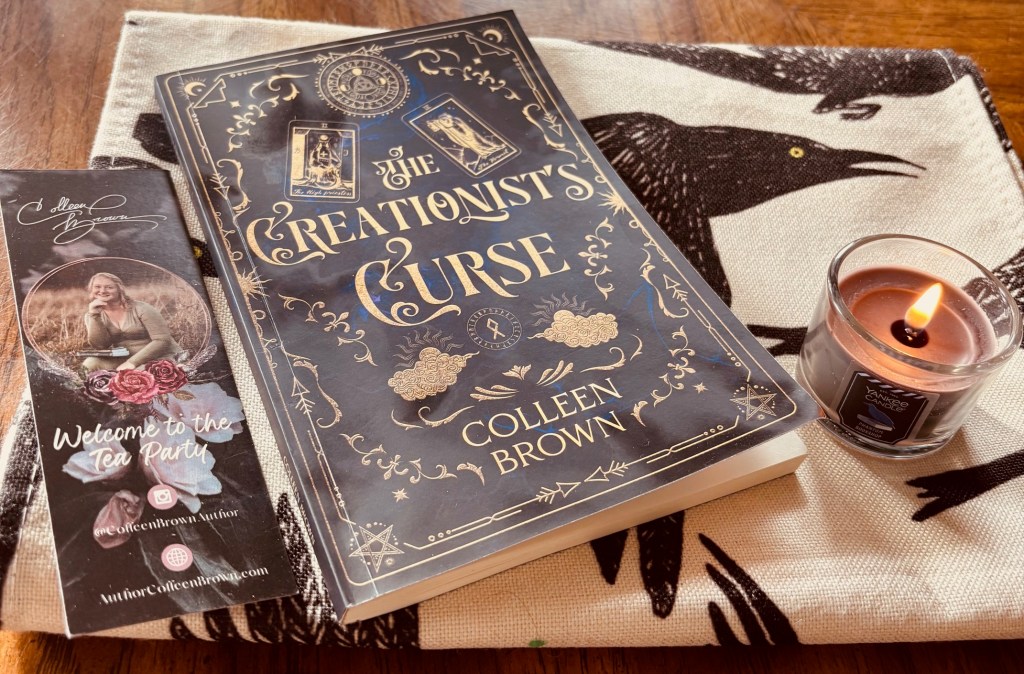
A while back, my talented writing friend Colleen Brown gifted me a print copy of her expanded short story The Creationist’s Curse, published in May of this year and available in e- and print copies and on Kindle Unlimited.
Isn’t that gorgeous?
From the back cover:
When Evelyn Awbrey, Curator of Arcane Books and the Occult, discovers a long-lost tarot deck linked to the infamous Creationist, Elvira, ancient magic stirs–and something begins to awaken. With the autumn equinox fading, dark forces hunt the relic, eager to tear apart the city of Margoza.
Evelyn will do anything to keep it hidden. To protect her daughter. To bury the truth.
But secrets refuse to stay buried. And the deeper she digs, the clearer it becomes: the curse isn’t just in the cards–it’s in her blood.
The Creationist’s Curse is a darkly enchanting tale of forbidden magic, deadly secrets, and how far a mother will go to protect what she loves… even if it destroys her.
She can hide the relic, but she can’t outrun the Creationist’s Curse.
A fabulous fall read
I loved this story the first time I read the original in the RHS anthology Meet Me at Midnight.In fact, it was my introduction to Brown’s work, the first time I realized she has the kind of prose you just want to sink into–fresh, lush, and especially sensory. It’s dark and gorgeously immersive without overwhelming you. No matter which story it is, you’re there, entirely in the scene she’s created, and the effect is as gratifyingly otherworldly as the subject of magic itself, which weaves its spells through all of Brown’s tales.
Now, in this latest version of Creationist, I appreciate how Brown has further developed certain characters in this deeply atmospheric, dark academia fantasy.
In it, readers understand more about the antagonist Nathaniel Brown/Huxley, the protagonist’s second husband and stepfather to her daughter. He is also an ancient, dark figure in disguise, as Evelyn has realized, secretly out to seize for himself the most powerful aspect of the Creationist Elvira’s tarot deck, which Evelyn works desperately to hide before it’s too late.
As Evelyn scrambles to secure the most powerful part of the deck before Nathaniel/Huxley can wrest it from her, she worries about the effect he’s had on her daughter all these years, before any of them realized his malevolence. What has he suggested to her child? What kind of influence has he wielded, when no other adult has been around? What things might he do in the years to come? Can she always be there to protect Mina?
This struck a raw chord for me; it’s a real-world anxiety many parents experience when they realize someone close to their child isn’t who they thought they were. I found this newly developed part, as such, especially effective–one of those moments in this genre that truly transcends all the fantasy, reminding us we are indeed reading a story about real human experience, the human condition.
Brown also develops Alaric’s character, an older gentleman and platonic friend to the protagonist who’s been gone for a while but is now mysteriously back, called forth, it’s suggested, for some larger purpose. It is in Alaric’s dialogue with another of Evelyn’s friends, the strong and admirable Martha, a colleague of Evelyn’s, that readers sense Alaric’s positioning as a mentor-to-be to young Mina, Evelyn’s daughter, and Brown lights a candle of hope for the larger story to come.
Finally, in this expanded version readers get to meet Evelyn’s child, little Mina, though only briefly. This precocious eight-year-old wakes at the story’s end, just before 1 am, to a strange sense of foreboding. In the surprise arrival of a crow and the abbreviated whispers between her stepfather and a man she’s never met (Alaric), Mina senses an ominous shift in her circumstances though she can barely understand any of it, and that tugged right on my heartstrings.
In short, the entirety of this expanded, newly-published version of The Creationist’s Curse is a delightful teaser, planting deeper suggestions about who these characters are plus the seeds of what’s to come for the larger narrative. This slim, gorgeous book serves, essentially, as an appetizer for a duology of dark fantasy novels with Mina at their center, and I cannot wait for Brown to publish them.
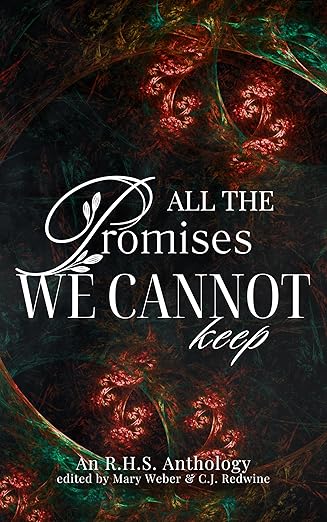
If you’re a fan of dark fantasy, dark academia, and/or lush, immersive prose, I recommend The Creationist’s Curse as well as any of Colleen Brown’s other short fiction, especially “The Crimson Trials” in Scales, Tales, and Tiaras; “What Goes Unkept” in All The Promises We Cannot Keep; and “A Potion for Forever” in Spellbound; all of which I adored. They’re all great autumnal stories to boot.
Free to download
Free to download
Thank you, Colleen, for your generosity and the gift of your work to the world.
Truly, I will not be surprised to find, one day, a novel of yours on the Bestseller shelf at Barnes and Noble, and I’ll be able to brag that I knew you when…
***
Before wrapping up, I also want to share my first seven days of November gratitude, in the spirit of this season of thankfulness. Each of these was inspired by the goings-on of that particular day, Nov 1 through today, Nov 7.
Healthy parents who can still travel to visit us
An adoring husband other women flirt with
Extra money to commission art that fuels my creativity (more about that next week!)
Time to devote to a specific passion project (more about that to come)
Writer friends who both inspire and support me, with everything from feedback/moral support to simply reading and commenting on my posts. If any of you see this–thank you Gloria, Colleen, Robyn, Kathlene, and Melinda!
Fellow Substackers to discuss the books I love with
Mythic Moose, which is more than a side hustle–it’s a sweet family endeavor
Scanning this list reminds me, yet again, how wonderfully privileged I am, especially when it comes to the people in my life, near and far.
Photo by Ksenia Philippova on Unsplash
Happy November! As always, thank you for reading, and please share anything you’d like in the comments–a bit of thankfulness or anything else.
The ghosts, I’m not so sure about. And honestly, I don’t really want them gone.
In 2021, right after we moved into our little 1800 Vermont farmhouse, we began experiencing things that were difficult to explain.
Our farmhouse
In those earliest weeks, Jer and I woke up multiple times to the smell of scrambling eggs and frying bacon. Seriously, it was like someone silently making a full-on breakfast downstairs.
“What the hell?” We’d look at each other, and after staggering down to start the coffee–can’t deal with spirits until you’ve had some caffeine–we’d see nothing beyond the dim kitchen and cold stove. The aroma, too, had subsided, or we’d quickly gone nose-blind.
Could that smell have been steam inside the floorboard radiators?
Except it was June. The heaters weren’t on, and, generally, steam doesn’t smell like bacon.
We let it go. There was a lot to do to settle in, and as long as this little old house was functioning in one piece, we weren’t too concerned.
These aromatic encounters didn’t last through our first year. Maybe the ghosts accepted the reality of new inhabitants. Who knows?
More recently, though, we’ve experienced other things, like being touched.
It happened to Jer first. He’d gone into the basement one day to get the dehumidifier to empty outside. When he came back up with it, he said something like, “That was weird.”
“What?”
“Something touched my head on the way down. I felt it very clearly.”
Then, earlier this year, I was washing dishes at the sink when I felt a cupped hand caress the side of my skull. It happened just once, but it was distinct.
I shrieked and nearly left my skin. Swiping frantically at my head, my first thought was a spider had somehow landed there. We have wolf spiders in our basement, and they occasionally make surprise appearances on the first floor. In my initial panic, I thought one had somehow landed on me Arachnophobia-style.
I made my husband run both his hands all through my hair and down the back of my shirt. I even lifted up my shirt and bra for him.
“Nothing’s there, I promise.” Then he grinned. “But that’s nice.”
Only when calm could I acknowledge what I’d felt was more like an intentional, tender hand than the legs of an errant arachnid. I’d say a human hand except no one was in the kitchen with me.
The second time it happened, a few months later, I was much calmer. In fact, it was kind of nice.
“Hi, Lucille,” I replied, naming the odd, deceased aunt of the man from whom we bought this long-standing family property. She lived here alone in the 1990s and apparently still plowed the fields using a horse, according to Shane, the seller.
Another time, Jer was at the toaster and I was snacking at our breakfast bar, and he turned to me.
“Was that you?”
“What?”
“Something just touched my shoulder.”
“Oh… not me. Must have been the ghost.”
That’s become a not-infrequent saying around here.
We’ve never seen anything strange, but when my mother stayed with us a couple years ago, she was sleeping in Daphne’s twin bed, where she could see straight into our master bedroom. Daph was between me and Jer in our room and slept soundly through that night.
In the morning, Mom asked how long Daphne was awake.
“She wasn’t. Did you see something?”
“I thought I saw her up and walking around the foot of your bed.”
“She was between us the entire night, as far as I remember.”
“Oh.” Mom looked rather disturbed. “I thought I saw someone walking around.”
Image from Microsoft Design
Hmm.
What’s been most frequent–and sometimes unnerving, I’ll admit–are the sounds.
A voice, once. Jer came out one morning after I’d dropped Daph at school, casually sipping his coffee. I’d just finished the chicken chores.
“How long have you been out here?”
“About fifteen minutes. Why? What happened?”
“Oh,” he shrugged. “Someone was just humming and singing upstairs.”
We hear bangs sometimes, too. Random whacks that might be the boiler or something related to it but don’t come from the basement. They sound much closer.
Uncle JT, who’s only four years older than my husband and visits us often, has said to Jer, “Your house is haunted as hell.”
He hears nocturnal thumping right outside his little guest room door, the door of our utility room where we’ve managed to fit a twin bed. The sound comes from the dining room, he says.
It freaks him out, he admits, but “I just keep the door shut and try not to think about it.”
For us, the sounds are usually footsteps. The sound of the old wooden floor creaking under shifting weight.
We hear these footsteps everywhere, including Daph’s room and our bedroom, and especially at night, when we’re already in bed.
At this point, we’re used to them. Often, when I’m just under the surface of sleep, I’ll register them, give myself a moment to decide if they’re actually outside myself or inside my head, and then I’ll turn over, letting them go, and the night is peaceful.
The energy in this old house isn’t malevolent. It’s only ever felt warm and benevolent. Super cozy.
Mostly.
So, if there are spirits here, I believe they approve of us. We’ve tried hard, after all, to be loving and respectful caretakers of this wonderful old property.
Maybe the ghosts even care about us. One time Daphne was on the edge of a meltdown, and she was cuddled up with my husband on the couch. Jer felt something like a warmth and phantom weight suddenly beside them, enveloping them. It was comforting, he said, like a phantom hug.
Isn’t that nice?
Only once have strange sounds truly frightened me. This was also my most vivid encounter with this weird energy to date.
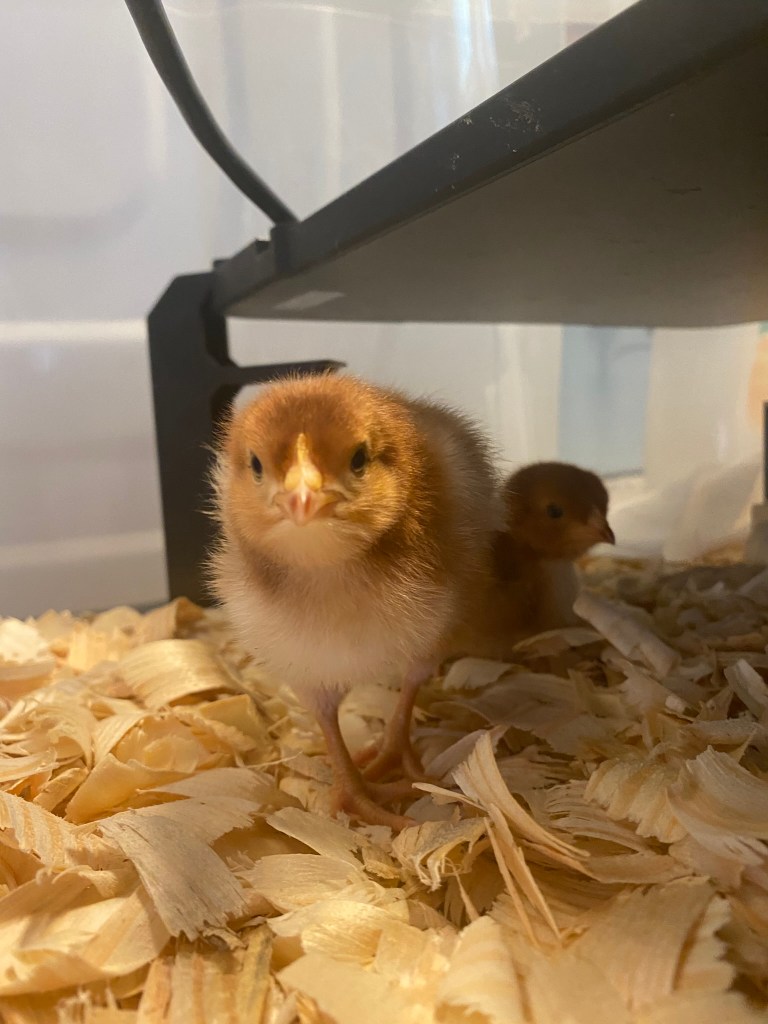
It was late, around 3 am one Sunday morning last September, when we were still brooding a batch of baby chicks indoors.
I was wide awake, my rational brain hard at work. I was writing on my laptop downstairs in the well-lit living room, laboring to get a short story edited for a looming deadline. I was totally immersed in the piece, but then I heard that familiar sound. The footsteps.
I paused, wondering if either Jer or Daphne was awake, maybe using the upstairs bathroom or up playing. If Daph gets up in the middle of the night–rare, thank goodness–she requires supervision.
I listened, hearing the steps again. They were erratic, pausing and starting, wandering it seemed, like someone was shuffling around in the same general place. But the sounds were softer than my daughter’s steps; she drives all her weight into her feet, as sensory input I think, and she likes to stomp.
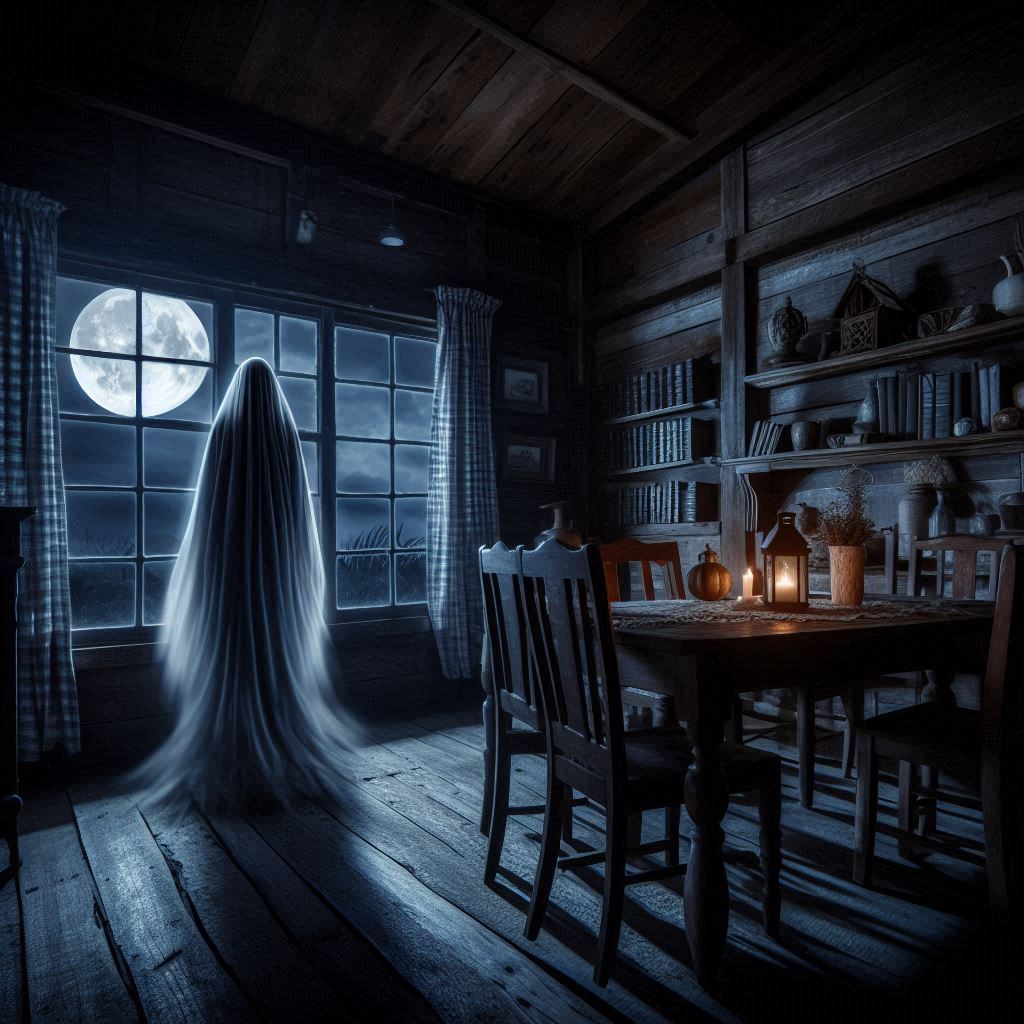
I realized–the noise was coming from the black dining room.
The outdoor floodlights weren’t on. I had not heard either bell hung on either outer door chime. I had not heard glass shattering.
Not an intruder. (That would be an entirely different scary story.)
I waited, fingers hovering over the laptop keys. Wondering how long these phantom sounds would last… what might happen next…
I was wide awake for it.
Then…
I heard our four chicks go nuts inside their plastic bin in the utility room, just off the dining room. All the sudden, they were squawking and flapping like little crazed banshees.
Mom, you would not believe what happened last night!
It was exactly the sound they made each time one of us lifted the screen off their brooder to change their water or shavings.
Dear. God. In. Heaven.
The blood drained from my body. My underarms were soaked, despite my goosebumps.
My lungs became lead, and I truly struggled for a minute to breathe.
All those classic symptoms, and I absolutely felt them.
It’s rare for me to remember specific past thoughts, but I remember these:
It’s probably nothing. Or it’s something you can explain.
If it isn’t, then it’s just energy. IT CAN’T HURT YOU…
Image from Microsoft Design
My prefrontal cortex literally had to fight my lizard amygdala in order to calm myself.
After that, everything went silent. Susie, Jeanie, Mimi, and Daisy all settled.
Once I could breathe, and move, I saved my document one more time, closed my laptop, left it perched on the broad arm of the couch, and slipped upstairs, leaving the lights on, electric bill be damned. I slid by that two-hundred-year-old dining room as fast as I could, eyes averted. I made it upstairs untouched, thank you great, good Lord above, and slid into bed against my husband.
In retrospect, I was terrified not so much because I felt physically threatened, but because I was suddenly, and so acutely, experiencing something I simply could not explain. And it had gone on and on, it seemed, for several minutes.
That’s it, isn’t it, really?
That fear of the unknown. What we can’t rationalize, what we cannot in the moment understand.
That’s at the heart of it all, I think.
All the terror.
But, that was one moment, and it was mostly me, I believe. Caught off guard.
“Maybe Lucille just wanted to see the chicks for herself,” Jer said later. “To make sure we’re taking good care of them.”
Maybe?
I am a rational person. I believe in physics, science, and empiricism. I believe that the simplest, most logical explanation is often the right one.
But I also know there is so, so much none of us can understand about the universe.
Sometimes, Jer and I talk about how time, a human construct anyway, isn’t as simple and linear perhaps as we Westerners believe. Maybe it’s much more complicated and cyclical, like a chain, and these ghostly encounters are really just the past and present brushing up against each other, or momentarily overlapping, The Others-style. I like that thought (and the idea that I’m Nicole Kidman).
I don’t mind sharing space with benign spiritual energy, the warm-hearted residents of the past. They were here first, after all, and maybe they’re still here living their own lives, and I respect that.
“Can you imagine them hearing Daphne scream and stomp in their time, in 19- or 1825?” Jer has said. “How terrifying would that be?”
“‘That’s one pissed off ghost,’” I said.
We laughed.
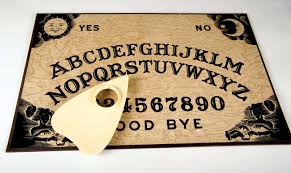
But, I’ll be honest. I will never bring a Ouija board into this house. And I don’t go downstairs after midnight unless I have to.
Thanks for reading! If you feel inclined to share any strange or supernatural experiences of your own, please drop them in the comments! I eat this stuff up.
Happy Halloween, everyone! I hope it’s spooky and fun.
Image from Microsoft Design
We all need some fun after everything that’s gone on this year (that’s the real horror, but I’m not getting into it here.)
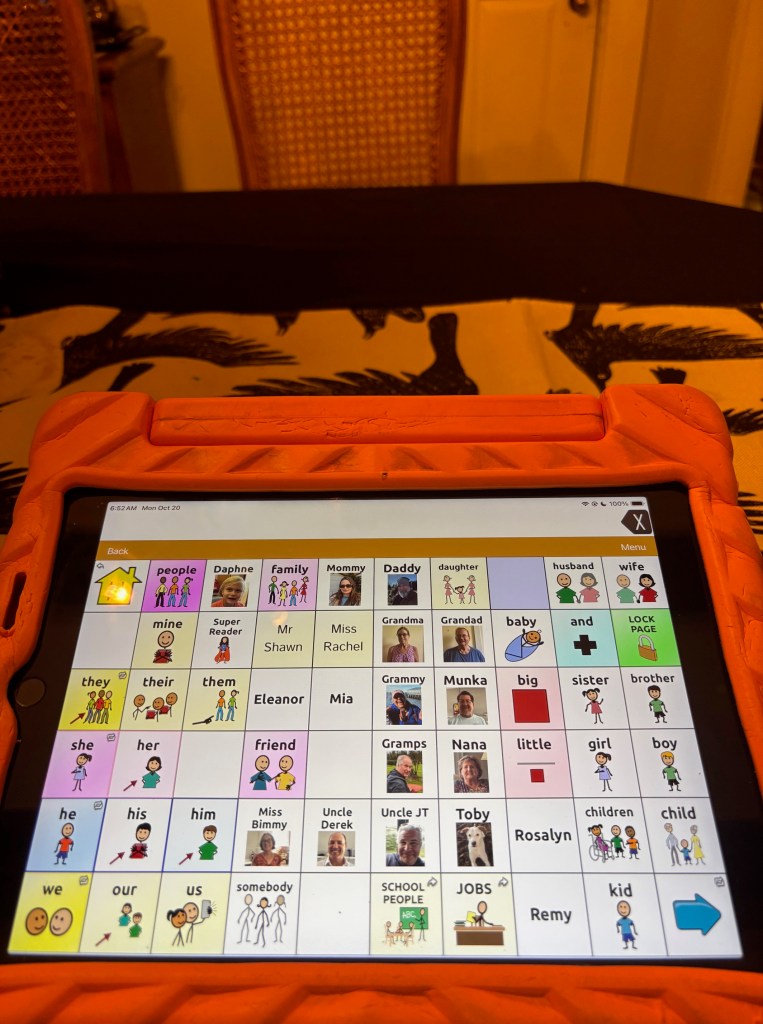
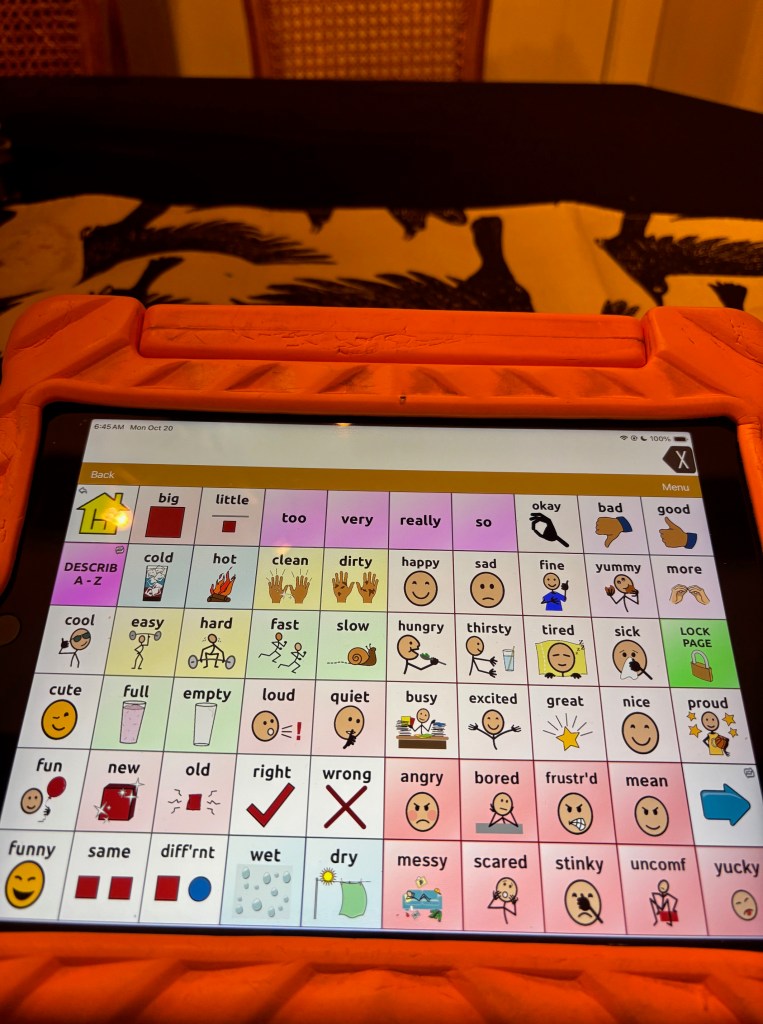
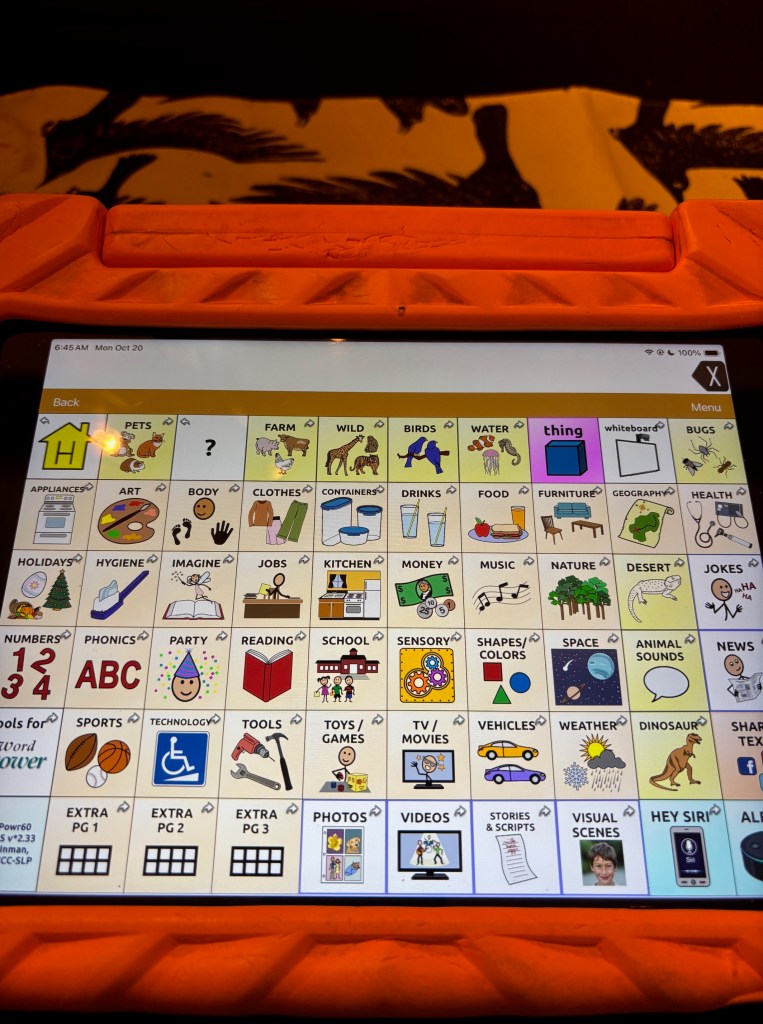
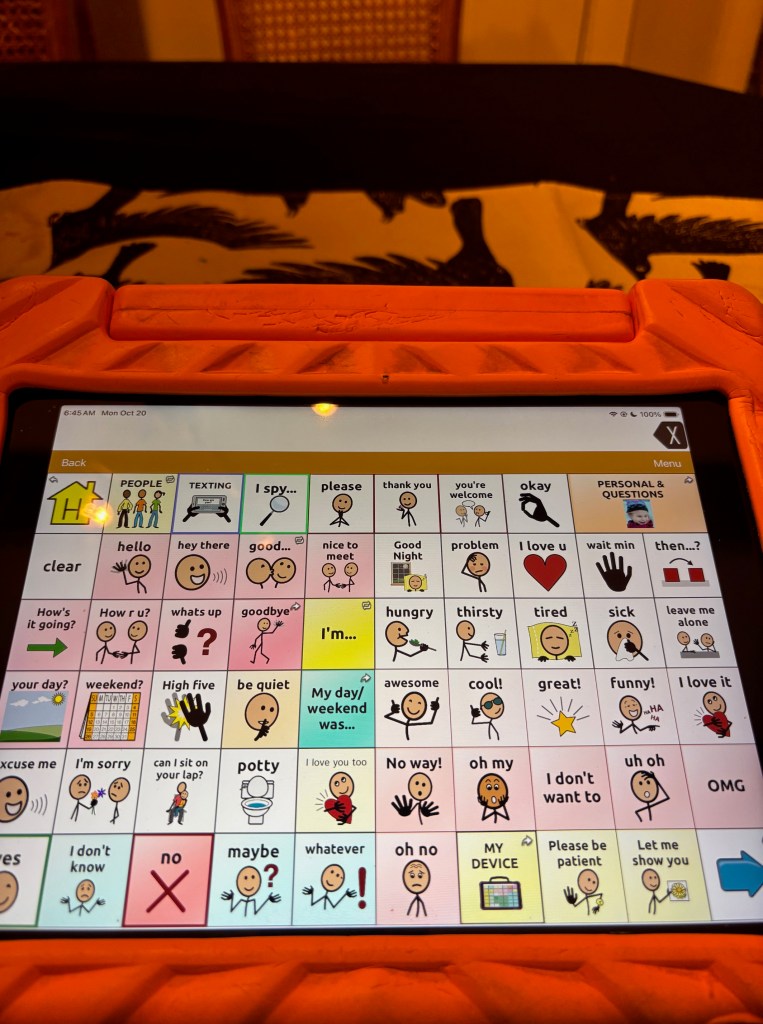
AAC is any manner or system which allows a non or limited-speaking person to communicate in ways other than their own vocalized words. It is a subject dear to me given that our daughter, Daphne, is a non-speaking autistic whose life has been so enriched by her alternative communication technology.
This is the third autumn, for example, that she’s been able to tell us via her AAC software, TouchChat (on her speech-dedicated i-Pad or “talker,” as we call it), what she wants to be for Halloween. In 2023 it was an elephant.
Last year, she said “squid” on her talker.
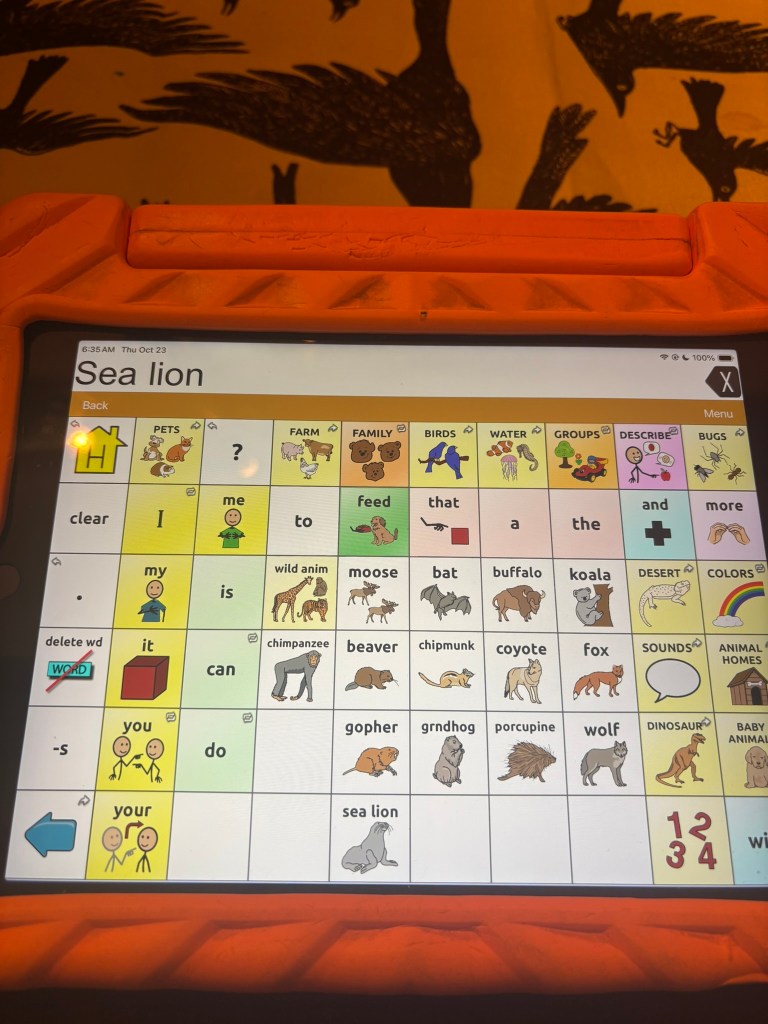
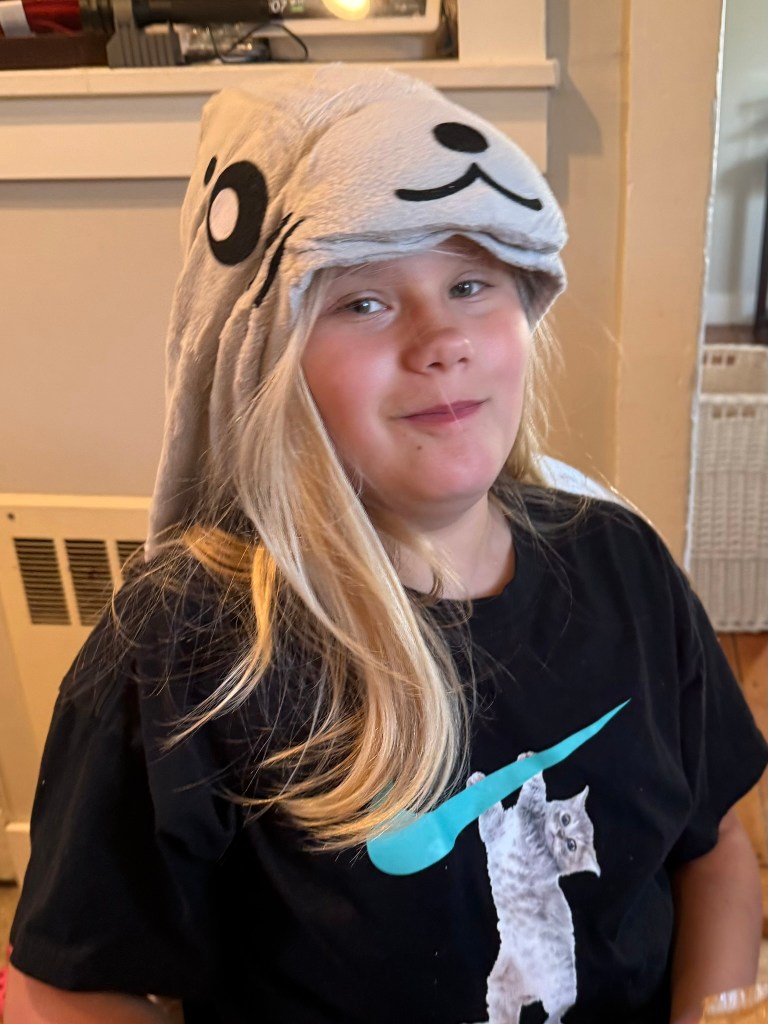
This year, inspired by our trip to the Mystic Aquarium, she told us “sea lion.”
Isn’t that simply wonderful?
Proud of her costume
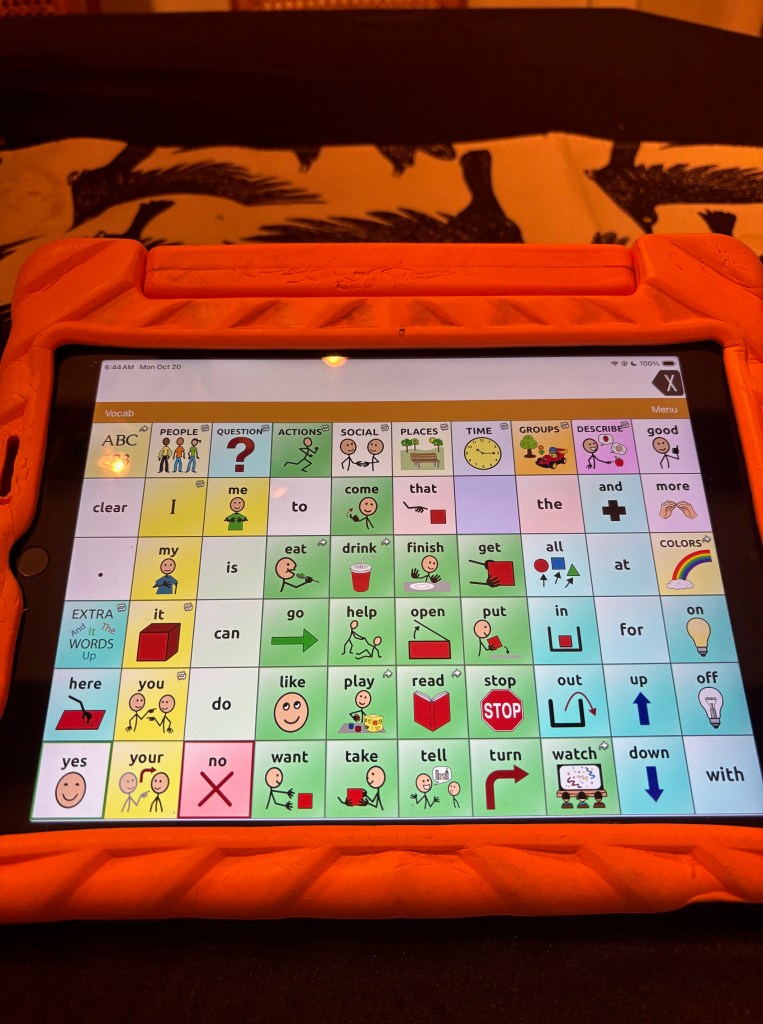
I was also asked this month to volunteer with the Vermont Family Network. I can’t discuss specifics due to confidentiality, but basically this work entailed sharing how our family has supported Daphne’s communication development. Here are some photos and a short video I submitted; they’re good little glimpses into what her software is like.
Main page with core (most frequently used) vocabularyPeople page, customizablePlaces pageActions pageDescriptions pageCategories page, where most fringe vocabulary (less frequent words) can be found
Daph’s inability to speak was one of the most devastating challenges we faced early in her diagnosis, but I don’t feel that way anymore. Truly, TouchChat is a major component of her voice, and she loves her talker. She can now express her basic needs, like what she wants to eat, drink, and do, while also using it to say “yes,” “no,” “please,” “thank you,” “help,” and “I love you” among other phrases. TouchChat is allowing her to become quite the self-advocate.
Social page
Quick video demo
Daphne also loves exploring her software and continues to learn new “fringe” vocabulary every day, especially in the context of songs, books, and games. The more playful for her, the better, as with any child. She can now answer academic questions and even sing and read with us using TouchChat.
I am eternally grateful for this technology and for all the speech therapists, educators, other experts, and families/advocates who do so much to empower AAC users and teach the world about its possibilities, normalizing its use for everyone.
Next week, when her grandparents, dad, and I take Daphne to the local Trunk or Treat at the Kingdom Campgrounds, she will be able to say “Trick or Treat” and “Thank you” while collecting her candy. She will, in the best ways, be just like everyone else.
Trying on her sea lion costume
In other seasonal news…
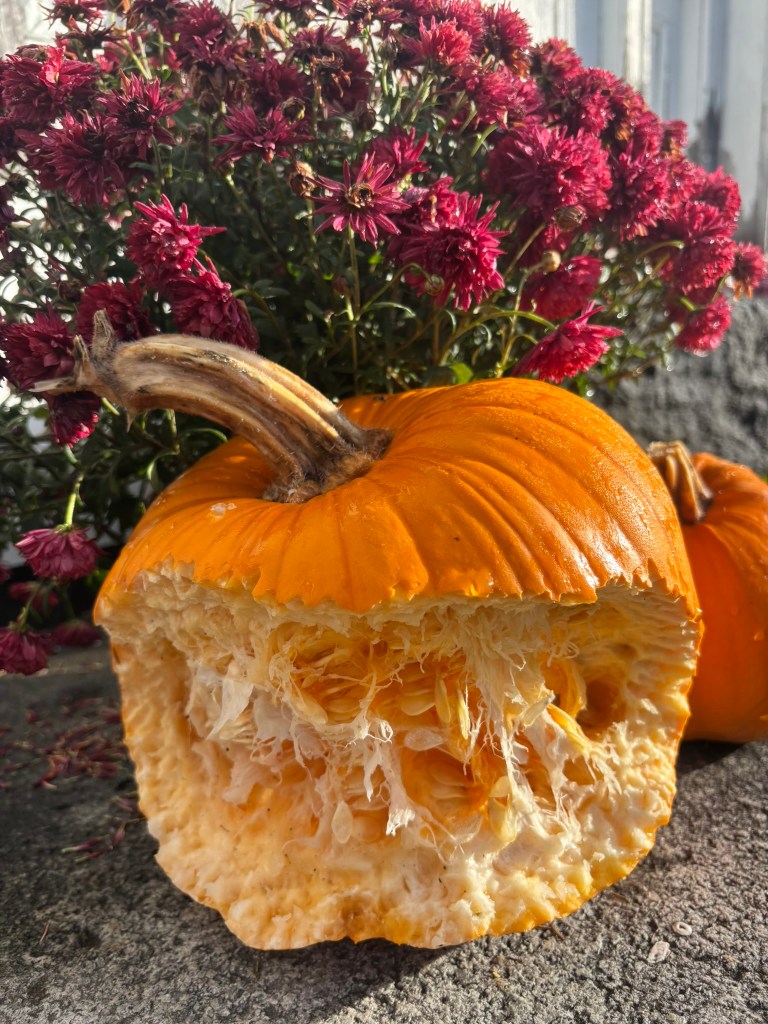
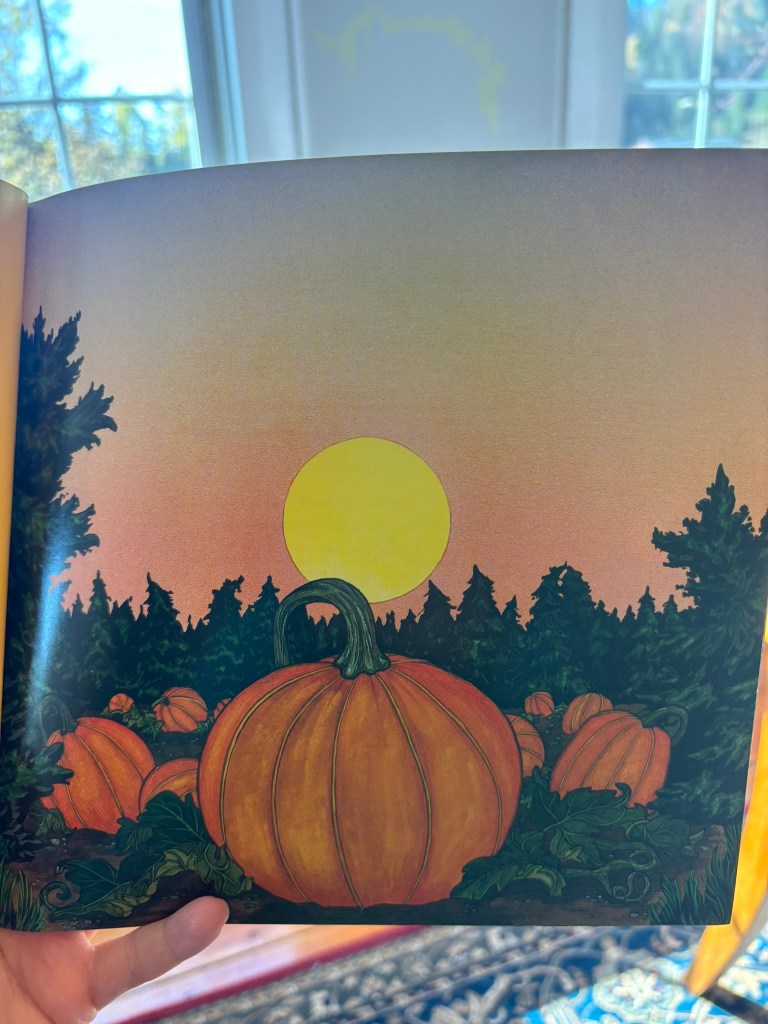
I harvested nine beautiful orange pumpkins from our garden. Most of them I left outside on display, but you can see they’ve become oversized hen treats.
Wow… hungry hens
No matter–it’s a great use for the gourds. Apparently, pumpkin is nutritious for chickens, the flesh “chock full of vitamin E, thiamine, niacin, vitamin B6 and iron” while the seeds are “an excellent source of dietary fiber, zinc, protein and healthy fats.” So yay, I’ll let the girls peck them all day, as long as they’re still eating their regular feed.
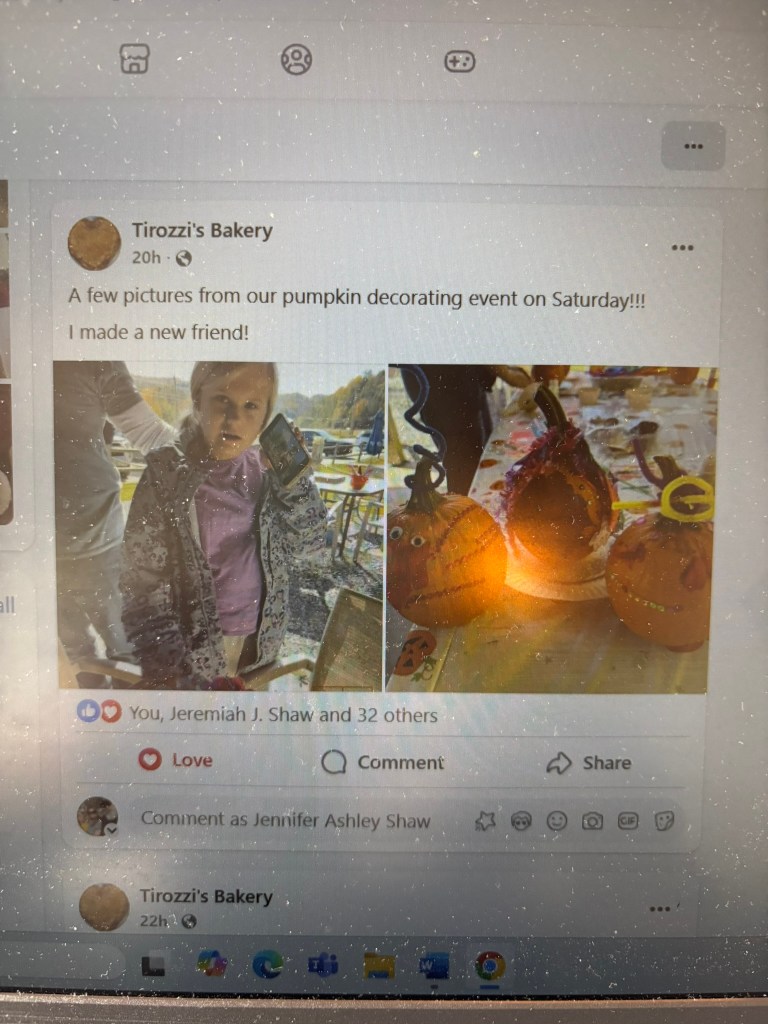
Speaking of pumpkins, we took Daph to a pumpkin decorating event at our favorite pizza place, Papa Tirozzi’s Bakery. She did a fabulous job tying a mermaid tail to her chosen gourd and pressing stickers and rhinestones on its surface, a great fine motor activity.
Concentrating on her craft
Daphne also happened to steal the organizer’s heart, and her picture made it onto Tirozzi’s Facebook page.
Social media darling
This weekend, we’re heading south for a family jaunt to the 2025 Carnage gaming convention in Killington. We’re visiting as guests this year, but we plan to scope it all out and, maybe, attend as Mythic Moose vendors next year. That could be a fabulous way to grow our online trading card game business.
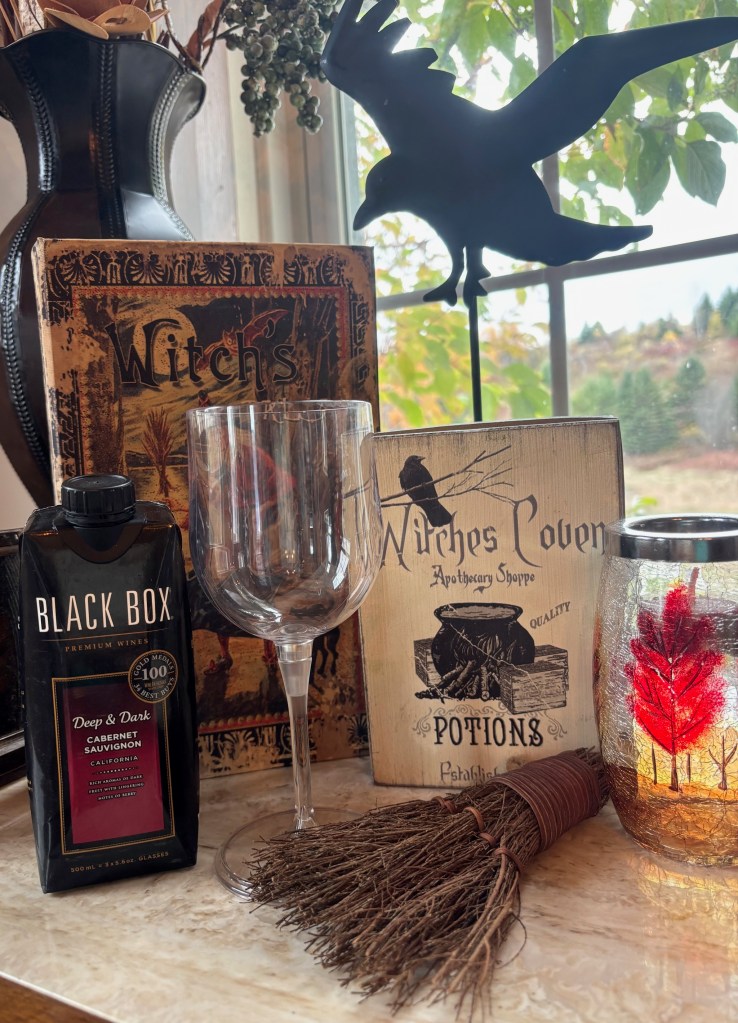
I’ve got my mini boxed wine and camping glass ready to go for the hotel room.
Goodies to go
I’d love to know your special seasonal plans! Or, if you have any questions about AAC, don’t hesitate to pop them in the comments.
I’ll let you ponder that while I provide a little backstory.
When my family moved from Houston to northern Vermont in 2021, we didn’t just relocate. My husband and I dug our hands deep into the soil of our lives and ripped up everything we could.
And while it was painful to leave our parents and siblings behind, it was also the most cathartic experience of my life.
Among the many things we re-envisioned was the type of house we wanted to live in. In suburban Houston, we’d had one of those master-planned community tract homes. Ours was an Ashton Woods, and that didn’t mean anything special. All the houses in our neighborhood–the David Weeklies, Newmarks, Pultes, etc.–looked basically the same. The bricks and rooflines were nearly identical, the floor plans all open-concept. Windows varied only in size. Uniqueness meant that perhaps a particular floorplan included a skylight, or the buyer could select something “different” from a pre-set list of minor structural upgrades. Interior detailing was minimal and based on no clear tradition or design concept except, perhaps, utilitarianism. Fixtures, countertops, backsplashes, etc. were chosen from catalogs, so they also conveyed the same generic aesthetic.
When we brought our relatives to see our lot during construction, my sister-in-law looked around and remarked, “It’s kind of Stepford-y, isn’t it?”
She wasn’t wrong.
So, when we made the radical decision to start over in New England, we resolved to find a more special home with a character truer to our tastes, even if it meant we chose something old, impractical,… and perhaps a little witchy.
That is exactly what we got. We purchased a small 200-year-old Cape Cod style farmhouse in the Northeast Kingdom, and, a vast majority of the time, I love it.
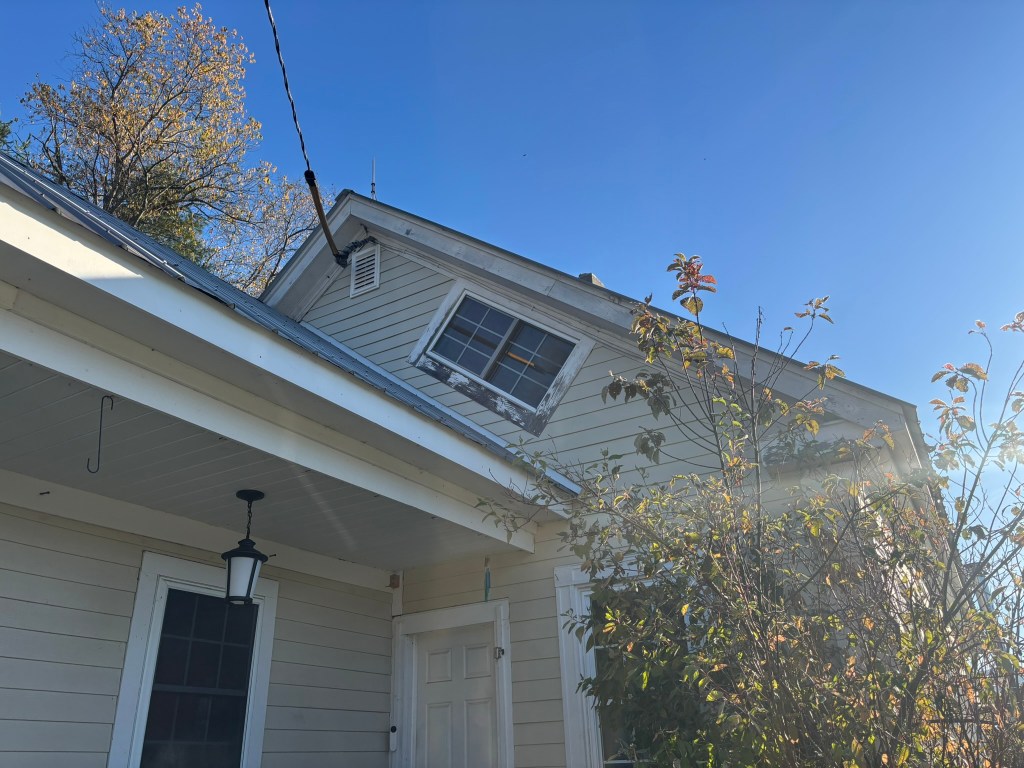
Our farmhouse photographed this morning, Oct 10th
One of the features I adore most is our witch window.
Closer view of our witch window
This is a second story window common in many old farmhouses of the region. The window sits at a 45 degree angle under a gable, usually just above a newer section of the house. It will strike you as odd, even quirky, but when you look at the available wall space, especially from the outside, it makes sense–the angle allows for a window where there would be no room for one otherwise, thanks to the added wing taking up a majority of space (Keri Murray Architecture).
In fact, the purpose of these windows, found commonly in central and northern Vermont, is entirely practical. They provide fresh air and daylight to an upstairs room, sometimes where an original window had to be taken out when a new wing was later added to the home. Often, the old window got reused, angled to fit under the roofline, saving money. It was a frugal maneuver, and 18th-19th century Vermont farmers had to be thrifty. I would argue that many Vermonters still are. It seems to be part of the NEK character.
But why that name?
Here’s the fun part. The legend goes, witches cannot fly their broomsticks through a crooked window, as state historian Devin Colman explains. Thus, the tilt of these window keeps these malevolent hags out, protecting inhabitants from ill fortune and harassment.
Particularly in their beds. At night, while they’re asleep.
When you think about the Freudian implications, especially in the context of a New England Puritan legacy, there’s a lot to consider unpacking.
Now, the first Vermonters were not Puritans, but many came from Massachusetts and New Hampshire, so many hailed from areas with Puritan roots. That probably carried with it superstitions and old beliefs in the Devil stalking the wilderness, ready to corrupt the noble efforts of good people, descendants of a culture centered originally on its belief in being God’s chosen, those who had forged the “City on a Hill.”
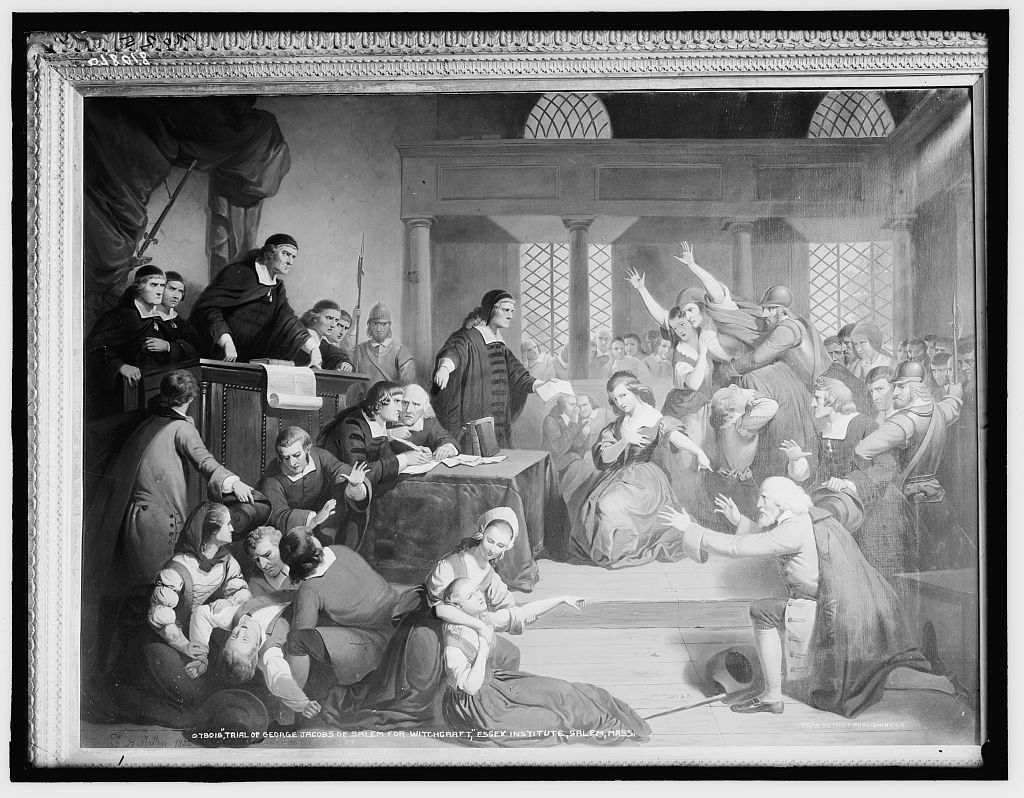
I can’t help but think about a possible connection to spectral harassment, too. During the Salem Witch Trials, many of the accused were convicted with the help of spectral evidence, which simply meant an “afflicted” accuser claimed this woman or that man had sent their spirit out to harm them, choking, biting, or pinching them in visions and dreams. Such an accusation came down, simply, to one person’s word against another’s.
“Saturday, she come into my bed in the middle of the night and bite at my breast!” cries Abigail Williams against Elizabeth Procter in Arthur Miller’s The Crucible.
Did such ideas, including this possibility of spectral bewitchment, consciously or unconsciously play a role in this peculiar window’s nomenclature? These windows have also been called lazy windows, Vermont windows, and coffin windows (since it would be easier to move a coffined body out the crooked window than down the narrow staircase, though I’m dubious). But “witch window” is what has stuck.
Playfulness aside, how much does this name speak to deep-rooted fears of spiritual and sexual corruption? Did any men or women lying in their beds, gazing out their angled windows at a harvest moon, feel better believing that Betty So-and-So from the next farm over couldn’t send her spirit in to harm them or sicken their children, no matter how odd, brazen, or independent she might be, or how much they might secretly desire her, even as they lay next to their spouses?
How much did 18th and even 19th century Vermonters believe in witchcraft? How superstitious were these people?
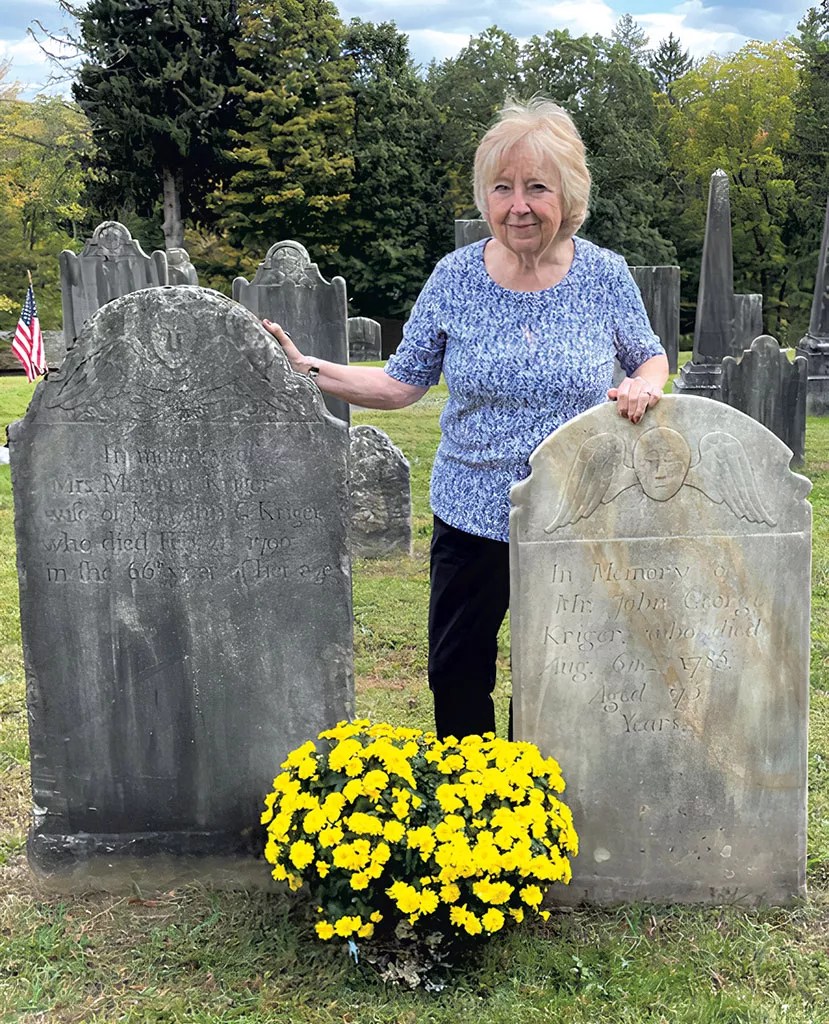
Apparently, they were paranoid enough to have a conducted a witch trial of their own as late as 1785, taking to account wealthy widowed businesswoman and former Loyalist Margaret Krieger in North Pownal. She was accused of being “an extraordinary woman” and, as a test of her connection to Satan, dropped through a hole cut in the ice of the freezing Hoosic River. She sank and so, having been “proven” innocent (only true witches floated), some good soul dove in to rescue her, and she was exonerated. Not surprisingly, she left that village, having survived her ordeal.
Hers was also New England’s last recorded witch trial.
Historian and genealogist Joyce Held, who uncovered the Pownal witch’s identity, at Krieger’s grave . Photo from Seven Days
In a fearful reaction to tuberculosis, Vermont also grappled with the Manchester Vampire around the same time. Captain Isaac Burton lost two wives to what was then called consumption. Believing his first wife, Rachel, had become a vampiric creature returning from the dead to harm his second wife, he had Rachel’s body exhumed and burned in public in 1793 (Picard).
Clearly, there was enough lingering superstition to prompt these extreme responses, though they really came down to nothing more than tragic manifestations of sublimated emotions: jealousy, desire, anxiety, terror–all that awful helplessness we feel in the face of things we do not understand and cannot control.
Those things that keep us up at night.
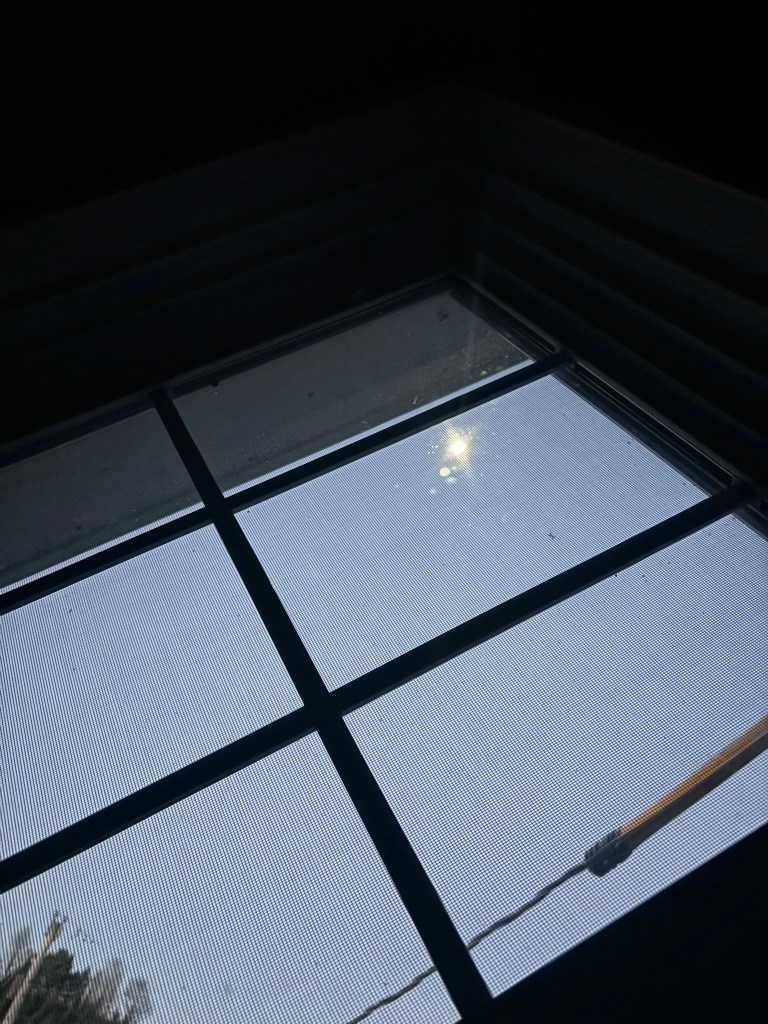
I think about them sometimes when I’m awake early in the morning, watching out our witch window as the gray moon hovers in its various shapes over our western hill.
View of this morning’s moon from my witch window
What I feel more than anything, however, is gratitude. That I get to speculate and daydream in this cozy old home that feels so much more like me. A home rich in little details and history. How I now get to enjoy my ordinary life among a bit of extraordinary local folklore.
It’s also good to know nothing wicked or uncanny can enter my abode, *wink, wink*.
Now, as for what might already haunt the insides–well, we’ll save that for another post.
Spooky season is here! I just adore this time of year, maybe even more so than Christmas.
Happy spooky season! Image from Microsoft Design
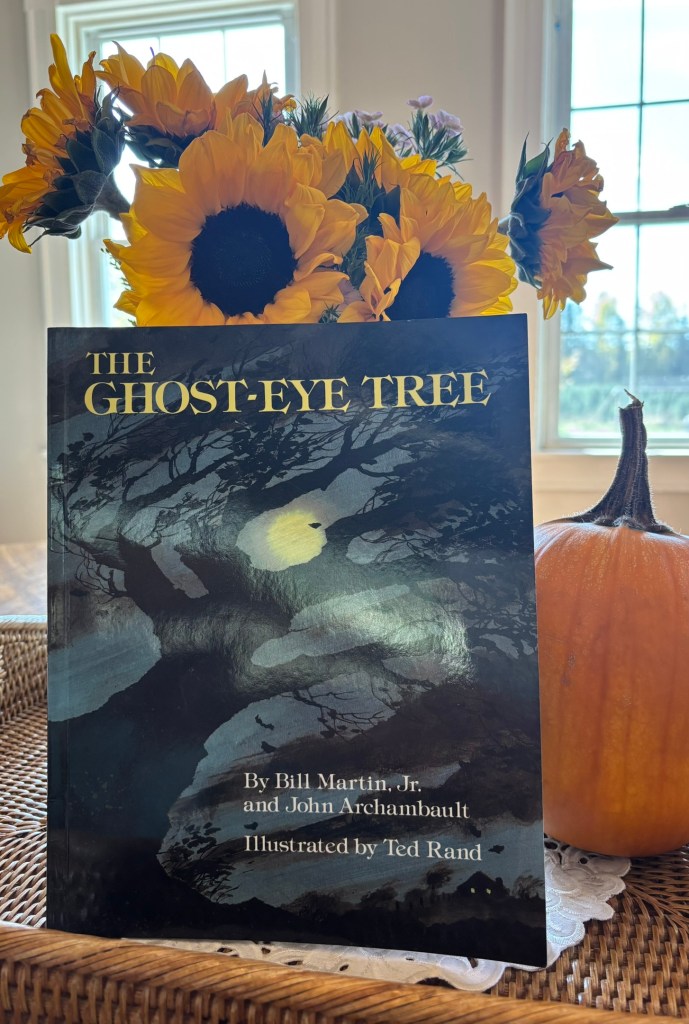
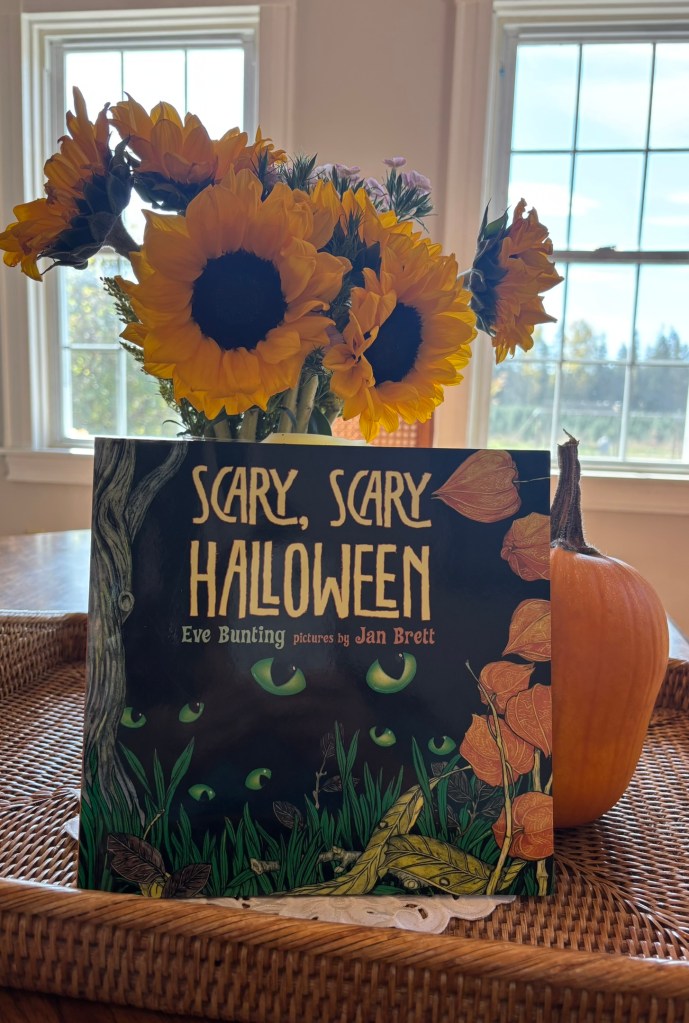
The first thing I did to celebrate was pull out Daphne’s Halloween books. We started reading them right away, including The Ghost-Eye Treeby Bill Martin Jr. and John Archambault, with illustrations by Ted Rand.
One dark and windy autumn night when the sun has long gone down, a young boy and his older sister are sent to the end of town to get a bucket of milk. As they walk down the lonely road, bathed in eerie moonlight, all the boy can think about is the ghost-eye tree...What will happen when they come to the tree? Can they run past it or will it reach out and grab them? (Blurb from amazon.com.)
This is one Daphne hasn’t always been partial too, but this year, the rhymes caught her attention, and now we’re reading it regularly.
This one is special to me, too, because I remember it from read-aloud in Mrs. Connelly’s first grade. I found it creepy then and loved the pictures.
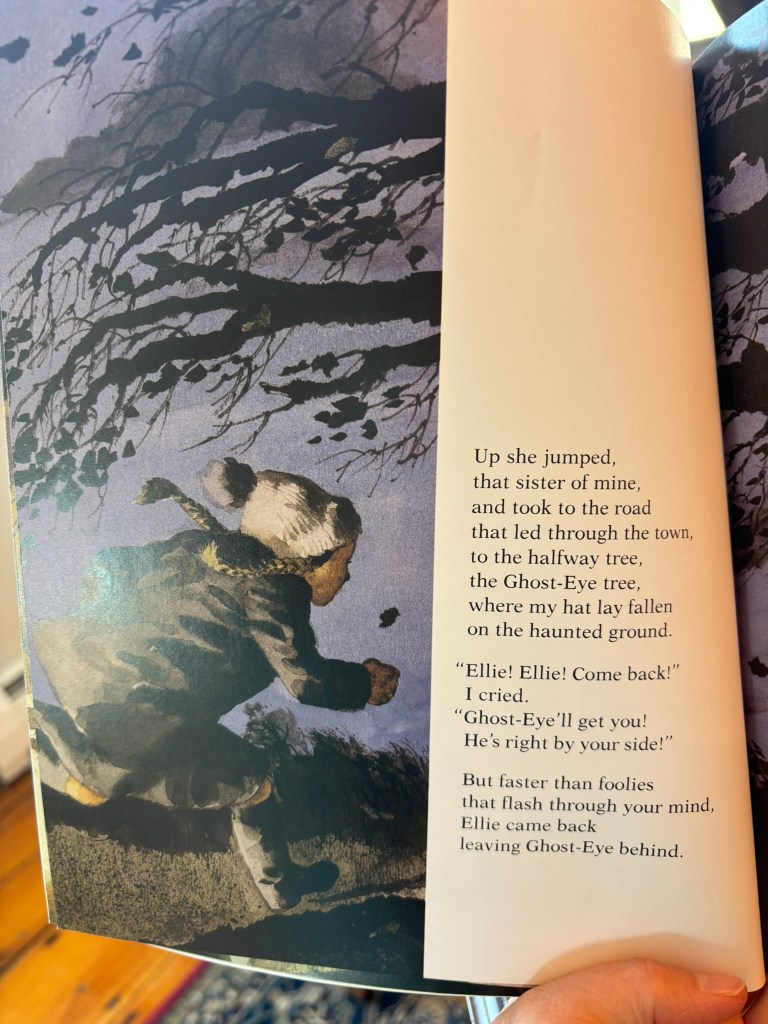
Don’t you just want to sink into those lines?
Now, I appreciate the folksy rhythm of the verse and the sweetness of the underlying story, what it’s really about–two siblings experiencing a surprising moment of tenderness. Ellie, the narrator’s sister, runs back to the terrifying ghost tree to rescue her little brother’s special hat, blown off his head when the tree scared them on their way home from fetching milk.
A good sister
The story captures one of those rare moments many of us can relate to, when we realize our awful brother or sister actually does love us and maybe isn’t so awful after all.
The story’s atmosphere and pictures are also meaningful now because they look so much like where we live. Rand’s artwork accurately evokes the deep darkness of the countryside, where the utter lack of electric light makes the black so thick it feels tangible.
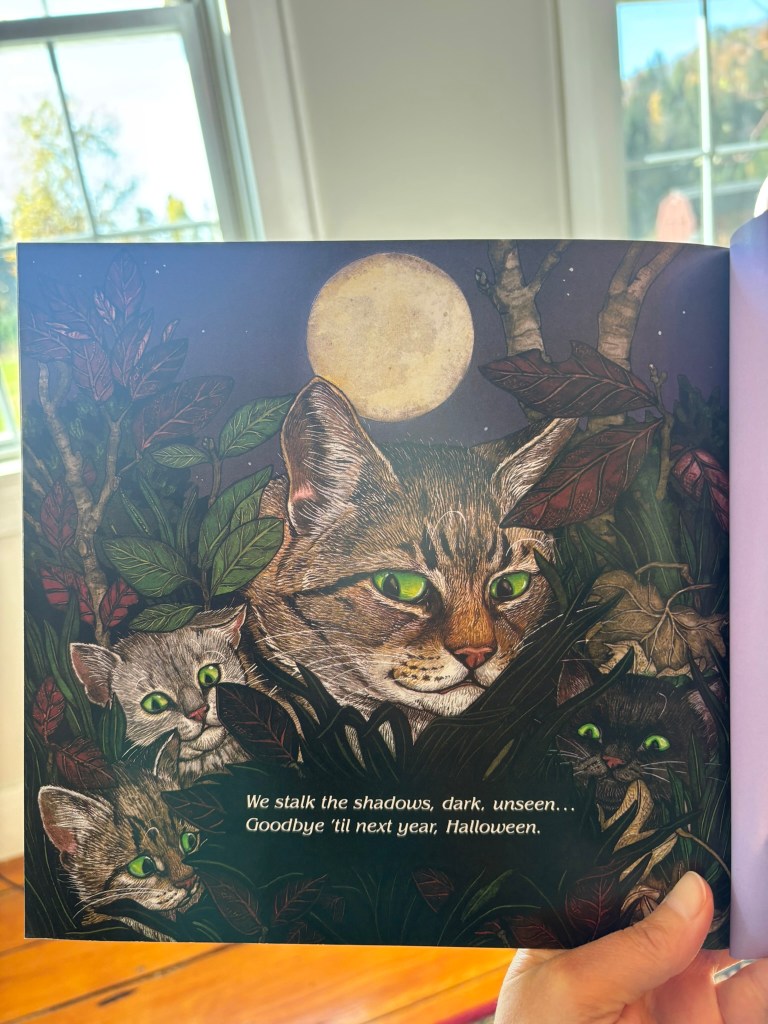
I can also appreciate the eyes in the tree, having seen ghostly, creepy eyes myself right in our own backyard. They’re only animals, of course. In our case, we sometimes see the eerie green of does’ eyes when we flash our high-powered flashlight over the fir trees on our way out to lock up the hens. In the book, the eyes in the old oak probably belong to an owl. But, from a child’s perspective–or even a fanciful adult’s–who’s to say for sure?
I also pulled out Scary, Scary Halloween by Eve Bunting, with pictures by Jan Brett.
Four pairs of eyes stare from the blackness to watch fearsome creatures trick-or-treat. (from amazon.com)
We haven’t read this one yet this year, but it’s also one of my favorites. I don’t remember it from school; I only know it as an adult, and I adore the delightful, surprising point of view from which it’s written–that of a mama cat keeping her kittens safe under the porch on Halloween night as all the strange ghoulies and creatures come and go.
Eight eyes indeed, and the real message–Halloween delights us all
It is also written in rhyming verse (all the way through unlike Ghost-Eye), so it also has that atmospheric sing-song quality, and its pictures are just gorgeous–also very much like Vermont, where we live.
Yep, looks familiar
When I used to read this book to Daphne back in Texas, I daydreamed about what it would be like to spend Halloween in countryside like this one. Well, now I do, and it is absolutely wonderful, giving our spooky days a deeper, more stirring autumn vibe.
The old English teacher in me can’t help myself when I read these picture books, either. I imagine all the ways these rich texts could be used in a Halloween unit: for inferencing, rhyming, understanding point of view, etc. It almost makes me want to develop a lesson, complete with a creative writing and art component. Like, how might you rewrite The Ghost-Eye Tree from the point of view of the owl up in that old oak? How would you illustrate it?
I also downloaded a couple old favorites for myself:Scary Stories to Tell in the Dark, Books 1 & 2 by folklorist Alvin Schwartz, complete with the original horrifying artwork by Stephen Gammell. I ate these up as a kid, as did several of my elementary classmates; I think we all bought our copies at the Scholastic Book Fair (way before they were banned), and of course the pictures were what first caught everyone’s eye. I still find them delightfully nightmarish.
Schwartz’s collection was also my introduction to a lot of American folklore–creatures like the wendigo, and urban legends like “The Babysitter” and “High Beams”–ugh, that one really got under my skin.
It wasn’t pure nostalgia that led me to purchase these digital copies. I have an idea for a little scary story of my own, a new spin on “The Bride,” a tale about a young woman who goes missing on her wedding day. She turns up dead years later in a trunk in her father’s attic, presumably after climbing in while playing hide and seek and getting trapped inside. It’s a variation on the old buried alive theme.
This artwork still chills me. Picture by Stephen Gammell
I’m considering setting my version in an old Vermont farmhouse that has a witch’s window; that window would play a significant role, of course. And, maybe, what happened to the bride wasn’t actually an accident…
I came up with the idea after coming across a call online for a themed issue of a horror magazine, and I wanted to revisit the original version before doing any drafting. I realized Schwartz’s book would be good source material.
We’ll see if I get a chance to write it. I might not be able to do anything with it, given time constraints and how it might actually turn out (I’ve been hard at work on something else, a short story epilogue to “Elspeth and the Fairy”), but getting this creepy story down would be good practice regardless. Who knows? Maybe I’ll just share it here for Halloween.
Tonight, while I enjoy an adult beverage, I plan to decorate the house.
What are your favorite titles for spooky season? I always love recs!
See you next week!
XOXO,
Jenn
Download a free e-book to read my latest published story!